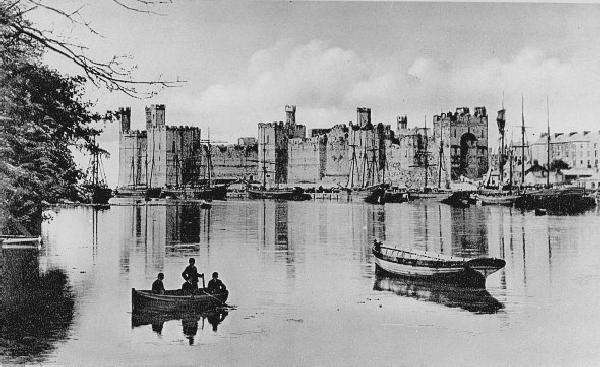
Figure 1.--Carnarvon Castle is deeply embedded in Welsh and English history. The town of Carnarvon itself is located along the Menai Straits, near the Roman station of Segontium. It was on Watling Street connecting Chester and London. The Battle of Waatling decided the fate of Britain was fought near Carnarvon. A fortress appears t have been built here during the struggle between the Britons and Anglo-Saxons. Edward I conquered Wales and ordered a fortress built at Carnarvon (1283). It was one of a series of castles the English built in Wales to seal their domination of the principality. Edward II was born at Carnarvon Castle (1284). He was the first Prince of Wales. The Castle changed hands several times during the Civil War. General Mytton finally tool the Castle for Parliament (1646).
The earliest population of Wales as the rest of Britain is of non-Celtic ancestry. They were absorbed or displaced by the Celts,for centuries the dominant civilization in Europe north of Greece and Rome. The Gaelic Celts were probably the first to populate Britain. Wales and other areas of Britain were was also occupied by the Cymric and Brythonic Celts. By the time the Romans first appeared (55 BC), the Welsh tribes were a mixture of the primitive native Iberians and invading Celts and referred to themselves as Cymry. The Romans after a protracted struggle finally subjected the Welsh during the rule of Emperor Vespasian. During three centuries, the Romans largely Romanized the Celtic people, at least the urban population. ere the historical evidence is limited and there were likely considerable regional differences. After the withdrawal of the Romans, Britain was invaded by Anglo-Saxon tribes. Romanized Celts moved west fleeing the Anglo-Saxons. Some moved into Cornwall and even Brittany across the Channel. Others moved north into Scotland. Still others sought refuge in the rugged Welsh mountains and gradually merged with resident Celts there. The rugged territory helped the Celts maintain their independence in several Welsh principalities, including Gwynedd, Gwent, Dyved, and Powys. It is at this time that the legends of King Arthur begin to appear and involve the resistance of the Romanized Celts to the Germanic Anglo-Saxons. The question arises as who were the true Britains. As the Saxons gradually prevailed except in the extreme western areas like Cornwall and Wales, they came to see themselves as the true Britons and the Welsh as foreigners. The term Welsh is actually a name given the Welsh meaning essentially foreigners. Wales was conquered by the English and Welsh political independence largely extinguished (12th and 13th centuries). The imposing Norman castles encircling Wales are a monument to the totality of the English onslaught. The conquest of Ireland and Scotland was much more recent and never as thorough as the subjugation of Wales. Interestingly, the Welsh appear to have held on to their language more successfully than the Irish and Scottish, suggesting a cultural resistance to English rule. Of course the fact that Wales was closer to England than Scotland and Ireland made the Welsh more vulnerable.
Pre-history
Humans reached the area of modern Wales in the Stone Age, but no one knows just when. The earliest known human remains provide a possible estimate (about 230,000 BC). Because of the scarcity of such finds, it is very likely that humans arrived earlier. Just how much earlier is unknown. Neanderthals appear to have been the first humans lived in what is now Wales. How they crossed the Channel which appeared about 400,000 BC. Fully modern humans (Homo sapiens) arrived much later (about 27,000 BC). Evidence of continuous human habitation dates from the end of the last ice age (about 9,000 BC). Archeologists have found , and Wales has many remains from the Mesolithic and , Neolithic era. Their are also Bronze Age finds, although this throughout Britain was part of pre-history because there was no development of written language.
The Celts
Very little is known about the earliest population of Wales and Britain in general. The Celts during the Iron Age the moved into Britain and came to dominate the island south of the Firth of Forth in modern Scotland. It was the Celts that invaded Britain because the Celts at the time controlled northern Europe beyond the classical centers of Greece and Rome. This included modern France where Britain could be viewed and easily crossed from the Pas de Calais. Iron weapons must have played a key role in the success of the Celts. Very little is known about this period and the Celtic conquest of Britain. This was not done by a centrally controlled polity. It was accomplished by a number of Celtic tribes often at war with each other. The existing population appears as a result of DNA evidence to have been absorbed by the Celts. Thus the British population became culturally Celtic, but was an ethnic mixture. The Gaelic Celts were probably the first to populate Britain. Wales and other areas of Britain. The Cymric and Brythonic Celts also populated areas of Britain. By the time the Romans first appeared (55 BC), the Welsh tribes were a mixture of the primitive native Iberians and invading Celts and referred to themselves as Cymry.
Romans
The Romans after a protracted struggle finally subjected the Welsh during the rule of Emperor Vespasian. During three centuries, the Romans to a degree Romanized Celtic Britain, at least the urban population. The condition of the Celtic tribes in rural areas is less well understood. The historical evidence is limited and there were likely considerable regional differences.
Anglo-Saxons
After the withdrawal of the Roman Legions, Britain was invaded by Anglo-Saxon tribes. Romanized Celts moved west fleeing the Anglo-Saxons. Some moved into Cornwall and even Brittany across the Channel. Others moved north into Scotland. Still others sought refuge in the rugged Welsh mountains and gradually merged with resident Celts there. The rugged territory helped the Celts maintain their independence in several Welsh principalities, including Gwynedd, Gwent, Dyved, and Powys. It is at this time that the legends of King Arthur begin to appear and involve the resistance of the Romanized Celts to the Germanic Anglo-Saxons. The question arises as who were the true Britains. As the Saxons gradually prevailed except in the extremes western areas like Cornwall and Wales, they came to see themselves as the true Britons and the Welsh as foreigners. The term Welsh is actually a name given the Welsh meaning essentially foreigners.
Normans
It is the Normans that are generally credited with conquering Wales. In fact the English conquest began with King Harold, son of Godwin. Harold's army overran Wales, defeating Llewellyn ap Griffith, king of Gwynedd (1062-64). Harold of course was defeated and killed at Hastings by William the Conqueror (1066). After securing his authority over the Saxons, William looked west at Wales. There was no single Welsh nation, but a number of Welsh principalities. The Welsh were largely the descendants of the Romanized Celtic people that have been driven west by the Anglo Saxon invaders following the Roman withdrawal from Britain. William then forced the Welsh princes to recognize his sovereignty. This was, however, a far cry from obtaining control over Wales. Welsh raiding parties throughout the 11th century raided English border communities. The Norman English kings in response created feudal lordships in the border area--referred to as the lords of the marchers. The marchers were difficult for the English kings to control, but did hold the Welsh in check. Conflict continued, however, between the English monarchy and its Welsh subjects. The Welsh defeated Henry I in 1136, but his son Henry II reestablish homage to the English crown. Prince Llewellyn of North Wales supported Simon de Montfort in his effort to seize the English crown from Henry III, but when this failed had to submit to Henry. Prince Llewellyn refused after Henry's death to pay homage to the English crown and the new king Edward I invaded Wales. He forced Prince Llewellynn at Rhuddian to submit to humiliating terms, including the surrender of eastern lands and an annual acknowledgment of fealty.
English Conquest
The earliest population of Wales was of non-Celtic ancestry. They were absorbed or displaced by the Celts,for centuries the dominant civilization in Europe north of Greece and Rome. The Gaelic Celts were probably the first to populate Britain. Wales and other areas of Britain were was also occupied by the Cymric and Brythonic Celts. By the time the Romans first appeared (55 BC), the Welsh tribes were a mixture of the primitive native Iberians and invading Celts and referred to themselves as Cymry. The Romans after a protracted struggle finally subjected the Welsh during the rule of Emperor Vespasian. During three centuries, the Romans largely Romanized the Celtic period of Britain. Here the historical evidence is limited and there were likely considerable regional differences. After the withdrawal of the Romans, Britain was invaded by Anglo-Saxon tribes. Romanized Celts moved west fleeing the Anglo-Saxons. Some moved into Cornwall and even Brittany across the Channel. Others moved north into Scotland. Still others sought refuge in the rugged Welsh mountains and gradually merged with resident Celts there. The rugged territory helped the Celts maintain their independence in several Welsh principalities, including Gwynedd, Gwent, Dyved, and Powys. It is at this time that the legends of King Arthur begin to appear and involve the resistance of the Romanized Celts to the Germanic Anglo-Saxons. The question arises as who were the true Britains. As the Saxons gradually prevailed except in the extreme western areas like Cornwall and Wales, they came to see themselves as the true Britons and the Welsh as foreigners. The term Welsh is actually a name given the Welsh meaning essentially foreigners. Wales was conquered by the English in the 12th and 13th centuries and Welsh political independence largely extinguished. The imposing Norman castles encircling Wales are a monument to the totality of the English onslaught. The conquest of Ireland and Scotland was much more recent and never as thorough as the subjugation of Wales. Interestingly, the Welsh appear to have held on to their language more successfully than the Irish and Scottish, suggesting a cultural resistance to English rule. Of course the fact that Wales was closer to England than Scotland and Ireland made the Welsh more vulnerable.
Industrial Revolution (19th century)
The Industrial Revolution began in Britain (mid-18th century). It transformed Britain from an important European country with a rural, agricultural economy into a global industrial powerhouse. Wales played an important part of that transformation. In southern Wales, iron production exploded as did coal mining (especially in the Rhondda Valleys). Iron/steel and coal were the foundation of an industrial economy. There was also copper smelting. This made Wales a pivotal part of the British industrial economy. Merthyr Tydfil became the largest town in Wales and the 'iron capital' of the world. Swansea became known as 'Copperopolis' for its massive copper smelting industry, which produced 70 percent of Britain's copper (late-18th century). Coal powered the Industrial Revolution. At its heart the Industrial Revolution was replacing human and animal powered with mechanical power. And this made coal mining essential. Southern Wales became a global leader in coal export. Cardiff became the world's most-important coal-exporting port. The South Wales Coalfield peaked (1913) It was vital not only economically, but it two World Wars. Wales became the world's first industrial society, with more people working in industry than agriculture (851). The population grew rapidly. This led to the development of an extensive rail networks and canals to transport goods. This included the first steam locomotive built by Richard Trevithick (1804). Welsh iron works not only supplied iron rails for the domestic Briish economy, but railways as far field as Russia and South America. While britain beneitted from Welsh resources, Welsh workers, especially the mines shred few of the benefit. This was vividlyt depictd in Robert Lewellyn beautiful book, How Green Was My Valley.
Labour Party
The Westminster Parliament is often described as the mother of all Parliaments. But in fact many constituencies were anything but democratic. Elections in many British constituencies involved only a handful of of wealthy landowners. In some cases even one. These were called 'rotten boroughs'. At the time of the American Revolution (1776), American colonial legislatures were elected by far more voters proportionally then British elections. Working people did not vote in Britain. The right to vote involved property ownership. This became a major issue in Britain during the Victorian era. The British electorate was expanded significantly through several key reform acts (19th century). This transformed the electoral system from one for the elite well-to-do to include men of increasingly more modest means. Major expansions occurred for middle-class men (1832) and working-class men (1867). This continued in the 20th century. As a result, most of Wales' adult male population could vote (late 19th century). They predominantly supported the Liberal Party because of the Nonconformist religious movement and the Party's association with various other progressive causes, especially reforms improving the lives of working people. Britain's Labour Party was born in Wales. The Independent Labour party was founded (1893). But did not immediately gain electoral success. Socialist societies and trade unions founded the Representation Committee (1900). The Labour Part from the beginning was Britain's socialist party. This would be the foundation of the modern Labour Party. Keir Hardie was the the first leader of the Independent Labour Party. (Prime-minister Keir Starmer is named after him). Hardie was elected an MP for Merthyr Tydfil (1900). The National Union of Mineworkers affiliated to the Labour Party (1908). Their four sponsored Welsh MPs became Labour MPs. This began a steady rise in the number of Labour Councillors and MPs in Wales. The turning point for Labour was World War I. The tragedy of the War was blamed on the Liberals. The socialist orientation of the Labour Party blamed the war on capitalism. Labour politicians would promote unilateral disarmament. There was a major shift from the Liberals to Labour. In the general election following World War I, Labour won half the Welsh parliamentary delegation (1922). From this point for over a century, Labour would dominate Wales, both local councilors and MPs. Britain over time voted in both Labour and Conservative Governments but election after election, Wales voted Labour. Along with the northern Red Wall, it was a fixture of British politics for a century.
Devolution
Devolution is the term used to describe the process of transferring power from the center (Westminster) to the nations and regions of the United Kingdom. The term is derived from the Latin, meaning 'to roll down' The idea is that government becomes more efficient by expanding the role of local government which is closest to the people. Labour leader Tony Blair, as Prime Minister, was a key architect of devolution in the UK, believing it was essential for addressing regional governance and preventing Scottish independence. One wonders if Labour's dominance in Scotland and Wales was a factor.
Blair's Labour Government initiated significant constitutional reforms (late- 1990s). This led to establishment of devolved parliaments and assemblies in Scotland, Wales, and Northern Ireland.
The legislative process for devolution were originally set out in the Scotland Act (1998), the Government of Wales Act (1998) and the Northern Ireland Act (1998), although all three have subsequently been amended. There is also a non-legislative framework of agreements between Government departments and the devolved institutions which help resolve disputes between central and devolved government.
The results of the 2026 local elections were extraordinary -- perhaps the most consequential election since the 1922 General Election when the Labour Party emerged as one of he two leading British political parties replacing the Liberals. Prime Minister Keir Starmer In his first week as UK Prime-minister, promised to devolve power down to local communities, arguing that decisions are best made by those with 'skin in the game' (2024). This aligns with Starmer's previous pledge to help citizens 'take back control'. Meanwhile, new Deputy Prime-minister Angela Raynor spoke of creating a 'devolution revolution'. Starmer and Rynor quickly changed their minds as public opinion polls quickly turned disastrously against Labour. Labour (and the Conservatives) did their best to cancel local elections (2925). The tried the same in 2026, but nation-wide local elections were held (May 2026). The results were huge, unprecedented gains by Reform, massive losses by Labour, and somewhat lower losses by the Conservatives. The most dramatic losses were in Wales, which Labour had controlled since 1922. Labour's collapse in the Senedd (Welsh parliament) was even more total than the most pessimistic predictions. For a century, the Welsh Labour Party was the democratic world's most successful election-winning machine, but the Labor is no longer a political behemoth in Wales. Britain has never seen anything like it. Labour managed a paltry third place finish. They now have only nine seats in a 96-seat Senedd. Plaid Cymru , the pro-independence party, has written a new chapter in Wales's political history. They are only a few seats short of a majority. Labour has been reduced to a minor player in Welsh politics. Prime-minister Starmer and other Labour leaders seem to think that Labour can quickly recover. We do not see Labour, however, reversing any of the policies that have proven so unpopular in Wales and elsewhere in Britain.