
The Invention of Capitalism
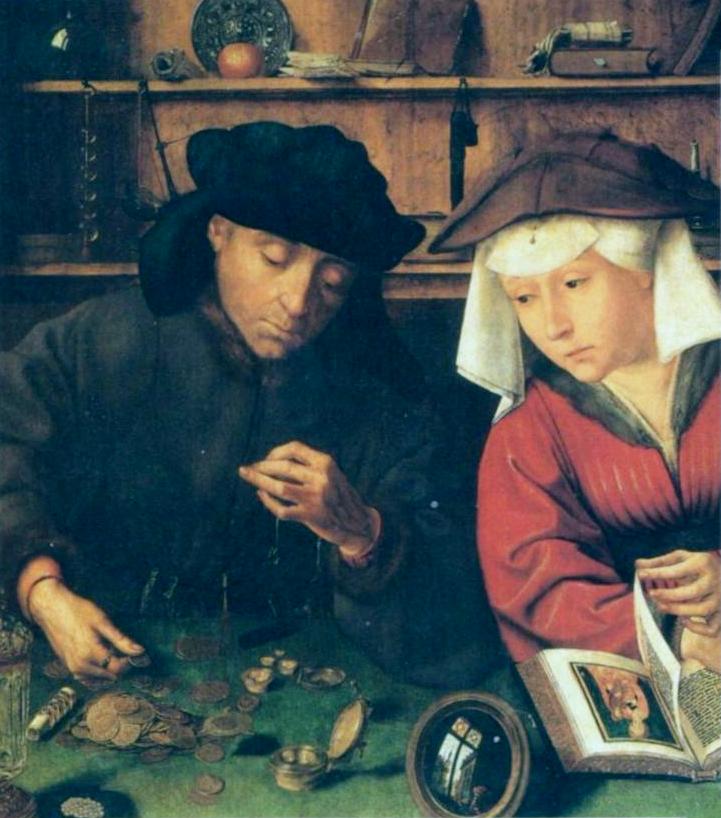
Figure 1.--This Flemish masterwork, 'The money lender and his wife', by Quentin Metsys (1466-1530) was painted in Antwerp, the primary port for Flanders. It was painted in 1514 as the conditions leading to the invention of capitlism were beginning to come together in northern Europe, but just before the Reformation. It beauutifully illustrates medieval ideas that were disolving, but still existed even in northern Europe. The husband is shown transfixed by his wealth, gold and jewels, which he acquired by lending money--something the Catholic Church disproved. His angelic wife depictd in more ideaized form is uneasy with her husband's focus on wealth. Notice her devotional book with the portrit of the Madona. (Probably not a Bible which the Catholic Church did not encourage people to read.)
|
|
Capitalism like democracy is the unique creation of the West. The two were intricately linked and appeared at the same place and comparable times--the Netherlands and England (17th century). Conditions favorable to the rise of capitalism occurred through large areas of Western Europe. This began with several developments. First was the quickening of economy in the late medieval era. In part because of the Crusades and the Renaissance we begin to see banks developing in the Italian city states. Second was the demographic crisis of the 14th century resulting from the devestaing plague. This substantially reduced the European populations and increased the bargaining strength of the peasantry in their relationship with fedudal lords. The result was to sinificantly weaken the manorail system. The result was to expand free labor, innovation, and productivity. Third was the maritime expansion of the West as a result of technological advances, both to the East and the discovery of the Americas in the West. Trade with the East expanded trade. The conquest of the America resulted un huge quantities of bullion (gold and silver) flooding into Europe as well as new products. The potato was particularly important becaus it significantly increased agricultural productivity, especially in northern Europe. Maritime trade with the East also shifted trade routes and commerce away from the Mediterranean, but also undemined the primarily trading economies of the Arabs and Ottomans. These devlopments might suggest that capitalism would be invented in southern Europe. There were the merchant banks of Italy and the vast wealth acruing to Portugal and Spain by the maritime outburst and conquest of the Americas. But this did not occurr, it was in northern Europe that capitalism was invented. The economonic hot spot of Europe began to shift to the north. The Low Countries dveloped an exptemely profitable wool weaving industy in Flanders. England was tied to this development as the source of the wool. Thus it was not the bullion rich countries, but the more productive countries and provinces to the north. Spain and Portugal squandered much of their weath on buying the products from the productive north rather than devloping their own industries. And at the same time the Iquisition discouraged innovation and free thought, in effect locking the medieval mind into the Catholic monarchies The rich Low Countries became a province of Spain. At about the same time the Protestant Reformation swept through northern Europe. This both separated part of the Low Countries from Spain and changed the outlook of the people of northern Europe, including ideas favorable to capitalism. Traders first in Amsterdam and and then in London created the first chartered joint-stock companies which helped to promote commerce and trade. The first stock exchanges were established. Important banking and insurance institutions were founded. The Netherlands under assault from the Spanish was not a large enough country to drive the creation of capitalism. England although aelatively small country at the time was. At the same time the Glorious Revolution took place in England, once and for all establishing the auhority of a Protestant elected parliament over a Catholic absolutist monarchy. And in this process Protesrant troops from the Netherlands played a key role. While it is understanable why capitalism was invented in northern Europe. It is less clear why it was not invented in India or China, both of which were richer than Europe at the time of the Reformation.
Modernity
Capitalism like democracy is the unique creation of the West. The two were intricately linked and appeared at the same place and comparable times--the Netherlands and England (17th century). They are inseparable pillars of modernity. Capitalism is ecomomic freedom. Democacy is political freedom.
Why Europe?
Conditions in Europe were favorable to the rise of capitalism occurred through large areas of Western Europe. This began with several developments which combined to create a socio-economic environment that was conducive to the development and evolution of capitalism.
Quickening medieval economy
The pace of European commerce began to quicken in the late medieval era. In part because of the Crusades and the Renaissance we begin to see banks developing in the Italian city states. The late-medieval era saw the expansion of trade in Europe. This laid foundation for a market economy. Merchants and traders began accumulating wealth through commerce.. This wasa imprtant step toward for capitalism.
Demographic crisis
There was a demographic crisis resulting from the devestaing plague epidemics (14th century). This substantially reduced the European populations and increased the bargaining strength of the peasantry in their relationship with fedudal lords. The result was to sinificantly weaken the manorail system. The result was to expand free labor, innovation, and productivity. It also weakened the existing class structure. This paved the way for more dynamic economic activities centered around trade and market. It made it increaingly possible for idividuls of modest birth to rise in sdociety.
Renaissance
The Renaissance introduced new ideas and ways of thinking.
Judeo-Christian Theology
Another factor explainng why Cpitalism developed in Europe is Christinity. 【Landes】 Given that capitalism was invented in CVhristain Europe and for several centuries limited to Europe this is a strong signal that Chistianity was involved. 【Novak】 In a way not understod in our modern secular society, religion wa still of huge imprtance at the time capitalism was created. One economc historian who dmits he is an unbeliever, maintgains that that the main factors in this great economic achievement of Western civilization are mainly religious. 【Landes】 Of all the world religions, Judeo-Chrisian theology places a greater emphasis on the value of the individual than any other religion. It would be thev Church after the fall of Rome that would undo the slave system ceated by Rome. During the Crusades, Church bentities set up mecahaisms for the tramsfer of wealth. During the medival era, the Church grew rich. By the lae medierval era, the Church came to ownsomething like a third of all the land in Europe. And land through agriculture wa he primary source of wealth. To administer its immense holdings, the Church deceloped a continent-wide system of canon law that conncted multiple jurisdictions of empire, nation, barony, bishopric, religious order, chartered city, guild, confraternity, merchants, entrepreneurs, and traders into one well-oiled economic system. The Church created local and regional administrative bureaucracies of arbitrators, jurists, negotiators, and judges, along with an international language thatcould be used -- canon law Latin. Usury was a problem. The Church forbade the payment of imterest. The Reformation brought new perspectives, with figures like Luther and Calvin challenging traditional views on usury. As with other issues like Helio-centrism and evolution, the Church adapted.
Maritime expansion
The maritime expansion of the West as a result of technological advances pened up new opportunities , both to the East and the discovery of the Americas in the West. Trade with the East grearly expanded commerce. The conquest of the America resulted un huge quantities of bullion (gold and silver) flooding into Europe as well as new products. The potato was particularly important becaus it significantly increased agricultural productivity, especially in northern Europe. Maritime trade with the East also shifted trade routes and commerce away from the Mediterranean, but also undemined the primarily trading economies of the Arabs and Ottomans. These devlopments might suggest that capitalism would be invented in southern Europe. There were the merchant banks of Italy and the vast wealth acruing to Portugal and Spain by the maritime outburst and conquest of the Americas. But this did not occurr, it was in northern Europe that capitalism was invented. The economonic hot spot of Europe began to shift to the north. The Low Countries dveloped an exptemely profitable wool weaving industy in Flanders. England was tied to this development as the source of the wool. Thus it was not the bullion rich countries, but the more productive countries and provinces to the north. Spain and Portugal squandered much of their weath on buying the products from the productive north rather than devloping their own industries. And at the same time the Iquisition discouraged innovation and free thought, in effect locking the medieval mind into the Catholic monarchies The rich Low Countries became a province of Spain.
Education
Protestant ethic
A century before the invention of capitalism, the Protestant Reformation swept through northern Europe. This both separated part of the Low Countries from Spain and changed the outlook of the people of northern Europe, including ideas favorable to capitalism. Traders first in Amsterdam and and then in London created the first chartered joint-stock companies which helped to promote commerce and trade. The first stock exchanges were established. Important banking and insurance institutions were founded. The Netherlands under assault from the Spanish was not a large enough country to drive the creation of capitalism. England although aelatively small country at the time was.: The Protestant ethic, which emphasized hard work, diligence, and discipline fostered a culture of entrepreneurship and innovation. 【Weber】 The Protestant ethic also jutified a pursuit of profit. It became a morally sanctioned activity. Here Calvanism was especially important.
Political freedom
At the same time the Glorious Revolution took place in England, once and for all establishing the auhority of a Protestant elected parliament over a Catholic absolutist monarchy. And in this process Protesrant troops from the Netherlands played a key role. The weakening of centralized power elininasted narriers like royal moopoloes and inernal custom duties. This created opportunities for capitalism to thrive.
China and India
While it is understanable why capitalism was invented in northern Europe. It is less clear why it was not invented in India or China, both of which were richer than Europe at the time of the Reformation. Afterall, for most of history, China hd th more advanced richer econiomy.n
Sources
Landes, David. The Wealth and Poverty of Nations: Why Some are So Rich and Some So Poor (1998).
Landes' work has been ctirticized as eurocentric. This is a charge that Landes deny. He points out that that he is describuing an economic miracle that happened originally only in Europe.
Novak, Michael. "How Chrstianity created capitalism," Religion & Liberty Vol. 10, No. 2 (July 20, 2010).
Weber, Max. The Protestant Ethic
CIH

Navigate the Chiildre in History Web Site:
[Return to the Main capitalism page ]
[Return to the Main modern industrial era economics page]
[Return to the Main Economics page ]
[Introduction]
[Biographies]
[Chronology]
[Climatology]
[Clothing]
[Disease and Health]
[Economics]
[Geography]
[History]
[Human Nature]
[Law]
[Nationalism]
[Presidents]
[Religion]
[Royalty]
[Science]
[Social Class]
[Bibliographies]
[Contributions]
[FAQs]
[Glossaries]
[Images]
[Links]
[Registration]
[Tools]
[Children in History Home]
Created: 2:03 AM 3/4/2017
Last updated: 5:00 AM 12/7/2025