|
The Roaring Twenties ignited the American economy. Now more and more Americans had cars. And they wanted better cars, not just the venerable basic Model-T. The autiomobile industry boomed and the Tin Lizzie had all kinds of competition with heavier, more luxurios models and innovations like larger, more powerful engines, starter engines, enclosed cabs, chrom trim, apolstered comfortable seating, and much more. People had money to spend and cvars were a major way of spending it. This created a massive industry, exceeding the production of all of Europe. And it was a major factor in a massive industrial expansion that meant that by the time Hitler and Stalin launched World War II (1939), the American economy was comparable to that of Britain, France, and Germany combined. All of this mean ever increasing quantities of oil was needed. And Texas oil men provided what was needed. The reported important discoveries near Mexia in Limestone County and more in Navarro County. Oil was discovered in the Panhandle (1921). Major fields were developed all across Texas. The most important of all was found in East Texas. Other finfs included west-central Texas and more fields in the Gulf Coast. The Daisy Bradford No. 3 erupted blew in near Turnertown and Joinerville in Rusk County (October 1930). This was the beginnig of the vast East Texas field. Noted wildcatter C.M. (Dad) Joiner drilled the first East Texas well on land that had been ignored by the geologists wmployed by the oil majors. These would be the field that would fuel the Allied World War II effort. At the same time, the Majors (Gulf Oil, BP, Texaco, and Chevron) were awarded concessions that made would evemtually make major discoveries in Kuwait, Saudi Arabia, and Libya.
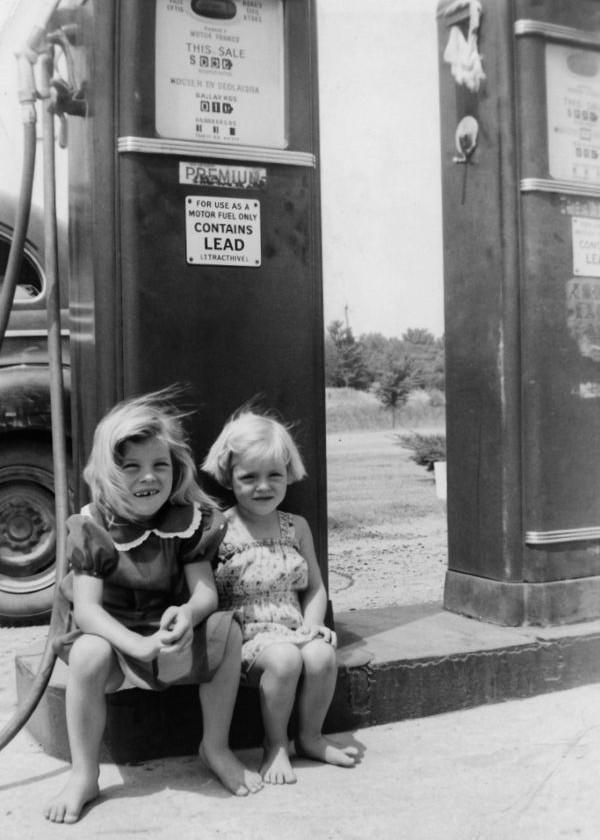
There were major developments in rehining formulations. GM engineer Thomas Midgley Jr. discovered that tetraethyl lead (TEL) significantly reduced engine 'knocking' (1923). This paved the way for higher-compression, more powerful engines that the aumobile comapes were manufcured for bigger cars. Workers at TEL production plants were suffered from severe lead poisoning (hallucinations, insanity, even death). Some cities briefly baned TEL gas. Despite the concerns, TEL gas was promoted as 'Ethyl' (oncealing the use of lead) and it became the industry standard for decades (figure 1). As a result, lead from car exhaust fumes contaminated the air and thus the water and soil rnd the orl. Health studies detected massive reduction in the overall intelligence of the population and even a link between lead exposure and violent crim. TEL gas ould not b phased out or dedcades (1970s).
Far more Americans owned cars and they wanted to go places in them. This presented a problem--a national highway system did not exist. There were few improved roads beyond city limits. Outside the cities a btter desription was wagon trails, especially in the West. Many of the major routes which would become highways were the surviving vestiges of old historic trails, such as the Oregon Trail or Santa Fe Trail. Automobile clubs like the American Automobile Association organized to lobby for better roads. We see the birth of named highays. The Lincoln Highway from New York to San Francisco was the first. Highway organizations were formed which placed and promoted their routes. Eventually there were over 250 named highways (1925). Colored signs marked these routes. Haphazard placement created motorist confusion. It became clear that the Federal Government would have to become involved to create a unified national highway system. Autmobile associations began demanding that the Bureau of Public Roads (part of the Department of Agriculture) study the idea. One idea was to give American highways a standard numerical designation. At the same time, road building technolgy was not only significantly improving and you begin to see improved roads at the Cajon Pass and over the Ridge Route.

Navigate the Children in History Website:
[Return to the Main U.S. oil industry: Inter-War Era]
[Return to the Main U.S. oil industry page]
[Return to the Main hydrocarbons page]
[Return to the Main U.S. economic sector page]
[Return to the Main U.S. Economics page]
[Return to the Main Economics page]
[About Us]
[Introduction]
[Biographies]
[Chronology]
[Climatology]
[Clothing]
[Disease and Health]
[Economics]
[Freedom]
[Geography]
[History]
[Human Nature]
[Ideology]
[Law]
[Nationalism]
[Presidents]
[Religion]
[Royalty]
[Science]
[Social Class]
[Bibliographies]
[Contributions]
[FAQs]
[Glossaries]
[Images]
[Links]
[Registration]
[Tools]
[Children in History Home]