|
Oil had a huge impact on the first half of the 20th century--the time at which the world as we now know it was determined. This was the case for two reasons. First because oil had huge military potential. Second because of who had it. By a stroke of seemingly random nature--it was the United States. Oil had huge military potential, although that was only becoming consequential when World I broke out in Europe (1914). The most obvious utility was in naval warfare. Oil returned a measure of independence to fleets that had been lost when coal began to replace sail (mid-19th century). Not only could ships carry several times as much oil as coal, oil had a far greater energy density than coal--meaning hips cold carry more fuel. The tonnage of oil doubled a ship's speed and nearly doubled its cruising range. This meant that navies were not nearly as tied to bases and the need to maintain large numbers of coaling stations. It also was the only fuel that new weapons systems (submarines, aircraft, and tanks) could use. Trucks would significantly affect logistics and force mobility--vital factors in warfare. All of this would impact World War I, but come to fruition in World War II. Fleets further increased their independence, The U.S. Navy created the fleet train, capable of replenishing entire fleets while still at sea. By the end of the War. oil meant that that fuel and logistics no longer limited fleet action--it was only crew endurance. The U.S. Pacific Fleet Navy during the Central Pacific Campaign, remained continuously at sea for over a year-- only switching names between 3rd Fleet and 5th Fleet based on whether Spruence or Halsey was in command. Aircraft could now strike at great distance making possible the strategic bombing campaigns that destroyed German and Japanese war industries. And armies became increasingly mechanized-- especially Allied armies. Axis armies were largely on foot and still depended largely on horse power of the four legged sort. The Germans despite Goebbels' propaganda used more horses in World War II than in World War I. A critical factor in both wars, especially World War II is that the United States and Britain controlled the great bulk of the world oil supply. Coal was widely distributed around the world, but neither the Central Powers in World War I or the Axis in World War II had adequate access to oil. The NAZIs obtained oil for a time from the Soviets and from Romanian fields. They also launched a synthetic oil industry. But this only provided part of what they needed. The Japanese succeeded in seizing oil fields in their Southern Resource Zone, but were unable to transport much oil back to the war industries on the Home Islands. As for who had the oil, it was primarily the United States. This was in part a fortuitous fluke of nature and in part the way that democracy and capitalism unlocked the innate potential of its citizens and one result was discovering the oil before it was discovered in many other places. America not only had huge oil deposits of its own, but the ability to prevent other Western Hemisphere countries from exporting oil to hostile nations. In addition a substantial part of the Eastern Hemisphere oil was in the hands of democracies (The British and Dutch) or the Soviets who were forced by Hitler to join a grand coalition with the democracies, an opportunity he had rejected in 1939. The world would look very different today if it was not America that had the oil.
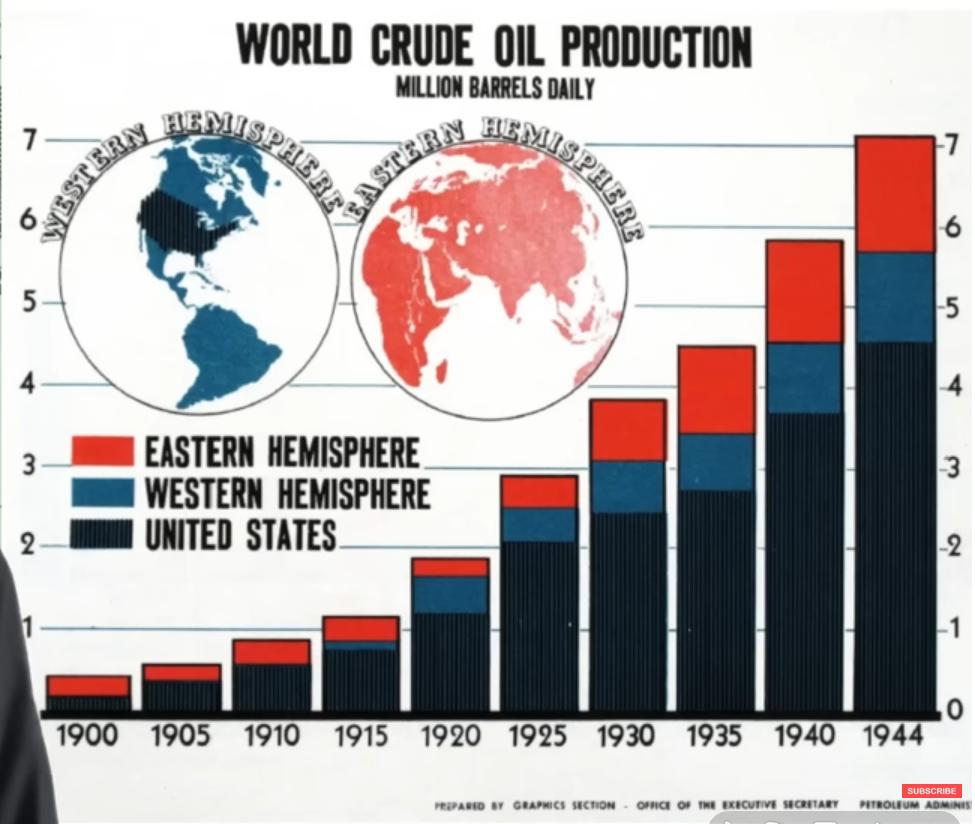
Oil had a huge impact on the first half of the 20th century--the time at which the world as we now know it was determined. This was the case for two reasons. First because oil had huge military potential. Second because of who had it. By a stroke of seemingly random nature--it was primarily the United States.
Oil was important because it had huge military potential. That imprtance was jut becoming consequential when World I broke out in Europe (1914). The most obvious utility was in naval warfare. Oil returned a measure of independence to fleets that had been lost when coal began to replace sail (mid-19th century). Not only could ships carry several times as much oil as coal, oil had a far greater energy density than coal--meaning hips cold carry more fuel. The tonnage of oil doubled a ship's speed and nearly doubled its cruising range. This meant that navies were not nearly as tied to bases and the need to maintain large numbers of coaling stations. It also was the only fuel that new weapons systems (submarines, aircraft, and tanks) could use. Trucks would significantly affect logistics and force mobility--vital factors in warfare. All of this would impact World War I, but come to fruition in World War II. Fleets further increased their independence, The U.S. Navy created the fleet train, capable of replenishing entire fleets while still at sea. By the end of the War. oil meant that that fuel and logistics no longer limited fleet action--it was only crew endurance. The U.S. Pacific Fleet Navy during the Central Pacific Campaign, remained continuously at sea for over a year-- only switching names between 3rd Fleet and 5th Fleet based on whether Spruence or Halsey was in command. Aircraft could now strike at great distance making possible the strategic bombing campaigns that destroyed German and Japanese war industries. And armies became increasingly mechanized-- especially Allied armies. Axis armies were largely on foot and still depended largely on horse power of the four legged sort. The Germans despite Goebbels' propaganda used more horses in World War II than in World War I. A critical factor in both wars, especially World War II is that the United States and Britain controlled the great bulk of the world oil supply. Coal was widely distributed around the world, but neither the Central Powers in World War I or the Axis in World War II had adequate access to oil. The NAZIs obtained oil for a time from the Soviets and from Romanian fields. They also launched a synthetic oil industry. But this only provided part of what they needed. The Japanese succeeded in seizing oil fields in their Southern Resource Zone, but were unable to transport much oil back to the war industries on the Home Islands.
Oil was also imprtant because of who had it. By a stroke of seemingly random nature--it was the United States.As for who had the oil, it was primarily the United States. This was in part a fortuitous fluke of nature and in part the way that democracy and capitalism unlocked the innate potential of its citizens and one result was discovering the oil before it was discovered in many other places. America not only had huge oil deposits of its own, but the ability to prevent other Western Hemisphere countries from exporting oil to hostile nations. In addition a substantial part of the Eastern Hemisphere oil was in the hands of democracies (The British and Dutch) or the Soviets who were forced by Hitler to join a grand coalition with the democracies, an opportunity he had rejected in 1939. The world would look very different today if it was not America that had the oil.
Fuels were also important, especially coal. Then a new fuel began to become important--petroleum. Oil was important in World War I. The navies of the day were shifting from coal to oil, in part because it significantly reduced the smoke trail. Tanks and trucks emerged as militarily important, And planes required high-octane gasoline. But draft animals remained vital to moving armies and artillery, Because of American trucks, the Allies were much more mechanized than the Central Powers. The Allied naval blockade cut the Central Powers off from needed oil imports. German chemists began working on synthetic fuel production. Allied control of the sea lanes meant that they could import all the oil they needed from America. One observer wrote that "...the Allies floated to victory on a wave of oil." [Viscount Curzon of Kedleston] This created a problem for Europe as so little oil was produced in Europe on the Continent, except for poorly developed Russia. Romania and Austria-Hungary (Galacia) produced small amounts. Thus it had to be imported. Oil became increasingly important when a new raw material began to become important--petroleum. At the urging of Admiral Jackie Fisher and First Lord of the Admiralty Winston Churchill, Britain began converting its fleet from coal to oil. German strategic thinkers also saw the importance, lending urgency to the rail connections with the Middle East. Coal continued to be important World War I, but oil was needed for aircraft, tanks, trucks, and U-boats. America was the greatest oil producer, the Saudi Arabia of the day. The Royal Navy guaranteed deliveries to Britain, but an embargo enforced by the Royal Navy cut Germany off. Germany went to war expecting a quick victory rendering embargoes moot and meaning shortages would not develop. It was a huge strategic blunder and in the end consume the short-lived German Empire. The inability to obtain needed raw materials seriously impacted German industry. Oil was a special problem. German at the time the war broke out was in the process of building the Berlin to Baghdad (Basra) Railway. This would have given the Germans access to vast quantities of oil that could not have been interrupted by the Royal Navy. The Germans hoped to obtained access to the Romanian oil fields, but the British blew up the Ploesti oil fields before the German Army arrived. One geologist writes that winning the First World War had been impossible "without gasoline for automobiles and airplanes, without oil for lighting in dugouts and on the homeland's flat soil, without diesel oil for submarines, and without lubricating oil for the innumerable machines in industry and transportation." This would be a scenario repeated two decades later, but with the the increasing demands of an enlarged navy, a powerful air force, and an increasingly motorized army made a petroleum-strapped victory even more unthinkable ..." [Friedensburg, p. 445.] Germany went to war expecting a quick victory rendering embargoes moot and meaning shortages would not develop. It was a huge strategic blunder. The quick Germany victory evaporated on the Marne only a month into the War. In the end the inability to import raw materials and food would be a major factor in the defeat of the short-lived German Empire.
It was not the military, however, that was key driver for oil usage. Automobile ownership and demand for electricity grew exponentially and, with them, the demand for oil. Gasoline sales first exceeded kerosene sales (1919). Oil-driven transport (ships, cars, and truck) as well as military vehicles made oil not only a vital economic energy asset, but strategic military asset. After World War I, the natural gas that was produced along with oil was flared off as a waste by-product. Slowly natural gas began to be used for industrial and residential heating and power (1920s). The natural gas molecule is not as energy dense as gasoline, but was of value and comparatively clean burning. Oil was delivered in many areas around the world before World War II. The fields began coming on line, especially after the War. They were controlled by the Seven Sisters.
Oil from an early point became an internationally traded commodity. The reason for that was that for the most part, with the exception of America, oil was found in countries with little use for it. And the countries that needed it (Europe) had very limited resources. Shell helped pioneer the oil tanks that could move oil around the world. There was one exception -- the Soviet Union. The Soviets had huge oil resources, only partially developed. Industrial development began during the final years of the Tsarist Empire just as oil was becoming an important commodity. There were exports, although the industry based along the Caspian Sea in modern Azerbaijan suffered from under investment.
The Russian Revolution put this resource in the the hands of the new socialist Soviet Union with its totalitarian leadership. The energy policy of the Soviet Union was an important element of the country's planned economy. The Soviet Union, unlike most European countries, was basically self-sufficient in oil. Several European countries had important coal resources, but only Romania has an important oil resource. And by the time the Soviet Union was created, oil was becoming increasingly important, both for the economy and military. Stalin's pursued an economic policy of autarky. Soviet economic growth was to a large degree based on keeping labor costs low and large inputs of domestic natural resources, including oil. There was no price mechanism in the Soviet economy. As a result, the actual value of Soviet manufactured goods were commonly less than the value of the production inputs. The Soviet oil industry was based in the Caspian area in modern Azerbaijan -- Baku 1 bordering on Iran. The Soviets at the time of World War II were planning an enormous increase in oil production based on Baku 2 -- an area between the Volga and the Urals. [Nazaroff, p. 81.] This huge oil resource was unknown to the Germans, but just Baku 1 was a major objective when Hitler launched Operation Barbarossa, the invasion of the Soviet Union (1941).
Oil played an even more important role during World War II fighting circled the globe and warfare became both mobile and mechanized. Military forces required huge quantities of oil for air, land, and sea operations. Oil was not evenly distributed around the world. Some countries had a great deal and other countries very little. The two major producers were America and the Soviet Union. America produced vast quantities of oil, to supply its industries and the many civilians who owned cars. Gasoline rationing was the major complaint Americans had on the home front during the War. It has been said that the Allies floated to victory on a sea of American oil. It also exported large quantities. The Soviet Union produced less, but still very large quantities. Production in the Caucuses was especially important. Britain and France had very limited domestic production, but imported from America and American associated countries Mexico and Venezuela). Fields in Middle east and India supplied British field armies and Indian Ocean Mediterranean fleets. The Axis on the other hand had very limited domestic oil resources. Japan in particular was almost entirely dependent on American oil. Some British analysts believed that the Germans could not launch another war because it lacked adequate domestic oil production. They were wrong, but oil wold become a major concern for the Axis. The Germans managed to cobble together enough domestic production, synthetic fuel production, and terrestrial imports (primarily from Romania and the Soviet Union--until 1941) to run their war effort, although oil was a serious constraint throughout the War. They even got the Soviets to ship them oil. Oil remained, however, a primary concern for German planners and was one of the inducements in invading the Soviet Union. Oil was even more critical for the Japanese who were dependent on American oil exports. Thus the Southern Resource Zone (SRZ), especially the oil-rich Dutch East Indies became a primary objective. Inconveniently for the Japanese, the American controlled Philippines Islands backed by the Pacific Fleet at Pearl Harbor lay between the Home Islands and the DEI.

Navigate the Children in History Website:
[Return to the Main Oil page ]
[Return to the Main economics fuel page]
[Return to the Main Economics page]
[Return to the About Us]
[Introduction]
[Biographies]
[Chronology]
[Climatology]
[Clothing]
[Disease and Health]
[Economics]
[Geography]
[History]
[Human Nature]
[Law]
[Nationalism]
[Presidents]
[Religion]
[Royalty]
[Science]
[Social Class]
[Bibliographies]
[Contributions]
[FAQs]
[Glossaries]
[Images]
[Links]
[Registration]
[Tools]
[Children in History Home]