|
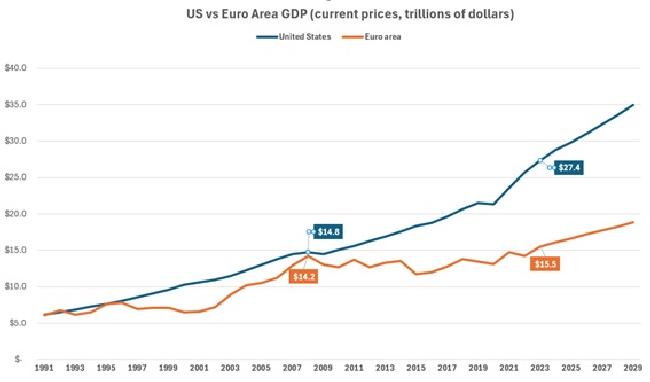
As capitalist market reforms were bringing prosperity to the Third World at a pace never believed possible, socialism was undermining the economies of Europe. The bright hope of European unification beginning with the European Coal and Steel Community (1951) brought considerable gains in the aftermath of World War II. Europe achieved economic successes without parallel in its history. And it was widely believed that the European Union (EU) (1993) and the Euro would ensure continued prosperity. I can recall talking to European friends, many of whom thought that America as in decline and was being eclipsed by Europe. But Europe had increasingly turned to Socialist economics and by the time the contrast between the market reforms and the economic straight jacket of socialism was becoming increasingly apparent. This finally reached a crisis when the EU periphery began to go bankrupt (2009). The EU managed to paper over this crisis, but the unresolved problems at the periphery are now appearing at the EU core (2014). Of course the socialist welfare state was developed with all the best intentions. And because it was funded by a prosperous private sector, it bough prosperity. But in country after country, governments had to begin borrowing money to meet the demands of the welfare system--essentially stealing from the next generation. Gradually socialist governments imposed more and more demands on the private sector as well a an increasingly restrictive legal framework. The result has been slowing growth and actual decline in some cases, high unemployment (especially youth unemployment), rising taxes, and increased borrowing. Another important concern is the impact on the invasion spawned by capitalism throughout Europe.
This can be seen most dramatically seen in the field of information technology, the whole computer revolution. The ECB has attempted to prevent financial disaster by backing sovereign bonds. But fiscal policy can keep the lid on only so long. Major market reforms are needed. he Eu economy is plagued with bad government policies: including excessively high taxes, job-destroying labor regulations, astronomical government spending (governments of course don’t generate wealth), government/corporate cronyism, an ever expanding body of rules and edicts, and tragically flawed monetary policies. This all restricts the pulse of commercial activity which is the basis of the economy and on which both personal prosperity and government social programs rest. There is no evidence, however, that European voters are prepared to support candidates prepared to make the needed reforms. In fact, the Greek public which was the touchstone of the crisis looked favorably on politicians (SYRIZA party) prepared not only to reject reform, but adopt even more radical socialist policies than those that drove the country into bankruptcy (2010s). Then the British hocked Europe by voting to exit the EU (2016). Driven by decades of post-2008 economic stagnation, restrictive EU fiscal rules, and migration crises, public and political sentiment has shifted. Economic stagnation has caused the European public to question the major established parties. British elections dhow hat the British public is rejecting the two main parties (2026). Euro-skeptic parties have steadily grown in Western Europe especially (France, Italy and Germany Italy). The whole European Project would be threatened even if one of these countries leave the EU. The reason for this is that incomes have been declining. This is primarily the result of Socialist policies along with increasing deficits to expand the generous welfare spending. And these problems increase even though America financial support. (Most Europeans are aware that Americas is financing their defense, fewer are aware of American support for health care.) Now while the European economy is stagnating, few Europeans seem to be giving up on socialism.

Navigate the Children in History Website:
[Return to the Main modern economic system page]
[Return to the Main economic systems page]
[Return to the Main Economics page]
[Introduction]
[Biographies]
[Chronology]
[Climatology]
[Clothing]
[Disease and Health]
[Economics]
[Geography]
[History]
[Human Nature]
[Law]
[Nationalism]
[Presidents]
[Religion]
[Royalty]
[Science]
[Social Class]
[Bibliographies]
[Contributions]
[FAQs]
[Glossaries]
[Images]
[Links]
[Registration]
[Tools]
[Children in History Home]