|
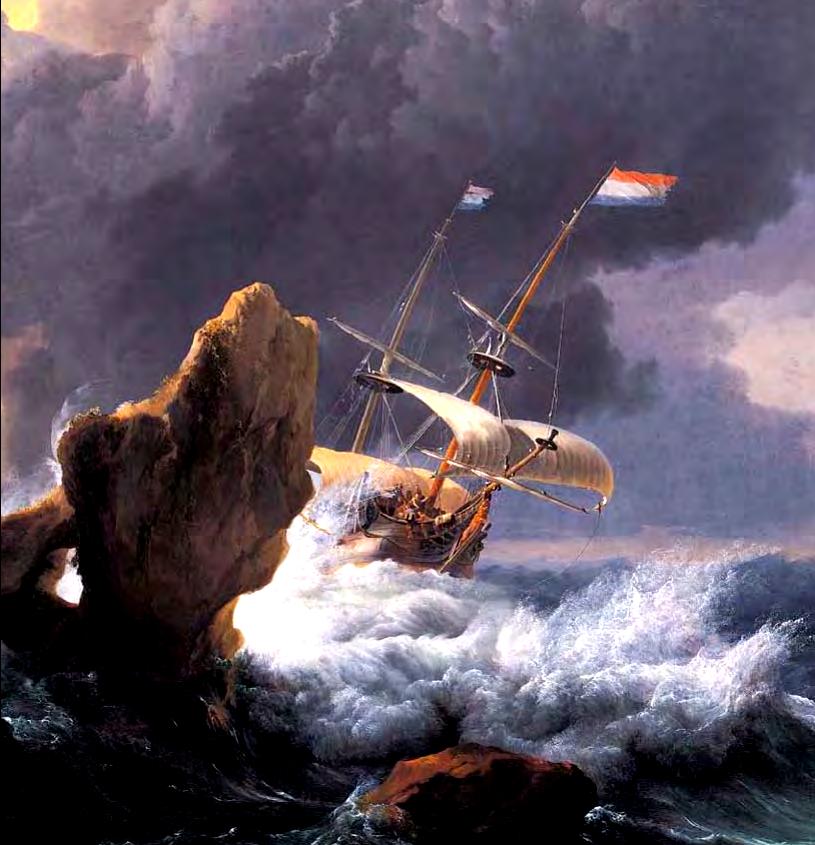
It was the Portuguese who first rounded the Cape of Good Hope (1488) and established maritime trade with the East (1498). They were, however, soon followed by the Spanish and then the Dutch. The Netherlands were a small country and under attack from Spain for its very existence. But Dutch navigators soon proved tough competition. In fact, it was the profits from the sea trade that helped gain Dutch independence. The Dutch became a major commercial and maritime power (beginning in the mid-16th century), becoming the financial center of Europe. This became possible with the defeat of the Spanish Armada (1588) and Spain's failure to suppress Protestantism in the northern provinces of the Spanish Netherlands. The Dutch voyages of discovery were primarily driven by trade and the search for spice routes (late 16th and early 17th centuries). The Dutch East India Company (VOC) was founded (1602). This was inevitable; the profits from trade with the East were enormous for anyone with seafaring technology, which the Dutch had. Dutch navigators charted major stretches of the Arctic, the Americas, the Indian Ocean, and the Pacific. The early Dutch explorers included: Duyfken, Gulden Zeepaert, Hartog, Houtman, Leeuwin, Pelsaert, Pera/Arnhem, Pool, Tasman, Vyanen, and Zeewulf. They are not as famous as many of the Portuguese and Spanish explorers because they were not the first. The tiny Netherlands acquired an overseas empire which included New Amsterdam (New York), Caribbean islands, the Netherlands Indies (Batavia, Sumatra, and other Indobesian islands), Cape of Good Hope, Ceylon/Sri Lanka (ousting the Portuguese), and Malacca (also ousting the Portuguese). This all began relatively close to home. Willem Barentsz and Jacob van Heemskerk explored the Orange Islands and Svalbard (1590s). They wintered in the High Arctic (1596–1597) while searching for a northeast passage. This was what they wanted: a northern passage to China. Trade with the East was where the major profits lay. The Dutch, English, and French all fixated on the Northeast or Northwest Passage. One of the most persistent was Henry Hudson, more associated with England. Hudson's third voyage was in part financed by the Dutch (1609). Hudson sailed for the VOC, exploring Manhattan and the Hudson River valley, laying the groundwork for New Netherland. Dutch expeditions also charted parts of the North American coast, Cape Horn (1615), and South Atlantic islands. Eventually the Dutch reached the East with southern voyages. Cornelis de Houtman led an expedition of four ships funded by the Compagnie van Verre. The fleet reached Bantam (Banten) in Java (1596) and returned to the Netherlands with spices, earning a huge profit (1597). And soon they were not just following the Spanish and Portuguese that hugged the coastline. They developed in secret a faster, but more dangerous route-- the southern Brouwer Route took advantage of the powerful winds at 40° degrees south. At those latitudes, the winds are prevailing westerlies—known as the Roaring Forties—rather than the more easterly trade winds in more northerly latitudes. They occur roughly between 40° and 50° south latitude. This brought the Dutch much quicker to the Spice Islands (modern Indonesia). This was a huge advantage. The Roaring 40s brought the Dutch to western Australia and is why it was Dutch explorers who first found Australia, New Zealand, and Tasmania. But the Dutch were not interested in settlement, and these places did not have the spices that were so important to the Dutch economy. Willem Janszoon made the first definite European landfall on Australia aboard the Duyfken at Cape York (1606). He was followed by Dirk Hartog (1616) and Willem de Vlamingh (1696–1697). The Dutch encountered resistance from the Australian Aboriginal peoples, who in any case did not have any valuable products to trade. It would be in the Pacific that the Dutch Empire would be centered. Dutch explorers moved up from Australian waters to the all-important Spice Islands (Indonesia), where, over time, they replaced the Portuguese. Abel Tasman explored Tasmania, New Zealand, Fiji, and Tonga (1642–43) and reached additional Pacific Islands (1644). Subsequent voyages reached places, including Easter Island and Samoa (1722). War with Portugal resulted when the Spanish seized control of Portugal- the Iberian Union (1580-1640). Thus Spain's war with the Dutch (1568--1648) now involved Portugal. The Dutch replaced the Portuguese as the dominant maritime and spice-trading power (17th century). The Dutch mobilized a combination of financial innovation, aggressive state-backed corporate power, superior bulk shipping/navigation, and Portugal's strategic overreach. The Portuguese were able, however, to retain control of Brazil, primaily because the colonial population was Portuguese.

Navigate the Boys' Historical Clothing Website:
[Return to the Main Northern European Voyages of Discovery page]
[Return to the Main Voyages of Discovery page]
[Return to the Main 15th century page]
[Return to the Main 16th century page]
[Return to the Main Dutch history page]
[About Us]
[Introduction]
[Biographies]
[Chronology]
[Climatology]
[Clothing]
[Disease and Health]
[Economics]
[Freedom]
[Geography]
[History]
[Human Nature]
[Ideology]
[Law]
[Nationalism]
[Presidents]
[Religion]
[Royalty]
[Science]
[Social Class]
[Bibliographies]
[Contributions]
[FAQs]
[Glossaries]
[Images]
[Links]
[Registration]
[Tools]
[Children in History Home]