***
war and social upheaval: the American Revolution Revolutionary War foreign allies
The American Revolutionary War: Foreign Allies
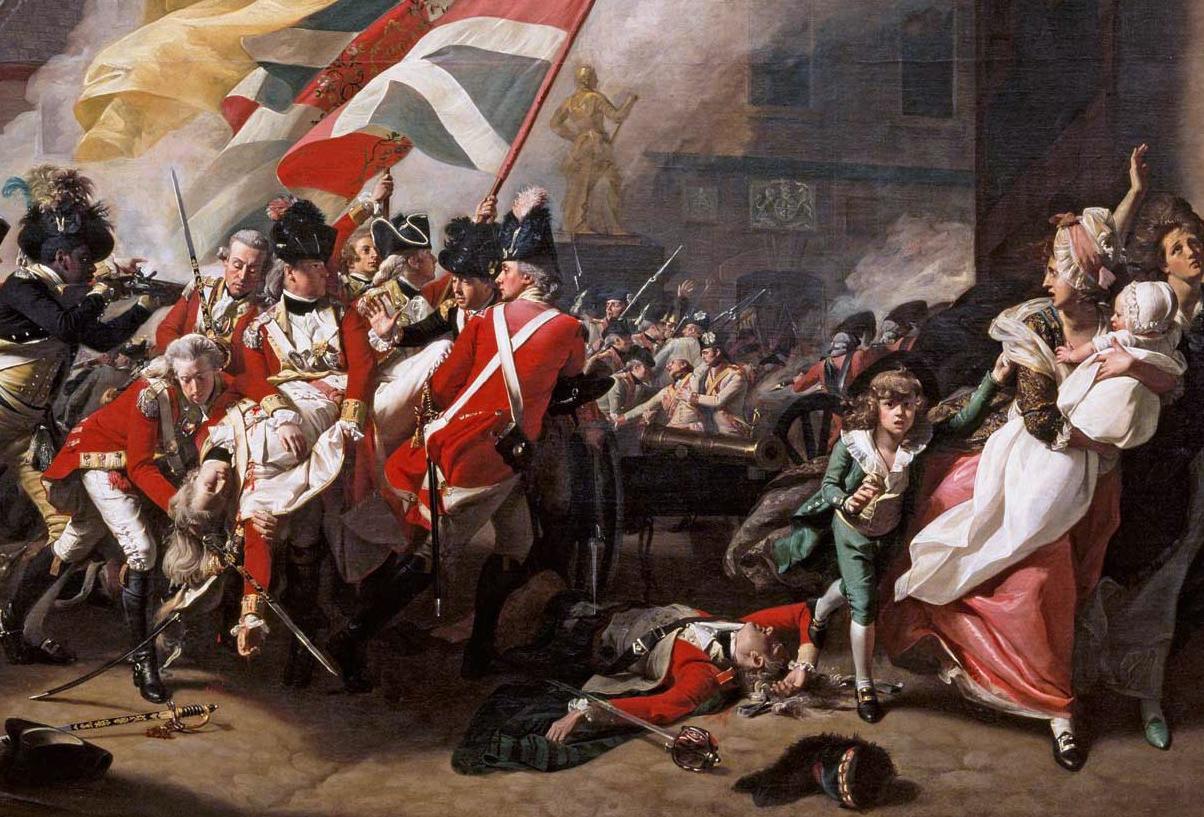
Figure 1.--This painting by British master Sir John Singleton Copley (1738-1815) illustrates a little known episode of the Revolutionary War, a French attack on island of Jersey in the English Channel. It is entitled 'The Death of Major Peirson' an incident occuring (January 6, 1781), a few months before the climatic battle of Yorktown. The Battle of Jersey was a French invasion of Jersey to remove the Royal Navy's use of the island to disrupt French and American shipping. British privateers operated from Jersey. France lauched an expedition to seize the island. Click on he image for an enlarged view.
The Americans did not fight the Revolutionaru War alone. They had allies. Ironically the Allies were mostly not others who believed in republicanism and the ringing slogans of the Declaration of Independence, but rather European monarchies who were ruled as absolutist soverigns--the very system the Americans were challenging. Of course this was only true in part. The Colonists were challenging the European monarch with limited powers and actually Parliament as much as the King. For the Europeans, it was opposition to the growing power of Britain that attracted them to the American cause. The French and Spanish saw the opportunity for both revenge as as well as gains. And French opinion beyond the Court had been powerfully changed by the Enlightenment. Benjamin Franklin as the American Commisioner masterfully played a role designed to take full advantage of Enlightenment thinking. The Dutch were different. They were a small republic, but they had also suffered at the hands of Britain's growing naval and mercantile power. Ironically, while America would gain areat deal from the Revolution, each of its three allies would suffer substantially despite the American victory. In sharp contrast, the British were fighting alone, except for German mercinaries they could pay. This was a sharp departure for Britain which usually fought its land wars with allies. Almost all of the famous wars which Britain and England before it fought on the continent were fought with allies. The Revolutiinary War was a rare exception. And in contrast to many smaller wars the British fought, the Revolutionry war after Saratoga morphed into a world war or at least major European war that streached Britains considerable resources.
American Allies
The Americans did not fight the Revolutionaru War alone. They had allies. Ironically the Allies were mostly not others who believed in republicanism and the ringing slogans of the Declaration of Independence, but rather European monarchies who were ruled as absolutist soverigns--the very system the Americans were challenging. Of course this was only true in part. The Colonists were challenging the European monarchy with limited powers and actually Parliament as much as the King. For the Europeans, it was opposition to the growing power of Britain that attracted them to the American cause. The French and Spanish saw the opportunity for both revenge as as well as gains. And French opinion beyond the Court had been powerfully changed by the Enlightenment. Benjamin Franklin as the American Commisioner masterfully played a role designed to take full advantage of Enlightenment thinking. The Dutch were different, They were a small republic, but they had also suffered at the hands of Britain's growing naval and mercantile power. Ironically, while America would gain areat deal from the Revolution, each of its three allies would suffer substantially despite the American victory.
British whigs
The British Whigs cannot exactly be called an American ally, after all hey were loyal to the Crown. They were, however, generally sympathetic to the Colonists and those sympathies aided the Colonial cause. The name Whig originated as a shortening of Whiggamore, the nickname of a Scottish Presbyterian, basically a Covenanter. The Whigs were a dominant political faction in Britain (18th ‑century). They coalesced among opponents of absolute monarchy and Catholic succession. They championed constitutional monarchy, parliamentary sovereignty, and the Protestant supremacy. They were thus the political heirs of the Glorious Revolution that ousted King James II (1688). They purged his Catholic supporters. Under the 'Whig Supremacy' (1714–1760), the party controlled the government, purging the Tories from all important offices. The Whigs become the party of liberalism, reform, and opposition to what was seen as the Crown's overreach. They were generally sympathetic to Colonists as issues developed on colonial rights and self‑government. The Tories were usually more aligned with the Crown and tighter imperial control over the increasingly assertive colonial legislatures. This complicated the issue because many MPs were bothered that the colonial legilstures wre callengin West Ninister spremecy. Whig sympathy was founded on the Whig ideals of liberty, constitutionalism, and resistance to arbitrary power. When open defiance broke out in the Colonies (1775), the Whigs were divided. Many Whigs, especially in the House of Commons, supported the colonists’ right to self‑government and opposed coercive policies. Whigs like Charles James Fox and William Pitt the Younger (at the time a Whig) criticized Lord North, te Crowen's chief minister (the term prime-minister wasnoy yet used). The major issues were his coercive measures and then conduct of the War. The cost of the War was a major issue. Other Whigs, especially those with important commercial interests in the Colonies supported maintaining British control and the Crown’s authority. As the War dragged on, the growing cost of the War and impact on trade became the major issues--issues that attacted some Torry support. .
France was a divine rights absolutist monarchy from which most Americans were grateful that the British had protected them during the French and Indian War which developed into the Seven Years War in Europe. France was a reluctant ally, but was attracted by the opportunity for revenge against the British after the comprehensive defeat in North America, the Caribbean, India, and Europe. The French government, led by King Louis XVI, sought to regain prestige and power lost during those conflicts. And supporting a popular cause was am attractive if expensive decision for the monarch who only recently risen to the throne (1774). The prospects for American victory at first seemed remote. Franklin and Adams worked to secure French assistance. Franklin proved especially adroitly exploited popular vsyopathies. It was the stunning news of the Colonists destruction of an entire British field army at Saratoga that decided the matter (October 1777). The French monarchy had no sympathy for the ideals of the Revolution. The French public and Enlightenment thinkers, however, were drawn to the Revolution. They were attracted to the idea of delivering a substantial defeat to Britain. It is said that wars make for strange bedfellow. Louis XIV for example, made common cause with Ottoman Turks invading Europe. France and the American colonies signed a Treaty of Alliance along with The Franco-American Treaty of Amity and Commerce at the Hótel de Crillon in Paris (February 6, 1778). France would be America's key ally in the War. The Americans received assistance from other countries, but only France had the capability of providing war winning levels of assistance. And we doubt if the Dutch and Spanish would have assisted the Colonies if France had not entered the War. Without France an American victory seems improbable. A French fleet arrived off Narragansett Bay in Rhode Island (July 29, 1778). They supported a Colonist effort to take back Rhode Island. The effort failed, largely because a storm damaged the French fleet. Even so, critically important arms and financial assistance assistance flowed to Washington's Continental Army. The war winning battle of Yorktown was fought by a American and French force defeated a second British field army (1781). The Americans succeeded in their struggle in large part because they were aided by a French monarchy that was opposed to offering the same liberties to his people that the Americans were demanding from their king. In the end, the massive aid to American virtually bankrupted the monarchy. This and the stirring example of the American Revolution led directly to the French Revolution (1789).
(The) Netherlands
The Dutch were the third former enemy of England to support the Colonies and declare war on Britain.
The Dutch people had favored the Colonies from the very beginning of the War. The Colonial naval hero, John Paul Jones, found refuge in the Netherlands. The United Provinces was considering involvement in the League of Armed Neutrality. Several European powers were conducting 'neutral trade' during the war. The Dutch were the most important, larfely because their Caribbean ports provided useful trabsshiping points. St. Eustatius was a particular sore point and provided much of the Continental Army's supplies. The British struck the Dutch to prevent this (1780). The result was the another Anglo-Dutch War (1780-84). This proved devestating for the Dutch. It was ruionous for their mercantil economy. As a result, the Dutch were no longer a major naval power. In the aftermath the Batavian Republic developed.
King Carlos III of Spain was a virtually absolute monarch, but he was also a man of the Enlightenment and open to new ideas. And he came to champion the American cause. Much more attention is given by historians to the French alliance and with good reason because it was key to the American victory. nd tge French fought alongside Washington at Yorktown. The Spanish alliance, however, should not be ignored. Spanish participation was also important. Here count Aranda played a critical role championing the Americans at court. The Spanish asked for Gibraltar from the British in exchange for sideing with Britain. When Briain refused, Spain declared war on Britain (1779). The Spanish both provided financial assistance to the American cause as well as supplies and engaged in military action. Spanish military actions were conducted in Europe, the Caribbean, Central america, the American South and Midwest. Wjile actual joint operations with Americans were limited, the extensive operations against the British diverted substanbtial forces that could have been used against the Colonists. Jorge Ferragut lead military campaigns against the British in North Carolina. Benjamin Franklin is best known for his role in France, but he was also the Continental Congress' Commissioner to Spain. He helped convince King Carlos to send money, uniforms, and military equipment to the Americans. The Spanish help finance the siege at Yorktown. Bernardo de Gálvez helped divert Royal Navy units at Pensacola assisting in Washington's victory at Yorktown (1781). Combat between the Americans and British essentially ceased after Yorktown. This was not the case with the Spanish. Spanish military actions after Yorktown, helped convince the British to make peace.
British Allies
In sharp contrast to the Americans, the British were fighting basically alone. The major exception was the German mercenaries they could pay. Americans refer to them as the Hessians. This was a sharp departure for Britain which usually found allies who provided most of the ground troops. Almost all of the famous wars which Britain and England before it fought on the continent were fought with allies that had substantial land armies. The Revolutionary War was a rare exception. And in contrast to many smaller wars the British fought, the Revolutionary War after Saratoga morphed it into a world war that stretched Britain's considerable resources. Once the French came into the War, much more was in play than the thirteen Atlantic-coast colonies. In particular, Britains Caribbean islands wre threatened and at the time the Caribbean sugar islands were the most valuable real estate in the world. This meant that Britain could not concentrate its strength soley against the rebellious American colonies. The massive British offensive failed to destroy Washington's fledgling Continental Army. Gen. Howe came very close, but failed with Washington's victory at Trenton (December 1776). The British recognized at this point that they would need allies. And this conviction only increased as the Americans acquired European allies while they were left fighting the war alone. This was a huge departure from British war policy which almost always involved acquiring allies when fighting land wars. The British deployed a large army to America, but not large enough to occupy a continent. They had their supporters, the Tories or Loyalists who remained loyal to the Crown. Historians debate just how important the Loyalists were. It is notable that all the colonial Legislatures supported independence. Even so, the Loyalists were an important part of the population as were those who were uncommitted. In addition to the Loyalists the British turned to two other groups, blacks (mostly slaves) and Native Americans. All these groups were important because they provided a much less expensive way of recruiting than enlisting and training regulars and German mercenaries. Lord North and other formulating Britain's war policy do not seem to have calculated the impact on public opinion in the colonies and support for the Continental Congress. In both cases they only marginally aided the British cause and infuriated not only the Patriots, but the Colonial population in general including many who were still uncommitted one way or the other. The backwoods areas which were already anti-British because of the large Scotts-Irish population. Attempting to ally with Natives Americans cost the British what little support they had in the backwoods which would play an important role in the War. The South might have been an area with the strongest pro-British sympathies. Trying to enlist the support of African slaves alienated the South, even many with pro-British sympathies.
Scotts
It is well known the important role the Scots-Irish played in the War. The role of the Scotts are less well known. The two groups were very different. They did have some similarities, Scottish ehnicity and Protestantism--Presbetarianism. Other thn that they ere different. The Scotts-Irish were from Ulster and had emigrated to the American colonies in large number during the early-18th century. They became an important part of the colonial population, especially in the bckwoods areas and they were largelt histile to the enhkish because of their exploitation in Ulster. They also wee alienated by the Angkian Church of England. The Scotts from Scotland came more recently and suprisingly they tended to be pro-British. A factor here was that the Anglican Church of rngland had not alientated the Scottish population. In Scotland, the Presbeteraian Church of Scotland was he established church. Also Scots were becoming an important element in the Nritish office corps. In addition yhe tight hold that the Scottish landholding aristocracy meant that Scottish regiment were an important part of the British Army in the first years of the war. [MacKillop, Scotland]
Irish
Research on the Irish particviopation in the Revolutiinaru War is lacking. Ireland of course was predominately Catholic, but was governed by the Protestant establisment. Ireland nefore the Potato Faminr (1840s) had a substantially larger population than Scotland. And like the Scots the Irish made up asibrnatial oart of the Beitish Armny officer corps. [MacKillop, CSpan] (It is no accident that the two most familar British Army officers familiar to Anmericans have Irish Protestant originsh--Wellington and Montgomery. Many Irish soldiers also served in the ranks. We think that they were mostly Irish Protestants, but have no actual date here.
Torries/Loyalists
The American Revolution has been called the 'First American Civil War'. Jefferson described Anericans as 'one people' in the Declaration of Independence (July 1776), but in fact the colonists despite the votes in the Continental Congress and state legislatures. Historians argue as to the relative size of the three groups of colonials (patriots, loyalists, and uncommited). Some historians dscribe tens of thousands of loyalists. The actual number may have been greater. Loyalists is how they referred to themslves. The Patriots labeled them Tories. The extent of the domestic divide is not fully reported in Revolutionary War histories. The Loyalists not only fought with the British, but there were encounters betwemn the Patriots anf Loyalists. This was some of the bloodiest and most savage fighting of the War. Even the British and Hessians were shocked. And there was extra-legal violence directed at both individuals and violence. The American Revolution began as debate and protests. It evolved into into heated, ncederary dusputes and violence, including tar-and-feathering, house-burning, and even lynching. The Loyalists like the Patriots armed themselves. The British provided arms while trying to keep arms out of Patriot hands. The Revolution was thus in part a civil war. And the Brutish adopted a southern stategy, believing that Loyalist feeling was strongest in the South. Brigadier General Nathanael Greene was one of the heros of the Revolution. After the British and Loyalists shatteeed the Patriot forces in the South, Greene took command of the Continental Army of the South (1781). A ketter to Colonel Alexander Hamilton, Washington's aide-de-camp, describes the sitution he encountered, �The division among the people is much greater than I imagined and the Whigs and Tories persecute each other, with little less than savage fury. There is nothing but murders and devastation in every quarter.� There was plentu of collaboration with the British. Wshington's Army suffered at Valley Forge because money was not provided to buy food. The British never had tht problem. Collaboration does not, however, necesarily mean that they were Loyalists. Many colonials were simply uncommitted. Reports reached Washington. He commented to a staff officer, �I am amazed,� wrote George Washington to a staff officer, �at the report you make of the quantity of provisions that goes daily into Philadelphia �.� The whole idea that the Revolution was in part a civil war largely evaportated in the glow of victory. Many Loyalists were forcd into exile or left of their own accord. And those that remained or had not joined the Patriot bandwaggon did not want to bring attention to themselves.
German Mercenaries
Britain until World war I never had a large army, but rather a small, highly professional force. Even during th Napoleonic Wars, Britain did not introduce conscription. Britin rather than its army, relied largly in the Royl Navy for its defense. The task in the vast Americn continent, however, required a large army because they had to do more than hld ports to control the colonies. And not only did they have to seize control of the colonies, but they mny other parts of their global empire to defend, especially after the French and Spanish entered the War. After leaving Boston, the Brutish put together a massive invasion force to destroy Wasington's fledgling Continental Army and restablish control. The Army as it existed was simply not large enough. The British turned to the expedient of hiring foreign troops. This was mostly Germans, because of their military prowess and the fact that severl German states maintained relatively large standing armies. Thiswas exception, but rnting them out provd profitable. And of course the British royal family was of German origins (Hanover) and had extnsive German contacts. The major source was Hesse-Kassel. Landgrave Frederick II of Hesse-Kassel hired troops out to his nephew King George III. They were an important part of the British force and especially hated by the Patriots. They were well-trained and diciplined oldiers. The British german relationship predated the Hanovarin British kings and extended into the 10th century. It was Prussian troops that saved Wellington and the British at Waterloo. The 20th century conflicts between the Britih and Germans was in large measure the modern work of Kaiser Wilhelm I--ho ironically was half British. Interestingly, many of these German mercenaries remained in America after the War and merged with at the time the still relatively small German community.
Blacks
The important role played by Blacks in the Civil War has been well publicized until recent recent years. Their role in the Revolutionary war has still not well publicized. Blacks fought on both sides, but predominately fought with the Colonists. Blacks joined the Continental forces in the early stages of the Revolution. Washingtoin was horrified to find Blacks bearing arms when he arrived to assume command. He attempted, but failed to have them dismissed. At a time when the Revolution was very much in doubt, he refused to endorse a South Carolina plan to raise Black soldiers. Washington did eventually agree torecruiting northern Blacks. Washington as the Revolution progressed came to lokk at his Black soldiers as some of the best in the Continental Army. At one of the most important engagements at Yorktown, he selected the 1st Rhode Island Regiment--75 percent of whom were Black. [Wiencek] The British tried to appeal for black support. This was a factor in the gradual shift of support in Colonial opinion, especially in the southern colonies where most blacks lived. The British shifted the campaign to the south expecting to find more support. Their overtures to black slaves was one reason that they did not encounter the level of support they had anticipated. >
Native Americans
Native Americans had played a major role in the French and Indian War (1756-63) and because many had supported the French suffered as a result. Now as tensions began to build between the Colonists and British, a new war was about to erupted in which they would again have to either take sides or remain neutral (1760s). They became involved in the brewing conflict when the British tried to consyruct an Indian territory west of the Appalachians and restrict colonial migration west. The Quebec Act (1774) was part of this pricess and inflamed colonial opinion. Native American tribes had to navigate a difficult diplomatic route in the brewing conflict. The choice was an powerful imoerial power which seemed to be trying to protect their lands and a rising neignoring republic intent on moving west. It was an entirely new world in which they wre ill prepared to navagate. Many were unwilling to take on the British again. American intentions were less well known, but for some chiefs seemed the greatest danger. Trade and supplies were also a major concern. In the end, some chose the British and other fought with the colonists. The larger number chose the Brutish. Joseph Brant or Thayendanegea, a Mohawk chief, sided with the British and helped ally four of the Six Nations with Britain. For the Brutish this was important. They were the weakest in the back coiuntry, heavily popiulated with the fervently anti-British Scotts Irish. Thus the Native Americans were an important ally where they were weak and it was diffivult and expensive to move in regulars.
Sources
MacKillop, Andrew. Scotland and the American Revolution (2019). MacKillop explains that while Britain and their scottish soldiers lost the war, they were well rewarded with land grants in Canada.
MacKillop, Andrew. C-Span presentaiin aired November 19, 2019.