|
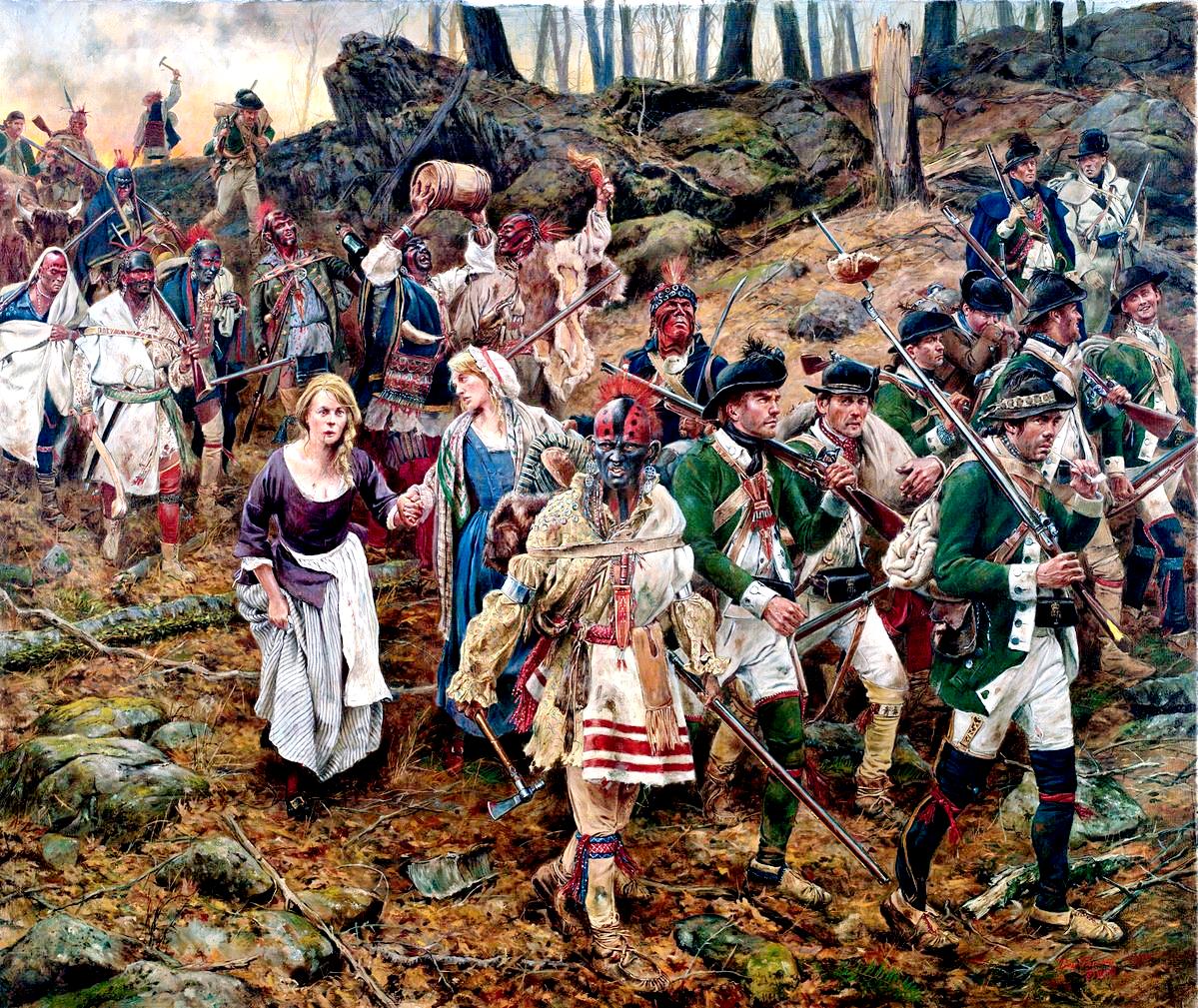
The massive British offensive failed to destroy Washington's fledgling Continental Army. Gen. Howe came very close, but failed with Washington's victory at Trenton (December 1776). The British recognized at this point that they would need allies. And this conviction only increased as the Americans acquired European allies while they were left fighting the war alone. This was a huge departure from British war policy which almost always involved acquiring allies when fighting land wars. The British deployed a large army to America, but not large enough to occupy a continent. They had their supporters, the Tories or Loyalists who remained loyal to the Crown. Historians debate just how important the Loyalists were. It is notable that all the colonial Legislatures supported independence. Even so the Loyalists were an important part of the population as were those who were uncommitted. In addition to the Loyalists the British turned to two other groups, blacks (mostly slaves) and Native Americans. All these groups were important because the provided a much less expensive way of recruiting than enlisting and training regulars and German mercenaries. Lord North and other formulating Britain's war policy do not seem to have calculated the impact on public opinion in the colonies and support for the Continental Congress.
The American Revolution has been called the 'First American Civil War'. Jefferson described Americans as 'one people' in the Declaration of Independence (July 1776), but in fact the colonists despite the votes in the Continental Congress and state legislatures. Historians argue as to the relative size of the three groups of colonials (patriots, loyalists, and uncommitted). Some historians describe tens of thousands of loyalists. The actual number may have been greater. Loyalists is how they referred to themselves. The Patriots labeled them Tories. The extent of the domestic divide is not fully reported in Revolutionary War histories. The Loyalists not only fought with the British, but there were encounters between the Patriots and Loyalists. This was some of the bloodiest and most savage fighting of the War. Even the British and Hessian were shocked. And there was extra-legal violence directed at both individuals and violence. The American Revolution began as debate and protests. It evolved into into heated, incendary disputes and violence, including tar-and-feathering, house-burning, and even lynching. The Loyalists like the Patriots armed themselves. The British provided arms while trying to keep arms out of Patriot hands. The Revolution was thus in part a civil war. And the Brutish adopted a southern strategy, believing that Loyalist feeling was strongest in the South. Brigadier General Nathanael Greene was one of the heroes of the Revolution. After the British and Loyalists shattered the Patriot forces in the South, Greene took command of the Continental Army of the South (1781). A letter to Colonel Alexander Hamilton, Washington's aide-de-camp, describes the situation he encountered, “The division among the people is much greater than I imagined and the Whigs and Tories persecute each other, with little less than savage fury. There is nothing but murders and devastation in every quarter.” There was plenty of collaboration with the British. Washington's Army suffered at Valley Forge because money was not provided to buy food. The British never had that problem. Collaboration does not, however, necessarily mean that they were Loyalists. Many colonials were simply uncommitted. Reports reached Washington. He commented to a staff officer, “I am amazed,” wrote George Washington to a staff officer, “at the report you make of the quantity of provisions that goes daily into Philadelphia ….” The whole idea that the Revolution was in part a civil war largely evaporated in the glow of victory. Many Loyalists were forced into exile or left of their own accord. And those that remained or had not joined the Patriot bandwagon did not want to bring attention to themselves.
Britain until World war I never had a large army, but rather a small, highly professional force. Even during th Napoleonic Wars, Britain did not introduce conscription. Britain rather than its army, relied largely in the Royal Navy for its defense. The task in the vast American continent, however, required a large army because they had to do more than hold ports to control the colonies. And not only did they have to seize control of the colonies, but they had many other parts of their global empire to defend, especially after the French and Spanish entered the War. After leaving Boston, the Brutish put together a massive invasion force to destroy Washington's fledgling Continental Army and reestablish control. The Army as it existed was simply not large enough. The British turned to the expedient of hiring foreign troops. This was mostly Germans, because of their military prowess and the fact that several German states maintained relatively large standing armies. This was an exception, but renting them out proved profitable. And of course the British royal family was of German origins (Hanover) and had extensive German contacts. The major source was Hesse-Kassel. Landgrave Frederick II of Hesse-Kassel hired troops out to his nephew King George III. They were an important part of the British force and especially hated by the Patriots. They were well-trained and disciplined soldiers. The British -German relationship predated the Hanoverian British kings and extended into the 10th century. It was Prussian troops that saved Wellington and the British at Waterloo. The 20th century conflicts between the British and Germans was in large measure the modern work of Kaiser Wilhelm I--ho ironically was half British. Interestingly, many of these German mercenaries remained in America after the War and merged with at the time the still relatively small German community.
The important role played by Blacks in the Civil War has been well publicized until recent recent years. Their role in the Revolutionary war has still not well publicized. Blacks fought on both sides, but predominately fought with the Colonists. Blacks joined the Continental forces in the early stages of the Revolution. Washington was horrified to find Blacks bearing arms when he arrived to assume command. He attempted, but failed to have them dismissed. At a time when the Revolution was very much in doubt, he refused to endorse a South Carolina plan to raise Black soldiers. Washington did eventually agree to recruiting northern Blacks. Washington as the Revolution progressed came to look at his Black soldiers as some of the best in the Continental Army. At one of the most important engagements at Yorktown, he selected the 1st Rhode Island Regiment--75 percent of whom were Black. 【Wiencek】 The British tried to appeal for black support. This was a factor in the gradual shift of support in Colonial opinion, especially in the southern colonies where most blacks lived. The British shifted the campaign to the south expecting to find more support. Their overtures to black slaves was one reason that they did not encounter the level of support they had anticipated.
>
Thec Spanisgh at first carved out their empire uncontested by other Eurooean powers (16th century). in the 17th century, as European nations scrambled to claim the already occupied land in the “New World,” some leaders formed alliances with Native American nations to fight foreign powers. Some famous alliances were formed during the French and Indian War of 1754–1763. The English allied with the Iroquois Confederacy, while the Algonquian-speaking tribes joined forces with the French and the Spanish. The English won the war, and claimed all of the land east of the Mississippi River. The English-allied Native Americans were given part of that land, which they hoped would end European expansion—but unfortunately only delayed it. Europeans continued to enter the country following the French and Indian War, and they continued their aggression against Native Americans. Another consequence of allying with Europeans was that Native Americans were often fighting neighboring tribes. This caused rifts that kept some Native American tribes from working together to stop European takeover.
Native Americans had played a major role in the French and Indian War (1756-63) and because many had supported the French suffered as a result. Now as tensions began to build between the Colonists and British, a new war was about to erupted in which they would again have to either take sides or remain neutral (1760s). They became involved in the brewing conflict when the British tried to construct an Indian territory west of the Appalachians and restrict colonial migration west. The Quebec Act (1774) was part of this process and inflamed colonial opinion. Native American tribes had to navigate a difficult diplomatic route in the brewing conflict. The choice was an powerful imperial power which seemed to be trying to protect their lands and a rising neighboring republic intent on moving west. It was an entirely new world in which they were ill prepared to navigate. Many were unwilling to take on the British again. American intentions were less well known, but for some chiefs seemed the greatest danger. Trade and supplies were also a major concern. In the end, some chose the British and other fought with the colonists. The larger number chose the Brutish. Joseph Brant or Thayendanegea, a Mohawk chief, sided with the British and helped ally four of the Six Nations with Britain. For the Brutish this was important. They were the weakest in the back country, heavily populated with the fervently ant-British Scots Irish. Thus the Native Americans were an important ally where they were weak and it was difficult and expensive to move in regulars.
.
Wiencek, Henry. An Imperfect God: George Washington, His Slaves, and the Creation of America (Farrar Straus Giroux, 2003), 404p.

Navigate the Children in History Website
[About Us]
[Return to Main Revolutionary War page]
[Introduction]
[Biographies]
[Chronology]
[Climatology]
[Clothing]
[Disease and Health]
[Economics]
[Geography]
[History]
[Human Nature]
[Law]
[Nationalism]
[Presidents]
[Religion]
[Royalty]
[Science]
[Social Class]
[Bibliographies]
[Contributions]
[FAQs]
[Glossaries]
[Images]
[Links]
[Registration]
[Tools]
[Children in History Home]