|
The United States developed nuclear weapons during World War II. It was a massive research anf development effort--the Manhattan Project. The Germans were unable to penetrate the security around thge Project, but the Soviets did. The Goldbergs were just one of the active Soviet spy rings. The first American atomic bomb was a uranium (fission) sucessfully andcsuccessfully tested (July 1945). A month latter, uranium and plutonium boms were used to end the Pacific War. The United states for a brief period had a monopoly on atomic weapons. American planners assumed that monoply would last some time. The Soviets had, however, their own nuclear experts and had begun their atomic project during the War. Stalin ordered the project after Soviet spies began reporting on the American project. The Soviet research was directed by nuclear physicist Igor Kurchatov. The Soviets aided by their spy operations and captured German scientists, exploded their first atomic bomb (August 1949). It was no accident that within a year, the North Korans heavily armed with Soviet weapons launched the Korean War. America debated the H-bomb (fussion weapon). Oppehimer argued against it, but his loyalty was questioned. Teller argued for it. Unbeknownst to the Americans, the Soviets had already begun their H-bomb program. [Reed and Stillman] Stalin put NKVD Chief Beria in charge of the project. They weapons were exponentially more powerful than fission weapons. The Soviets tested a primitive fusion weapon (1953). The American H-bomb was the first true fusion weapon and was exploded over Bikini (1954). The Soviets followed with their own H-bomb (1955). Andrei Sakharov played a major role. The Soviets set out to build a super bomb. Nuclear fallout from some of the mega-bombs they exploded, however, caused the Soviet leadership to respond to American overtures for limits on nuclear testing. The first step was banning tests in the atmoshere. The Limited Test Ban Treaty (1963) banned all nuclear tests except for those performed underground. From then until the signing of the Comprehensive Test Ban Treaty (1996), most nuclear tests were performed underground. The Chinese exploded their first nuclear weapon (1964) and their first H-bomb 3 years later (1967). Nuclear weapons are no longer a Cold war Issue. With the end of the Cold war, the United States and Russia have reduced their nuclear arsenal. The arms race in South Asia between India and Pakistan has gone nuclear and both countries now have large niuclear arsenals. Israel is widely believed to possess nuclear weapons. North Korean has also developed nuclear weapons. And now Iran is on the verge of developing nuclear weapons.
Stalin launched the Cold War a year before the Americans dropped the atomic bombs ending World War II, ving housnds of Ameican lives an millions of Japanese likves. The American public saw the bombs as ending World War II and had no idea the Cold War was even underway. President Truman was so criticized and so low in the polls that he dd no even dare announce it. He used the occasion of a visit by Winston Churchill speaking at Fulton, Missouri to announce it (March 1946). Churchill use the tern 'Iron Curtain' to refer to the political, military, and ideological barrier created by the Soviet Unpin to prevent free contact between itself and its puppet eastern and central European allies on the one hand and the West on the other. He warned the Americans of Soviet expansion, and explained that an "iron curtain” had descended from Stettin in the Baltic to Trieste in the Adriatic. Behind that line lie all the capitals of the ancient states of Central and Eastern Europe…. All these famous cities and the populations around them lie in…the Soviet sphere, and all are subject, in one form or another, not only to Soviet influence but to a very high and, in some cases, increasing measure of control from Moscow." At the time, the atomic bomb was not an issue. America had a nuclear monopoly, but after the Japanese surrender had stopped making atomic bombs. The bomb did not begin to become an issue until the Soviets detonated an atomic bomb (August 1949), by which time Americans were well aware that the Cold War had begun. The Soviet bomb changed attitudes about the bomb. For many nuclear weapons became a huge issue, if not not the major issue. We hear some saying 'Better Red than dead.' There is no doubt the atomic bomb made the Cold War dangerous, but less fully understood is the degree to which nuclear weapons led to the greatest period of peace in Europe since the Pax Romana. The Americans had no intention of attacking the Soviet Union. And the Soviets were deterred from attacking the West by the prospect of nuclear annihilation. The Soviets used fear of the atmmic bomb to separate America from its Europen allies, especially Britain and West Gerrmany. 'Ban the Bomb' became a central feature of Soviet propaganda.
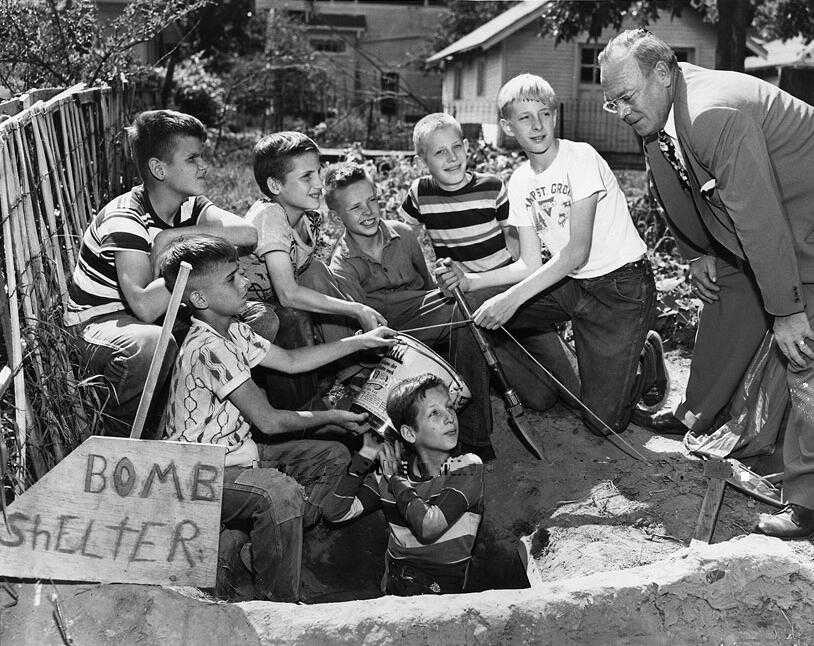
The United States developed nuclear weapons during World War II. It was a massive research and development effort--the Manhattan Project. Two fission weaons produced were dropped on Japan (August 1945). The Germans and Japanese also had nuclear projects. The Axis powers were, however, unable to penetrate the security around the Project, but the Soviets did. The Rosenbergs were just one of the active Soviet spy rings. The first American atomic bomb was a uranium (fission) sucessfully tested (July 1945). A month latter, uranium and plutonium bombs were used to end the Pacific War. The United states for a brief period had a monopoly on atomic weapons. America debated the H-bomb (fussion weapon). Oppehimer argued against it, but his loyalty was questioned. Teller argued for it. Unbeknownst to the Americans, the Soviets had already begun their H-bomb program. [Reed and Stillman] The American H-bomb was the first true fusion weapon and was exploded over Bikini (1954). There was understanably great concern among the public after the Soviets set off their first bomb (1949). this was about the same time that the glow of the World War II partnership had worn off and Americans had begun to realize that the Soviets had launched the Cold War and the dangers posed. Families begn building bomb shelters (figur 1). Kids did Duck and Cover exercizes at school. A CIH reader writes, "It is quite a photo here. I was 12-years old when a friend told me her father was building a bomb shelter in their backyard. I asked my dad could we build one, never mind we were renting. I remember he said, 'How long are you going to be able to eat and drink in a bomb shelter if the earth above is radioactive?' Knocked that idea to hell!" [Steng] Looking back, many historians use terms like the Red Scare and Anti-Communist Hysteria, commonly underestimating the Soviet threat. While a great deal is written about McCartyism, musch less is written about the Soviet Espionage effort and the military threat. In the 1950s the Soviet nuclear arsnal was small, but the conventionl military threat in Europe was considerble. By the 1960s, the Soviet nuclear threat was real.
American planners assumed that their nuclear monoply would last some time. The Soviets had, however, their own nuclear experts and had begun their atomic project during the War as soon as theu learned of the Manhattan Project. Stalin ordered the project after Soviet spies began reporting on the American project and put NKVD Director Beria in charge of it. The Soviet research program was directed by nuclear physicist Igor Kurchatov. The Soviet effort was aided by their spy operations, most famously but not exclusively the Rosenbergs, as well as captured German scientists. They , exploded their first atomic bomb (August 1949). It was no accident that within a year, the North Korans heavily armed with Soviet weapons launched the Korean War. The Soviets tested a primitive fusion weapon (1953). The Soviets followed with their own true H-bomb (1955). Andrei Sakharov played a major role. The Soviets set out to build a super bomb. The heavy nuclear fallout from some of the mega-bombs they exploded affectd their own people and territory.
This eventually caused the Soviet leadership to eventually respond to American overtures for limits on nuclear testing.
The destructive power of nuclear weapons was tragically demonstrated at Hiroshima and Nagasaki. These were uranium/plutonium fission weapons. The explosive energy was aporimately 0.02 million t of TNT. Fussion weapons were an increable order of magnitude beyond the destructive power of fission weapons. The first thermonuclear (hydrogen fusion) bomb released approximately 10 million t of TNT (10 megatons) and both the United States and the Soviet Union built larger weapons. The largest nuclear weapon ever detonated was the Soviet he Tsar Bomba which released an energy equivalent in excess of 50 million t of TNT (50 megatons). These bombs were built before pinpoint accracy was possible. And given the destructive power of these weapons, there was no need for pin point accuracy with the H-bomb.
The Chinese exploded their first nuclear weapon (1964). At the time with the development of the Sino-Sovoet Split, Soviet officials considered a premptive strike, but ultimately decided against it. The Chinese exploded their first H-bomb 3 years later (1967).
The first step was banning tests in the atmoshere. The Limited Test Ban Treaty (1963) banned all nuclear tests except for those performed underground. From then until the signing of the Comprehensive Test Ban Treaty (1996), most nuclear tests were performed underground.
Nuclear weapons are no longer a Cold war Issue. With the end of the Cold war, the United States and Russia have reduced their nuclear arsenal. The arms race in South Asia between India and Pakistan has gone nuclear and both countries now have large niuclear arsenals. Israel is widely believed to possess nuclear weapons. North Korean has also developed nuclear weapons. And now Iran is on the verge of developing nuclear weapons.
Reed, Thomas C. and Danny B. Stillman. The Nuclear Express: A Political History of the Bomb and Its Proliferation.
Steng, Ramie. E-mail message (may 30, 2015).

Navigate the Children in History Website:
[Return to Main Cold War weaponry page]
[Return to Main Early Cold War Phase page]
[Return to Main Cold War page]
[Return to Main anti-Communist hysteria page]
[Introduction]
[Biographies]
[Chronology]
[Climatology]
[Clothing]
[Disease and Health]
[Economics]
[Geography]
[History]
[Human Nature]
[Law]
[Nationalism]
[Presidents]
[Religion]
[Royalty]
[Science]
[Social Class]
[Bibliographies]
[Contributions]
[FAQs]
[Glossaries]
[Images]
[Links]
[Registration]
[Tools]
[Children in History Home]