|
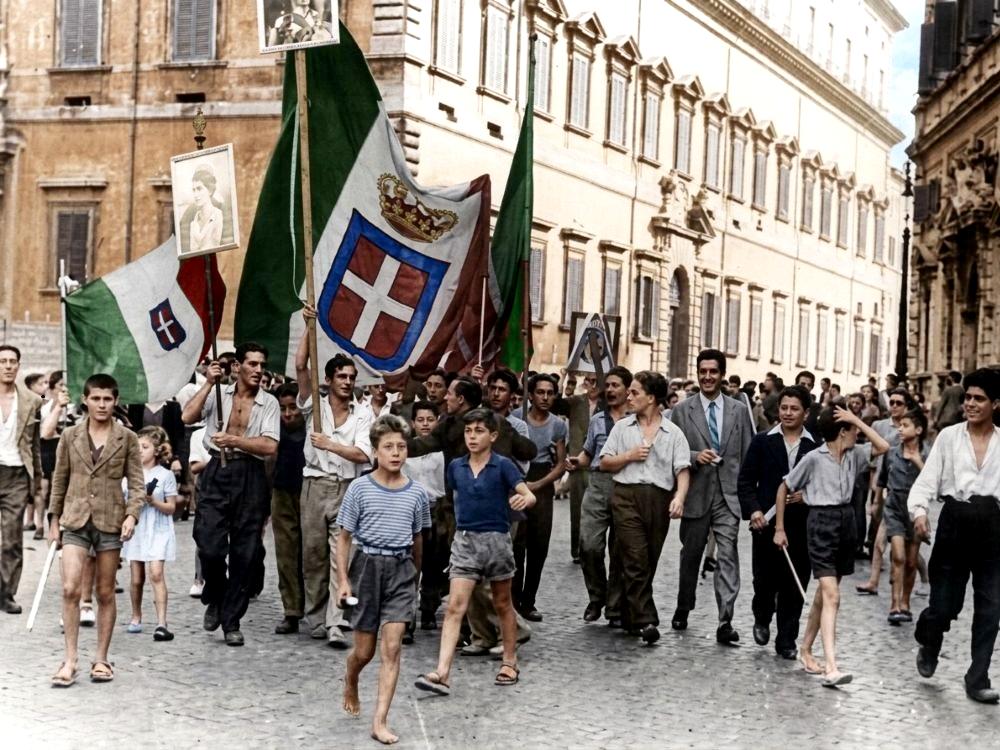
King Victor Emmanuel III's reign was badly tarnished by his association with Mussolini and the Fascists. It is not entiely clear what the King's motivations were, but fear of the Communists was probbably a factor. Or he could have feared being overthrown by the Fascists who had stormed Rome. He had held Mussolini at arms length and even more so the Germans, but he had not openly resisted them until the Allies invaded (September 1943). The King formally abdicated (May 1946). His son briefly became King Umberto II. As promised, however, a national refendum was held whether to continue as a kingdom or become a republic (June 1, 1946). The country in a highly regional outcome, narrowly voted to abolish the monarchy and create a republic. The outcome of the vote was far from certain for many reasons. Because Mussolini and the Fascists had seized control, no elections had been held in Italy for 22 years. The last general election for parliament took place (April 6, 1924). They were the first and last since Mussolini had come to power and were severely manged by the Fascists. The last free elections had been held (May 15, 1921). he 1946 referendum took place one year after the end of the war. Women were allowed to vote for the first time. In 1924, only men had the right to vote, and there were approximately 7.6 milliom voters (63 percent of eligible voers -- men aged 21 and older). In 1946, approximately 25 million people voted (89 percent of eligible voters aged 21 and older, men and women.) Of these, 13 milliom were women. You might have thought with women voting that the monarch would have had a better chance of winning. Opinions were highly polarized. This was not solely due to social circumstances. The Communists who were very influential once theAllies invaded, consituting a large portion of the republican vote. Ultimately, the industrialized north voted mostly for the republic, while the more conservative south voted for the monarchy.

Navigate the Children in History Website:
[Return to Main Cold War Italian page]
[Return to Main Cold War European country page]
[Return to Main Cold War country page]
[Return to Main Communism page]
[About Us]
[Introduction]
[Biographies]
[Chronology]
[Climatology]
[Clothing]
[Disease and Health]
[Economics]
[Freedom]
[Geography]
[History]
[Human Nature]
[Law]
[Nationalism]
[Presidents]
[Religion]
[Royalty]
[Science]
[Social Class]
[Bibliographies]
[Contributions]
[FAQs]
[Glossaries]
[Images]
[Links]
[Registration]
[Tools]
[Children in History Home]