|
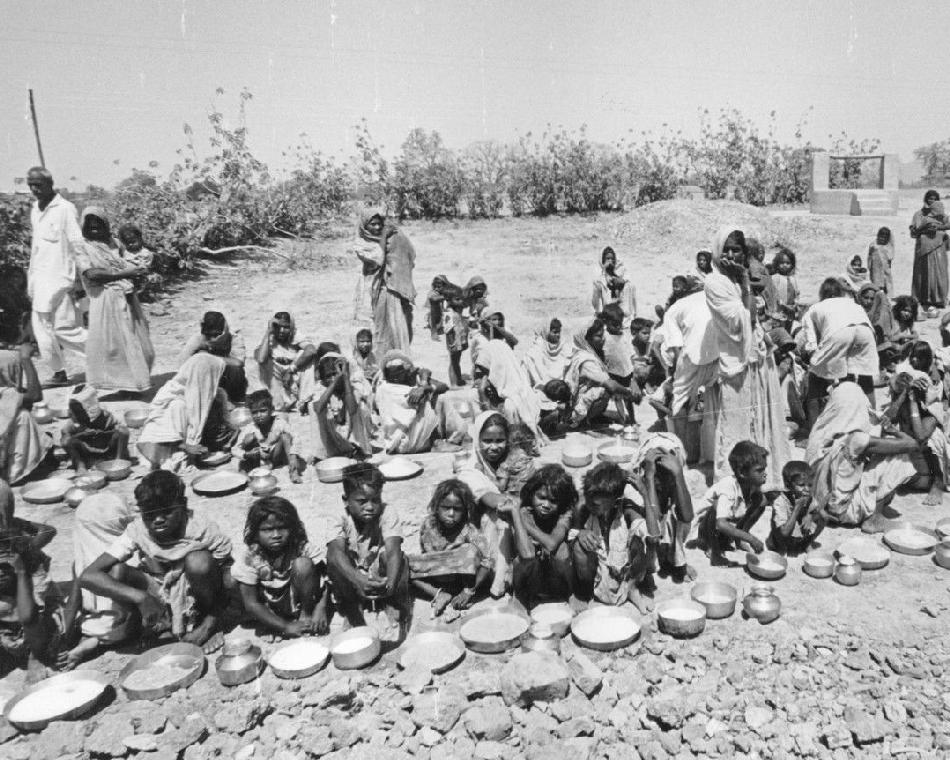
Famine is one of the great killers of human histiory. Drought, Famine, Plague and Pestilence are the feared natural dissters discussed in the Bible. Plague remains one of the worst calamities that can befall mabnkind. It is no longer, howver, an entirely natural event. Modern society grows more than enough food to feed the entire humn population. Modern reporting continues to focus on the natural causes, especially drought. Mamy make a connction with global warming. Some are so commited tp theglobal arming nrativ that they ignore the political and economic dimensions of famine. Famine is as old as history and surely predates history. It is believed that climate change and resulting food shortages drove man to migrate from Africa. Hunter gthes were not as vulnerable to famne because they could move. Settled griculturl societies were less mobile and thus more vulneranle. Thee is a great deal of historical information on famine. We note famines enduced by drought and other natural causes. Others are cosscoul enginered events as well as due to neglect or indiference. Both political and economic concerns are involved in the engineered famines. Some are genocidal in chracter.
The Irish Potato Famine began with a blight of the potato crop. The Irish had come to depend on the potato as a mainstay of their diet. No other crop produced so much food per acre of land. The blight was devestating and spread with amazing speed. Within a year a bountiful crop was reduced to rotting fields. Vast expanses of Irish firelds were ruined by black rot. It would have not been as bad if the Irish diet had been more diverse, but the poor Irish peasantry survived on the potato harvest. Potato crops accross Europe failed, but nowhere in Europe was the poopulation so dependant on the potato. Not only was the potato gone, but the crop failure caused the pricev of other food crops to soar, placing substitute foods beyond the purchasing power of the destitute Irish peasantry. The Irish peasantry were tennantv farmers who eked out a subsistaence existance with the potato not only found their food stocks roting, but were unable tom pay their rents. Soon their British and Irish Protestant landlords were evicting them from their homes. Some of the Irish peasants out of desperation attempted to eat the rotting potatos. Whole villages were devestated by cholera and typhus. Parish priests desperately tried to tend to their congregtions and feed the starving. Inn some cases the dead went unburried. Many were burried without caskets. English relief efforts wre inadequated and even these wereec abandoned in the midst of the famine. Work houses because of inadequate nutrition and unsanitary conditions were death traps. The Irish famine has been seen by many as the greatest humanitarian disasaster of the 19th centuy. This was in part because so many died and others forced emmigrate. Over 1 million are believed to have actually sucumbed to statvation and disease. But most tragic of all was that it was preventable. Throuhout the Famine, Irish, and English landowners were exporting food. One author points out that a quarter of the peers in the House of Lords owned land in Ireland and failed to act. [Wilson] As the 19th century moved on, independence became a possibility, but not an inevitability. The central development in the 19th century was the Irish Potalo Famine (1845-50). The reforms of the 19th century could have succeeded in integrating Ireland within the rest of the United Kingdom. This did not occur and the central reason was the Famine. The potato famine and more importantly the British reaction to the Famine resulted in a Holocaust of horendous proportions. After the Famine, Irish independence was inevitable.
Germany decidedto resolve the Balkans crisis by going to war, attacking France through neutral Belgium (August 1914) Food became an issue from the very begging of the War. The German Army seized the Belgian civilian fodd supply. The Germans did not do this with the expressed purpose of starving the Belgians. They did it to further their invasion plans and with no real concern about gow this would affect the Belgians. Germany was a food importing country, but believed that their vaunted Army would win the war before food and raw material shortages would affect the German economy. The Belgians were saved by the Belgian Relief effort organized by an unknown American mining enginner, Herbert Hoover, and supported through the generosity of the American people. The Germans of course did not quickly defeat the Allies. They were stopped by the Miracle on the Marne by the French army (September 1914). This meant that because of the Royal Navy blockade, that German could not imprort neither the food needed to support its people and the raw materials needed by its industry. Serious food shortages developed early in the War. The food situation reached crisis levels with the Turnip Winter (1916). Food became aserious problem througout the Central Powers and countries occupied by the Central Powers (Serbia and Romania). The United States ws able to prevent famine in most Allied countries (Belgium, Britain, France, Greece, and Italy). It was not able to get needed food into Russua or the countries occupied by the Centrl Powers (like Montenegro, Poland--then occupied Russia, and Montenegro). As a result, by the end of the War, Europe was starving. America set in motion a massive relief effort save an entire continent from starving. This was unprecedented and at time the greatest humanitaroan effort in world history.
Famine is often not included as a major killer in World War II. A lot of attentiion is gien to the bombing which was a minor killer. Famine throughout history has been a majo killer in wsarfare. Bombing and other military means of killing is an expenice way of jilling, expnsive economically and with manpower. Famine is a very inexpensive way to kill. Civilians can find ways of attemting to avoid bombing and other military action. People in contrast have to eat and eat well and regularly. It is not something that can be avoided. Ehe Germans understood this, in part because of their World War I experience. As a result, NAZI officiaks preparung for war studied how to use food as a weapon even before the War. The result as the NAZI Hungerplan (Hunngr Plan). In World War II there were several deadly famines. This included famines vaused on purose and well as fanines caused out without any planned desire to kill. Famines are the most difficult mortalities to quantify bcause most the deaths occured in rural ares and not recorded statitically. Another fcor id poor nutrition weakned the body's immune system. And the immediate cause of death may have been disease.
Communist theorists present socialism and central planning as a scientifically proven method of managing eonomies, making economies more efficent and avoilding the uncertainty and chaos of market fluctuations. Communist regimes use images of happy peasants producing boutiful harvests and well-fed workers. As with most aspects of socialism, the theory is seductive because it sounds so wonderful. Actual performance could, however, not be more different. Communist regimes have tragically not only oveseen subtantial declines in harvests, but have actually caused the worse famines in human history. No economic system has so collasally failed. The Communists also failed in industry, but the agricultural failure was more collasal and castistrophic. And in many instances caused these famines in countries that were historic bread baskets. The Communists, for example, turned Russia and Ukraine from a major grain exporting area to a country that had to import grain to fed its population. A famine has two causes. First is a dramatic drop in harvests. Second is a failure of relief operations. This explains why Communist regimes have caused so many of these terrible famines. Not only does collectivization based on Marxist theory reduce harvests, but Communist regimes have typically attenpted to prevent news of their failure from leaking out of their closed societies. To admit a famine is to admit failure which is something they can not do and continue to claim that that they have the cietific key to the future. Hiding these famines meant that tens of millions of people died. Communist leaders prefered to let their people die in the millions rather than admit failure. And if that was not bad enough, the Communists have actually created artifical famines to target people who they considered untrustworthy. This was the case in the terrible Ukranian Famine created by Stalin.
Most of Africa achieved independence from European colonial power after World War II in the 1960s. In most countries the transition was peaceful. The new colonial leaders knew virtually nothing about economics, but widely believed that theough Governmenment management and socialist policies that they could rapidly develop their economies. Depite massive foreign assistance, virtually every country except South Africa proved to be economic disasters. Not only did the newly independent countries not rapidly develop, but living standards in many countries have actually deteriorated. And a tragic series of famines followed one after another in steady sucession. Civil wars and droughts were often involved as had rapid population increases, but the larger cause has been incompetent leadership, widespread corruption, socialist big government policies, and in more recent years Islamic fundamentalism. The people of Africa have, as a result, paid a terrible price. The famines that were once rare have now become endemnic. Millions of people through Africa are now affected. The situation is worst in East Africa. The countries hardest hit vary from year to year. The press tends to focus on drought and try to explain the problem away with climate change. There is little doubt that climate change is a factor, although there is a great deal of doubt how global change is ocurring and what can be done about it. Drought certainly can lead to a famine. And global warming can cause a famine and lead to a higher frquency and length of a famine. It is unlikely that all these famines could suddenly appear just because of global warming. The Sahel is especially vulnerable, both because of the environment, but also because of primitive technology. The sharp increase in famines over such a short period since independence (1960s) in no coincidence. It suggests much more is involved other than global warming. One noted economist points out that no substantial famine has ever occurred in a liberal democracy. [Sen] Too often the political or economic dimensions of fammine are ignored. Many of the best known famines are political famines such as Stalin's Ukranian famine and the famines caused by the NAZIs during World War II. Sometimes and in the case of Stalin, they Were politically inspired . In other cases such as the NAZIs in Greece, the Japanese in Indonesia, or the British in Bengal, it was largely a matter of indiference. The African famines seem to have a more complex mix of causes.
One of the most important, but least recognized events of the Cold War was the Green Revolution. While the Communisrs (Soviets, Chinese Communits, Ethioppia, Kymer Rouge, and North Koreans) like the Facists before them caused famines, America generated an explosion of farm productivity. Even before World War II, populations in many developing countries began to grow at extremrly fast rates. These high rates were in part the results of historical trends. A major factor was also improvements in health care made possible by health care programs financed by Europe and America. While populations were increasing, farming technology in much of the Third World had remained unchanged for centuries. Economists by the 1950s began to talk about a world-wide Malthusian famine because population growth would outrun the food supply. Agromists had been increasing crop yield by using mpre and more nitrogen fertilizer. This was possible because a German Jewish scientist, Fritz Huber, before World War I had figured out a chemical process for fixing nitrogen. This made possible increased food production by increasing the avialabilitt and cost of fertilizer. Farmers by the 1950s, however, had reached limits on the use of nitrogen. They found that seed heads were growing so heavy that stalks would collapse. An American agricultural scientist, Norman Borlaug, began working for the Rockefeller Foundation and began working on a project to help Mexico conquer hunger. Borlaug found a strain of wheat with a stubby stalk that could support a heavy seed head. He then transferred the gene to tropical weat and produced a strain that could support large sead heads. Bourlaug's work resulted in a wheat strain that could produce yields four times per acre than what was previously possible. This was just the first step in what is now known as the Green Revolution that eliminated famine in much of the Third World. The number of lives he saved are virtually impossible to calculate, but musr be in the hundreds of millions, if not billions. About half the world now eats grains descended from Borlaug's work. Bourlaug was awarded the Nobel Peace Prize (1970), surely one of the indivuals most deserving of the award.
The Muslim world is largely restricted to a geographic 10-40 box and faces a food crisis of Biblical proportions. This crisis is being ignored by the left-wing woke legacy media and academicians. The modern woke legacy media is fixated on promoting fictional Islamic charges demonizing Israel -- the only country in the 10-40 Muslim box seriously addressing the on going and worsening water and food crises. The 10-40 Muslim box is the area of the world with the lowest levels of precipitation. But rather than addressing the climatic issues like Israel is doing, Muslim especially Arab leaders and clerics have squandered vast sums conducting genocidal wars against Jews. And because of the influence of the Muslim lobby, the United Nations is also ignoring the issue. This is leading to what may be the greatest calamity in all of history -- a vast famine involving tens of millions of deaths if not hundreds. Not only is the 10-40 Muslim box already the driest area of the globe, but precipitation levels are declining as the area heats up faster than any other area. The oil states like Saudi Arabia may be able to buy the food needed, but several counties like Egypt and Yemen can already not feed themselves and rely on the charity of other countries for humanitarian food shipments, mostly Western Christian nations. Yemen between firing missiles at international shipping prefers to use scarce water resources to grow khat -- a stimulant of no nutritional value. But even greater problems are developing. The countries of the Maghreb are all reporting water problems. Libya with small population may be able to survive by tapping fossil water from a large desert aquifer. Egypt for millennium has relied on the slender, Nile River to support agriculture. The Nile can, however, no longer supports Egypt's large and growing population. Worse still, Ethiopia has built dams restricting the flow of the Nile which will reduce agricultural harvests. Iraq and Syria also for millennium have relied on the Tigris and Euphrates Rivers to support their agriculture. These are the rivers that gave rise to civilization. Turkey has damned the flow of both rivers. Iran has dammed the flow of rivers into eastern Iraq. The incompetence of the Iranian Islamic authorities has destroyed the country's fragile hydraulic system leading to severe and growing water shortages. Further aggravating the water problem, Afghan Taliban authorities have damned rivers flowing into eastern Iran. Pakistani terror attacks on India has caused that country to restrict the flow of the Indus River into Pakistan. India is not a Muslim country, but has a large Muslim minority and water hungry China is damning the Brahmaputra River reducing the vital flow of water into eastern India. This will also impact Bangladesh because it is causing salt water intrusion. The combination of all of this may lead to the most disastrous famines in history. And the irony is these countries are still intent on destroying Israel, the one country developing technologies that could help their agricultural sector. The Christian West has to some degree ameliorated the dreadful African famines of the 20th century. Given the size of the Muslim populations in the 10-40 box it seems beyond the capability of the West to deal with the catastrophe to which the Muslim world is hurtling. And the substantial Muslim populations now in West show no desire to address this problem, intent om attacking Jews and pursuing non-existent charges of Islamophobia.
Sen, Amartya. Democracy as Freedom (Anchor, 1999).

Navigate the Children in History Websites:
[Return to Main specific war and crises page]
[Return to Main war essay page]
[Introduction]
[Biographies]
[Chronology]
[Climatology]
[Clothing]
[Disease and Health]
[Economics]
[Geography]
[History]
[Human Nature]
[Law]
[Nationalism]
[Presidents]
[Religion]
[Royalty]
[Science]
[Social Class]
[Bibliographies]
[Contributions]
[FAQs]
[Glossaries]
[Images]
[Links]
[Registration]
[Tools]
[Children in History Home]