|
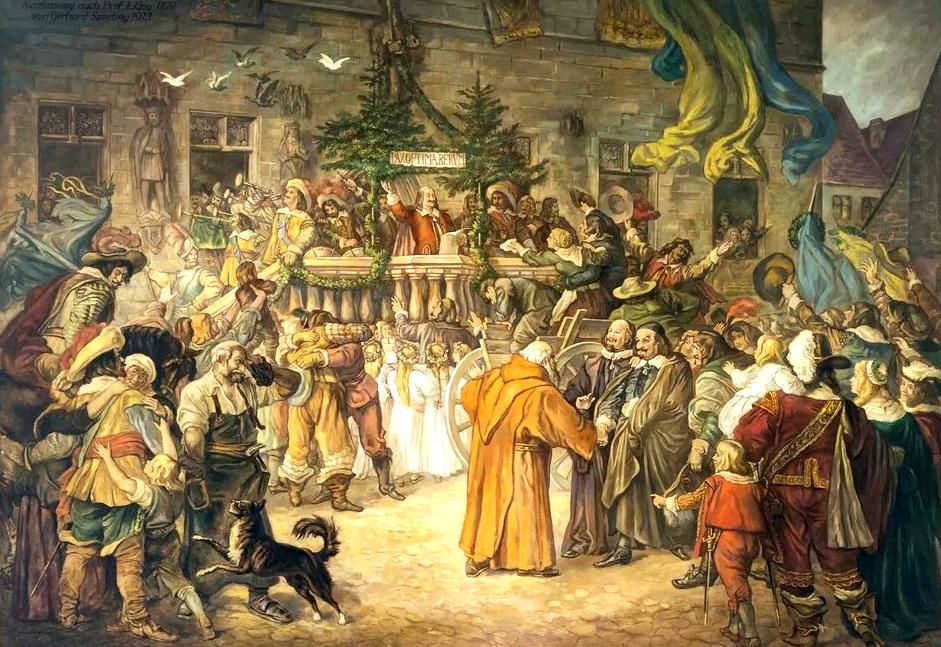
The Peace of Westphalia ended the Thirty Years War which ravaged much of Germany. The Treaty established the conerstone of modern diplomacy that states are soverign which continues to his day. Before Westphalia there were other contending structures, most notably that of international religious organizations such as the Catholic Church. Religious passions subsided in Europe after the signing of the Treaty of Utrecht. Waring factions did not abandon their commitment to their version of orthodoxy, but the motivation to force such orthodoxy on another state by force was larely abandoned. War was certainly not abandoned in Europe, but religion became an increasingly less important factor in the wars. This shift and the steady appearance of new Protestant denominations were undoubtedtly factors in the steady development of religious tolerartion within states, especially Protestant states. The Treaty established the still conorstone of modern diplomacy that states are soverign. Before Westphalia there were other contending structures, most notably the Holy Roman Empire and the Catholic Church. The Thirty Years War had profound implications for the nations of Europe. In many ways, the modern European state system emerged from the War. Much of the map of modern Europe as well as the religious make of Europe was largely determined by the Thirty Years War and the Peace of Westphalia that ended it.
The Peace of Westphalia ended the 30 Years War which ravaged much of Germany. The Thirty Years War was the most bloody and destructive war ever fought in Europe until the Napoleonic Wars of the early-19th century. It was not as the name suggests one single war lasting 30 years, but rather a series of related wars fought over that period. The War began in Germany (Holy Roman Empire) and gradually spread to much of the rest of Europe. It was actually a series of wars involving most European countries, but fought primarily in Germany. The war was exceedingly brutal, in part because of the religious passions of the Reformation. The struggle was between Catholic and Protestant princes aided by non-German coregilionalists. While initially a religious war, the fighting was complicated by dynastic rivalries and the desire of the Sweeds and French to curb the power of the German Holy Roman Empire dominated by the Hapsburgs. The War devestated Germany. It is believed that about 6 million civilians, mostly Germans, perished in the conflict. More Germans died in this War than in either World war I or II.
The Thirty Years War was the major War ended by the Treaty of Westphalia, but the Treaty also ended a war that had been simmering for even longer. The Eighty Years' War (1568–1648), also called the Dutch War of Independence or Revolt, was the ultimately successful struggle fought by the 17 Provinces of the Netherlands against the German and then Spanish Habsburg Empire. It finally ended with European recognition of the independent Dutch Republic--a novel idea in a continent dominated by kings and emperors. It recognized weakening dominance of Spain on the continent. It began as a religious conflict after Luther inadvertently launched the Protestant Reformation in Germany 1517) which soon spread to the Netherlands where the wealthy burgers were primed for new religious doctrine. The spread of Protestantism (especially Calvinism) in the Netherlands. This was an affront to his the fervent Catholicism of Spanish King Philip II and the Inquisition. The heavy tax burden imposed on the wealthy Dutch was another issue. Philip despite the flood of gold and silver flowing into Spain from the Americas, was in constant need of tax revenue to support his foreign wars--primarily waged to confront the spread of Protestantism. Unlike the Netherlands, Spain was not a highly productive country. And adventures like the Spanish Armada were ruinously expensive (1588). Philip was determined to centralize power and end the traditional local rights and degree of self-governing status achieved by the prosperous Dutch nobles and burgers to both eradicate Protectionism (and Protestants if necessary) and to get at their wealth.
The Treaty established the still conorstone of modern diplomacy that states are soverign which continues to this day. The Thirty Years War was one of the most destructive ever fought in Europe. It was also one of the most signifucant and the results helped shape Europe in ways that are still with us. The treaty ws not easily arrived at. Negotiations began in 1643, but the issues involved were difficult . Negotiations were conducted in two separate, but concurrent sessions at Münster and Osnabrück. The sessions resulted in two treaties which are collectively known as the Peace od Westphalia. The Treaties was finally signed 5 years later (1648). While signed by most of the combative powers, French and Swedish participation in the War had seriously weakened the control of the Hapsburgs on the Holy Roman Empire. Rather than coalese into a German nation state., the Empire became a loose confederation of sovering states and numerous small princely and religious principalities as well as free cities. It is at this time that France achieves control over Alsace which hd been part of the empire. France also gained control over several border forts. Swesen was awarded western Pomerania as well as the bishoprics of Bremen and Versun. The independence of the Nerherlands and Switzerland wre recognized. France and Spain continued fighting for more than a decade. These two countries finally ended the war with the Treaty of Pyrenees (1659). The Holy Roman Empire for much of the medieval era was the dominant power in Europe. The devestation of Germany and the weakening of the Empire left France as the dominant power in Europe.
The Treaty of Westphalia essentially settled the religious issue. The terrible religious wars that plagued Europe duruing the 16th and 17th centuries were finally ebded. The Cathloic Hapsburgs efforts to destroy Protestantism hadfailed. Sain no longrer had the power to contiunue the struggle. Westphalia confirmed the predominance of Catholicism in southern Germany and of Protestantism in northern Germany. It also confirmed the principle of the Peace of Augsburg (1555) that Catholic and Lutheran princes could determine the religion adopted in their territory. Princes could also choose Calvinism. This did not mean freedom of religion, but it was a step toward it. Before the Peace of Westphalia there were other contending structures, most notably that of international religious organizations such as the Catholic Church. Religious passions subsided in Europe after the signing of the Treaty of Utrecht. Waring factions did not abandon their commitment to their version of orthodoxy, but the motivation to force such orthodoxy on another state by force was larely abandoned. War was certainly not abandoned in Europe, but religion became an increasingly less important factor in the wars. This shift and the steady appearance of new Protestant denominations were undoubtedtly factors in the steady development of religious tolerartion within states, especially Protestant states. The religious issue had been a major factor in beginning the Thirty Years War.
Treaties were nothing new. There are records of treaties fating back to ancient times, preserved on clay tablets and monumental stone carvings. The Treaty or Peace of Westphalia was much more than just another treaty. The Treaty established the still basic cornerstone of modern diplomacy that states are sovereign. Before Westphalia there were other contending structures in Europe, most notably the Holy Roman Empire and the Catholic Church, but not nation states. Hugo Grotius described the basic principles for modern international law (1625). But that at the time was political theory. It was the Treaty of Westphalia that recognized the birth of the modern nation-state system (1648). There were actually two treaties signed at Munster and Osnabruck that ended both the Thirty Years War and and the Eighty Years War. And in doing so they recognized monumental changes in European state craft. First, the contracting powers recognized the sovereignty of individual nation states. Second, they established the principle that each state controls it's own domestic affairs. This set a template for all treaties and border negotiations that followed, This at the time was just in Europe, but over time the rest of the world followed suit. It is the system of international law that currently dominates in our modern world and divides the world into some 200 very different countries.
The Thirty Years War had profound implications for the nations of Europe. In many ways, the modern European state system emerged from the War. Much of the map of modern Europe as well as the religious make of Europe was determined by the Thirty Years War.
France: France was confirmed as the most powerful state in Europe, a situation that would endure until the Franco-Prussian War (1870-71) and the unification of Germany. France with Swedish help stopped the Hapsburgs, who also had an imortant Italian possesions, from dominating Europe. France received most of Alsace on the west bank of the Rhine. Increasingly the Rhine was taking shape as the geographic division between France and Germany. France also received (as a result of the Treaty of the) parts of Flanders and Artois in the Spanish Netherlands as well as lands in the Pyrenees.
Germany: Germany was potenially the dominant country in Europe, but because of divisions within the Empire the Germany did not emerge as a unified country. The Austrian Habsburgs had failed to achieve Ferdinand's twin goals: to strengthen his authority within the Empire and to destroy Protestantism . The Empire continued until the Napoleonic Wars, but it was essentially a historical fiction rather than a real German political entity. The Austrian Hapsburgs did, however, achieve some dynastic successes. Bohemia was now part of the Hapsburg patrimony and within Bohemia Protestantism was destroyed as well as the power of the old nobility. The Hapsburgs with Austria and Bohemia, geographically were placed to expand east in the Balkans, south in Italy, or to continue toinfluence the other German states in the Empire. The individual German states within the Empire maintained the right to make war and conclude alliances. The German states varied greatly in size andpower. The Germans would not unify until 1870. The Elector of Brandenburg emerged as te most important of the northern Protestant princes. Brandenburg which evolved into Prussia emerged as a northern Protestant counter to southern Catholics led by the Hapsburgs. Prussia received part of Pomerania a well a some secularized bishoprics. The War was a turning point in the rise of the Hohenzollern dynasty. Bavaria retained the upper Palatinate and the title of elector. The War was, however, the last major role that Bavaria was to play in German history. The Lower Palatinate was restored to Frederick's
son as wll as the title of elector--requiring the creation of an eighth electorate.
Switzerland: The independence of Switzerland was recognized from Austrian (Hapsburg) rule and its separation from the Empire.
The Netherlands: The independence of the Netherlands from Spain was confirmed. While the Dutch were now independent in the north. Spain retained its hold in the south which was called the Spanish Netherlands (modern Belgium).
Dutch independence would next be challenged by France and Louis XIV.
Sweden: Sweden obtained part of Pomerania and the bishoprics of Bremen and Verden.
The Treaty of Westphalia established the principal that nation holds exclusive control and legal authority over its own geographic territory. All states, regardless of physical size or military power, were to be treated as equals under international law. Outside nations and external authorities (like empires or religious bodies) are barred from interfering in another country's domestic politics or chosen religion. Religion of course was a major factor in the Thirty Years War. The Treaties were signed in the Westphalian towns of Osnabrück and Münster in 1648, ending an era where supreme authority in Europe belonged to the Pope or the Holy Roman Emperor. The Treaty formed the baseline framework for modern international bodies, including the founding principles of the United Nations Charter. Left unsaid was just what a nation was. And notably while nation states were forming at the time the Treaty was signed, as late as World War I, Europe was dominated by four Great empires (Austrian, German, Ottoman, and Russian (Tsarist). Nation states that formed before World War I (1914-18) were: England/Britain, France, Italy, the Netherlands, Portugal, Spain, and Sweden. Poland was an important state, but was dismembered (18th century). Europe was much more diverse than is the case today. What were referred to as nation states consisted of countries with substantial regional and cultural difference. This was especially true in England, Germany, Italy, and Spain. Ethnicity, geography, language, and religion were major factors in creating the various European states. The was somewhat less true as the nation state system spread around the world. African and Middle Eastern countries, for example, have borders based on lines drawn by European powers with no input from the people involved. Most of the early early nation states consisted of states with a single dominant ethnicity and loyalty to a monarchical sovereign. The British people, for example are subjects. The term citizen when it first appeared in Revolutionary France terrified Europe (1789). The Act of Union in Britain involved creating a whole new nationality primarily to ensure the Protestant Succession. 【Colley, pp. 24-25.】 This as done largely by emphasizing Protestantism and the dangers posed by Catholic powers--first Spain and than France. Over time the dominant ethnicity came to mold most countries, often around powerful capitals like London, and Paris. But the homoginization of Europe is a relatively new phenomenon. The Welsh still largely spoke Welsh until the Westminster Parliament introduce a national school system (1870). Gaelic was still spoken in the Highlands. Regional difference were still very important in Italy, especially the north/south divide. Northern Italians were much more patriotic than southern Italians. Spanish regional differences continue to this day with violent separatist movements. British Prime-minister Tony Blair reopened this Pandora's box when he introduced devolution (late-1990s). Ethnicity and Volk culture was especially important in Germany reaching xenophobia levels during the NAZI era (1933-45). Religion was also particularly important in building Dutch, Irish, and Polish nationalism. America was a while new phenomenon. As in England Protestantism was important, but unlike England there was no established church embedded in the legal system. And as a result of the huge immigrant flow after the Civil War (1861-65), religion and ethnicity became much more diverse. The Constitution became the core of American nationalism. Something that is sadly under attack today. Many Europeans did not quite what to think of the colossus arising across the Atlantic. The British saw America as a force to be reconned with by the mid-19th century, but had not decided if the United States was a threat or potential ally. The Germans decided that issue forcing battered Britain into American hands. Many Germans on the other hand were dismissive of America thinking the United States without a core ethnic identity was not a true nation. The resolution of the British/German assessment of America would determine the outcome of the 20h century. A new force arose in the 20th century--Communism. It would gain control of most of the Tsarist Empire, But the the failure of socialist economies and the nationalities issue that tore the other great empires apart would lead to the demise of the Soviet Union (1991).
Colley, Linda. Britons: Forging the Nation, 1707-1837 (Yale University Press: New Haven, 1992), 430p.
McNeil, William H. The Rise of the West: A History of the Human Community (University of Chicago Press: Chicago, 1991), 828p.

Navigate the Children in History Website:
[Return to Main peace treaty page]
[Return to Main specific conflict page]
[About Us]
[Introduction]
[Biographies]
[Chronology]
[Climatology]
[Clothing]
[Disease and Health]
[Economics]
[Freedom]
[Geography]
[History]
[Human Nature]
[Ideology]
[Law]
[Nationalism]
[Presidents]
[Religion]
[Royalty]
[Science]
[Social Class]
[Bibliographies]
[Contributions]
[FAQs]
[Glossaries]
[Images]
[Links]
[Registration]
[Tools]
[Children in History Home]