|
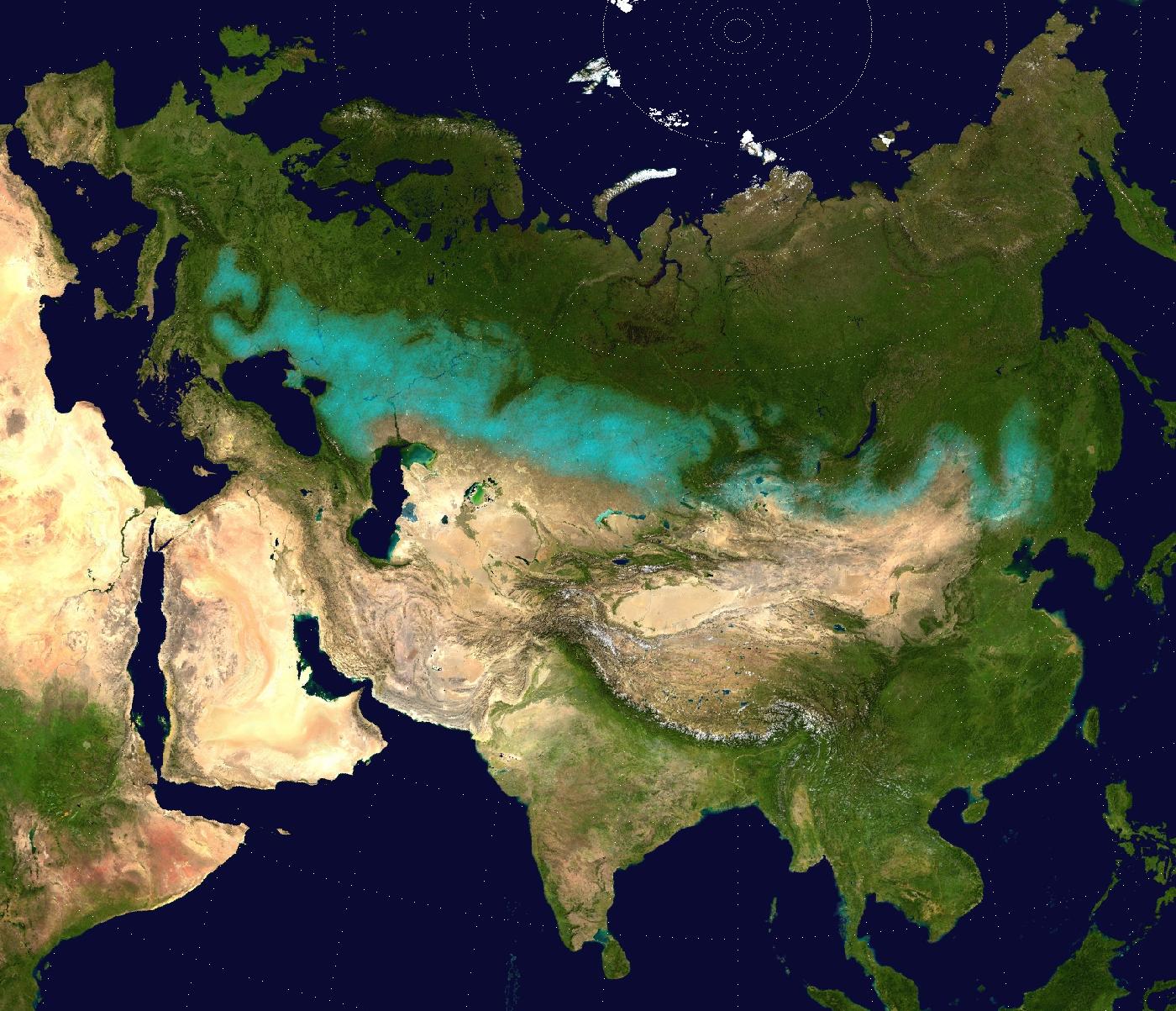
The Eurasian Steppe is a vast 5,000 mile (8.000 km) variously water level grassland belt. This strip of land is somewhat cut by the north-south running Ural Mountains separating Europe and Asia. It extends from Hungary in the West stretching through Ukraine, Russia, Kazakhstan, and Mongolia to Manchuria in the East creating the Steppe Crucible. Large areas of the Eurasian Steppe is flat, but not the whole area. We see rolling hills pierced in some areas by mountains. The most important mountainous interruption is the north/south axis of the Urals. This divides the Steppe into a western (European) and eastern (Asian) area. The western Steppe lies mainly in the Ukraine along with adjacent areas of Russia). The eastern Steppe lies chiefly in Kazakhstan, Mongolia and China (Manchuria). The western Steppe is wetter and warmer meaning potentially more productive than the eastern Steppe. .
The Eurasian Steppe likeoceans has served for millennia as both a major barrier and at times for trade and nomadic migration connecting Eastern and Western peoples.
To the north and south the Steppe horsemen were stopped by the frigid Arctic/tundra/taiga (boreal forest) barrier and to the south the Central Asian deserts (like the Gobi) and towering Himalayas. One author claims that the Steppe's 'pitiless' climate bred hard and cruel men. 【Kaplan】 We are not sure about that, but the Steppe did breed warring tribes. They struck out of the Steppe to the east and west, but primarily to the West and Southwest. The great river valleys are commonly seen as the most important geographical features as they gave rise to great civilizations. Here people concentrated because of the elevated great agricultural productivity. The Steppe was the virtual opposite. The Steppe could support grazing animals, but not large human populations.
The Steppe is an area of varying, but relatively low-precipitation, enough for hardy, regenerative grasses, but not enough for trees or agriculture without irrigation. (The European section is better watered. The European areas is similar in that regard to the American Midwest and the South American Llanos and Pampas. It is the Eurasian Steppe, however, that has had a huge impact on history, both European and Asian history. People migrating out of Africa first reached the European area of the Steppe. And here two technological achievements profoundly empowered the Steppe people: 1) domesticating the horse and 2) inventing the wheel made one of the Steppe people (the Yamnaya) the progenitors of half the world population--the Indo-European peoples. In modern times, China has been the linch-pin of history, affecting European history before the Europeans were even aware of China. When China was strong the steppe tribes struck west. During periods of weakness in China the Steppe tribes invaded the Middle Kingdom.
The Eurasian Steppe is a vast 5,000 mile (8.000 km) variously water level grassland belt. This strip of land is somewhat cut by the north-south running Ural Mountains separating Europe and Asia. It extends from Hungary in the West stretching through Ukraine, Russia, Kazakhstan, and Mongolia to Manchuria in the East creating the Steppe Crucible. To the north and south the Steppe horsemen were stopped by the frigid Arctic/tundra/taiga (boreal forest) barrier and to the south the Central Asian deserts (like the Gobi) and towering Himalayas.
Large areas of the Eurasian Steppe is flat, but not the whole area. We see rolling hills pierced in some areas by mountains. The most important mountainous interruption is the north/south axis of the Urals.
The Urals Mountain divides the Steppe into a western (European) and eastern (Asian) area. The western Steppe lies mainly in the Ukraine along with adjacent areas of Russia). The eastern Steppe lies chiefly in Kazakhstan, Mongolia and China (Manchuria). The western Steppe is wetter and warmer meaning potentially more productive than the eastern Steppe. .
The European or Pontic–Caspian Steppe is the vast plains and rolling countryside of southeastern Europe. It begins along the northern coast of the Black Sea (Euxeinos Pontos / Εὔξεινος Πόντος by the Greeks in antiquity). And extends as far east as the Caspian Sea. In modern trms this meaans from Moldova and western Ukraine across the southern to western Kazakhstan. It is the eastern part of the vast Eurasian Steppe. Geographers wwould describe as part of the Palearctic temperate grasslands, savannas, and shrublands ecoregion of the temperate grasslands, savannas, and shrublands biome. The term Ponto-Caspian region is commnly used biogeography to identify the flora and fauna the western Steppe. Modern genetic research has confirmd what historians and biolgists have long speculted that it was here that horses evolved .
Central Asia is primrily covered by steppe and deserts. They fill the area between the frigid northern forests and the fertile southern basins of China in the east and the Fertile Cresent (Mesopotamia) in the west which served as the great centers of early civilization. Siberia is located to the north of the Asiatic Sreppe and is asubstantial portion of northern Asia. It is an area of frigid winters anbd land covered primarily by softwood forest and in the extremne nort, Arctic tundra.
The Eurasian Steppe likeoceans has served for millennia as both a major barrier and at times for trade and nomadic migration connecting Eastern and Western peoples. One author claims that the Steppe's 'pitiless' climate bred hard and cruel men. 【Kaplan】 We are not sure about that, but the Steppe did breed warring tribes. They struck out of the Steppe to the east and west, but primarily to the West and Southwest. The great river valleys are commonly seen as the most important geographical features as they gave rise to great civilizations. Here people concentrated because of the elevated great agricultural productivity. The Steppe was the virtual opposite. The Steppe could support grazing animals, but not large human populations.
The Steppe is an area of varying, but relatively low-precipitation, enough for hardy, regenerative grasses, but not enough for trees or agriculture without irrigation. (The European section is better watered. The European areas is similar in that regard to the American Midwest and the South American Llanos and Pampas.
It is the Eurasian Steppe that has had a huge impact on history, both European and Asian history. People migrating out of Africa first reached the European area of the Steppe. And here two technological achievements profoundly empowered the Steppe people: 1) domesticating the horse and 2) inventing the wheel made one of the Steppe people (the Yamnaya) the progenitors of half the world population--the Indo-European peoples. In modern times, China has been the linch-pin of history, affecting European history before the Europeans were even aware of China. When China was strong the steppe tribes struck west. During periods of weakness in China the Steppe tribes invaded the Middle Kingdom.
Kaplan, Robert D. The Revenge of Geography: What the Map Tells Us About the Coming Conflicts and the Battle Against Fate (2012).

Navigate the Children in History Website :
[Return to the Main geographic features page]
[Return to the Main geography page]
[About Us]
[Introduction]
[Animals]
[Biographies]
[Chronology]
[Climatology]
[Clothing]
[Disease and Health]
[Economics]
[Ethnicity]
[Geography]
[History]
[Human Nature]
[Law]
[Nationalism]
[Presidents]
[Religion]
[Royalty]
[Science]
[Social Class]
[Bibliographies]
[Contributions]
[FAQs]
[Glossaries]
[Images]
[Links]
[Registration]
[Tools]
[Children in History Home]