|
Europe over more than two millenia of over devestating conflict has organized itself along ethnic and linguistic lines. This has not occurred in Africa. Most modern African states reflect the boundareies drawn by European colonial powers in the 19th century during the scramble for Africa. The Europeans commonly ignored tribal and linguistic afinities among African peoples. This mean that tribal groups were often fracrtured and separated by the European imposed boundaries. Thus modern African states commonly are composed of multiple tribal groups. And many tribal groups populate multiple countries. We have begun to collect information on some of these tribal groups. This is not a subject we know much about, but as with much of HBC, wecare interested in leaning more and encourage readers to add their insights.
The Afar people inhabit the Horn of Africa are and are concentrated in Ethiopia and areas of Eritrea, Djibouti, and Somalia. They are a nomadic people who eke out a living in a rocky, arid enviroment. They also inhabit the Awash Valley and the forests of northern Djibouti. The popuulation totals about 3 million people. They speak Afar.
Their lives are built around the livestock they heard, goats, camels, and sometimes cattle. Religion also plays an important part of their lives. Most Afars converted to Islam (10th century). There are also a few Christians. Afar clothing is an interesting blend of Arab and African influences. The women perhaps reflecting the prevalence of Islam traditionally wear head scarves, but go bare breasted.
Abayudaya meaning the "People of Judah", similar to the Jewish term Children of Israel, are a Ugandan group which practices Judaism. They belong to the Baganda tribe of eastern Uganda aroun the town of Mbale. Unlike Ethiopian Jews they are not genetically linked to the Hebrew people of Israel or the Diaspora.
The term Bedouin evolved from the Arabic term "badawi" meaning "desert-dweller". It is a term that has been generally applied first the Arabian nomadic pastoralists, but has come to be used to describe the nomadic peoples living in the desert belt extending from the Arabian Peninsula, Negev, and Sinai through the North African Sahara to the Atlantic Ocean. The Bedouin are divided into two main groups which is reflected in their Arabic dialects. There are eastern and western Bedouin, divided roughly along the Egyptian-Libyan border. The Bedouin are more of a people defined by life style than ethnicity. The Bedouin of Arabia are of Semetic origins. Other Bedouins have more varied origins. The Bedouin are known for a nomadic life style, but their movement is primarily seasonal, and based on the availability of water and grazing conditins. When there is some precipitation they may move deeper into the desert, but during more arid periods move back to areas where water is more available. Given the desert environment, the Bedouin are particularly known for herding camels, but also heard other livestock like sheep, goats and cattle. There are also known for their Handicraft work.
The Musli outburst allowed the Arabian Bedouins to move out of the Arabian Peninsula, brining Islam and the Arabic language with them. First they moved to Syria and Egypt (7th century). Gradually the Bedouin moved west, but primarily into North Africa rather than sub-Saharan Africa. The Bedouin population is declining. The nomadic life style was limited by modern national boundaries and the desire of people for a more affluent, sedentary life style.
The Dinka people live in the southern Sudan along both sides of the White Nile. The Dinka are one of the branches of the Nilotes. They are known for centuries as Dinka, but they actually call themselves Moinjaang, "People of the people." The Dinka are the largest ethnic group in southern Sudan. The Dinka groups retain the traditional pastoral life of the Nilotes, but have added agriculture in some areas, growing grains, peanuts, beans, corn (maize) and other crops. Women do most of the agriculture, but men clear forest for the gardening sites. There are because of the climate usually two plantings per year. Some are fishers. The boys tend goats and sheep while the men are responsible for the cattle. The cattle are central to the Dinka culture Before the coming of the British the Dinka did not live in villages, but travelled in family groups living in temporary homesteads with their cattle.
The Efé are one of the pygmy people of central Africa. There are Pygmy people in the tropical rain forests of Central Africa that inhabit an area stretching roughly from Cameroon east across the Congo into Zaire. The Pygmies are principally known for their small stature. Adults are only about 3-4 fett in height. The Pygmy peoples are earliest surviving inhabitants of the Congo Basin dominated by Zaire. DNA analysis suggests that the Pygmies are one of the oldest living human populations. Anthropologists believe that Pygmies have lived in the Ituri Forest for over four thousand years. The Pygmies there call themselves Mbuti. The Mbuti includes several tribes, including the Efe, the Aka, and the Bayaka. Pygmies tend to be are lighter skinned than their Negroid neighbors. We are not sure why this is the case. Pygmies are a gentle, peaceful people who have retreated into the less productive areas of the rain forest by the more dvanced Bantu people. They are forest dwellers existing on a hunter-gtger life style. Some may practice primitive agriculture, planting fields in the middle of the forest, but cobinuing to hunt and gather. The more isolated groups continue to lead aifestyle little changed over several millenia. The Efé live in the Democratic Republic of the Congo.
The origins of the Fula are a matter of conjecture. There are atraditions of Semetic origins. Others speculate that the Fula arose from the mixing of proto-Berbers of North Africa and the Bafur Saharan people. Several other theories exist. We do know of any DNA studies. The Fula or Fulani (also Fulbe) today are an important ethnic group of about 25 million people spread 20 countries throughout Western Africa into Central Africa as well as the northern Sudan. The Fula are most prominnt in Cameroon, Guinea, Mali, Niger, Nigeria, and Senegal, but are found in mumbers throughout West Africa as well as nothwestern Cental Africa and the northen Sudan.
The bulk of the Fula people live from Lake Chad east to the Atlantic Ovean. While a major West African group, the Fula are a minority in all of the different countries they ingabit. They are most prominsnt in Guina (about 40 percent). The Fulani have traditionally been nomadic pastoralist and trading people which is why they are so widely distributed throughout West Africa. They have traditionally hearded cattle, goats and sheep across the extensive dry interior of West and Central Africa south of the Sahara. They thus pursued a life different and separate from the more settled agricultural populations because their lives and social organization was determined by the needs of the animals they hearded. Their language is Fula which is classified within the Atlantic branch of the Niger-Congo language family.
We have some limited information on individual Ethiopian tribal groups. Many of the most destinctive tribes live in the Omo Valley. We have not yet found much information on the Ebore / Abore. We know that they are one of the Omo Valley tribes which practice body painting. The girls shave their heads until they are married.
The Hamar / Hammere are a small tribe found in southwestern Ethiopia. They have been described as one of the vanishing tribes of the Omo Valley. They live in Hamer Bena woreda (district). This is a well-wattered fertile part of the Omo River valley. This is part of the ebub Omo Zone of the Southern Nations, Nationalities, and Peoples Region. The Hamar are aeople still lrgely untouched by the modern world. They are for the most part pastoralists with a high value placed on livestock, especially cattle. A 1994 census reported a population of about 40,000 people. Very few members of the tribe have educations beyond the primary level. The language of the Hamer people is Hamer-Banna which is in the Afro-Asiatic language family. Hamer-Banna is an Omotic language and is primarly spoken in the Omo River Valley of Ethiopia by the Hamer tribe. Hamer boys traditionally wear mud body painting. An important Hamar tribal ritual is an initiation ceremony, the jumping of the bulls ceremony. One aspect of the ceremony is that the female relatives of the individual undergoing the bull-jumping test are whipped during the trial.
The Himba are nomadic pastoralists who live in the Kaokoland area of northwestern Namibia. The Himba are descendants of Herero herders and they still speek the Herero language. They fled into the less desirable remote northwest after an uprising was supressed by the Germans who colonized Namibia (Southest Africa). Many of the Herero perishedd uring the Herero War (1904). They were displaced by the more compliant Nama. The Himba managed to survive y survive in harsh savana, in almost desert-like conditions. The Himba herd sheep, goats, and some cattle. They move location several times each year as the livestock quickly deplete the porr grazing land. Their houses are cone-shaped dwelings built from the brush available and covered with mud and livestock dung. The Himba have clung to their traditions into the modern era. The Himba women are noted for their intricate hairstyles and traditional jewellery. The Himba are technolloficallt primitive, never mastering weaving. Traditionally men and woman wear few clothes apart from a loin cloth or goat skinned skirt, although now one sees some Western clothing. They use red ochre and fat to protect themselves from the sun. This gives their bodies a red color.
The Karamojong sometimes written as Karimojong are an ethnic groups comprising several different related tribes. They inhabit primarily northeast Uganda near the South Sudan and Kenya borders. They are centered in the southern part of Karamoja region, about 10 percent of the area of modern Uganda. They speak Karamojong which is one of the lanuages of the Nilo-Saharan language group. Anthropologists based largely on lingistics believe that the Karamojong as part of a sinle grouping migrated from Ethiopia (17th century). The reason for the migration is unknown, but may have been caused by drought. As they neared what is now Kenya, the migrants split, fragmenting into smaller groups. One branched settled im what is modern Kenya and developed into the Kalenjin group and Maasai tribal cluster. The other branch, the Ateker, migrated further west. The Ateker split into several additional groups, including the Turkana in western Kenya. Several tribal groups developed in Uganda, including the Iteso, Dodoth, Jie, Karamojong, and Kumam. The related Jiye and Toposa settled in what is now South Sudan. All of these tribes make up the Teso or Karamojong Cluster. They are traditional agro-pastoral herders who in outward appearance resemble the related and better known Maasai pastoralists. Like the Masai, have a cattle culture. They are constantly moving their herd around a difficult teraine searching for grazing land. They have in Uganda developed an usavary reputation as cattle raiders. The area of northeast Uganda where they live is an isolated area. Thy have had less contact with Westerners than most other Ugandan tribes. Many Karamojong still do not wear western-style clothes. They tend to wear traditional dress consisting of a blanket worn like a shawl, often choosing red and black. The women produce elaborate beadwork for decoration.
The Lozi/Balozi tribe also constitute over 5 percent of the Zambia’s population, some 0.6 million people. They live in western Zambia, a region known as Barotseland. Small numbers of the tribe is located across the borders in neigboring countries: Namibia (Caprivi Strip), Angola, Botswana, Mozambique (50,000), and Zimbabwe (8,000). The Lozi speak Silozi, a central Bantu language. Unlike the other major trines, the Lozi believe that Barotseland is where they have always lived. The Lozi in pre-colonial times were conquered by a Makololo/kololo army from the south (about 1830). The Lozi egained their independence in an uprisinh (1864). They traded in gold, copper, and food crops. The Lozi are the least developed of the major Zambian tribes. Their culture is centered on the flood cycle of the Zambezi River. They celebrate the Kuomboka festival (February or March). At this time they migrate from the Barotseland lowland flood plain of the Zamezi to higher grounds to avoid the floods. The Makololo people called the, the people of the plain from which their name Lozi was derived. The Lozi spelling originated from German missionaries. The Lozi has been governed by a monarchy. The reigning monarch is known as the Paramount King or Litunga--meaning 'keeper of the earth'. The most famous Litunga was who reigned from 1878 to 1916. He requested requested Queen Victoria to create a Barotseland protectorate. Britain showed little interest. The British South Africa Company tun by Cecil Rhodes acquired Barotseland making promisrs to invest and build infratructure. When gold, copper or other valuable material was not found, the British South Africa Company defaulted on its commitments. [Reader] Barotseland was eventualy incorporated into Northern Rhodesia, but retained substantial autonomy. This continued when Northern Rhodesia achieved independence as Zambia (1964). Lozi leaders wanted to remain a British protectorate. Barotseland today is the least deveoped of the Zambian regions.
One of the tribal groups of northernn Ghana and Togo are the Mamprusi/Mampruli. Although not a majority, they are the akrgest sungke ethnic group in the north. The Mamprusi kingdom is one of several related states founded by descendants of Na Gbewa -- a parially legendary figure (13th century). Na Gbewa had founded the Kingdom of Dagbon, in modern northern Ghana. The Kingdom of Dagbon is one of the oldest and most organised historic traditional kingdoms of Ghana. The sons and daughters of Na Gbewa are seen as founding other states, including the Mamprusi Kingdom. The Mamprusi Monarchy was founded by a great warrior named Tohazie the Red Hunter--red because of his fair complexion. The Marpusi fought other tribal grouos to protect their trade in slaves and other products, contracting mercinaries from the west -- modern Ivory Coast (18th century). Then in the19th century the Eutopeans began to expand theur control bryind the ciast--moving north. The Mamprusi are part of the Mole-Dagbani ethnic group, related to the Moshi, Nanumba, and Dagomba. The Mamprusi populatiin is about 450,000 people in Ghana and some 10,000 in neigboring Togo. The Mamprusi inhabit an area of northern Ghana between the White Volta and Nasia rivers. They view themselves as living a central palace and being more civilized than the surrounding universe of peoples surroundung them. Mamprusi lands are part of the climastic zone in the Guinea Savanna. This probably relects land better suited for agriculture than the surrounding area. The Mamprusi traditionally lived in circular compounds surrounded by their farmland. Marpusi settlements are clustered around the compound of the chief.
The Mangbetu are found in the northern Congo (Zaire) and Democrativ Republic ofthe Congo, along the border with the Central African Republic and Sudan. They speak Mangbetuti related to central Sudanic languages. Before the development of DNA techniques, linguistics was a principal tool of scholars studying pre-literate groups like African tribes and Native Anerican tribes. Thus it is believed that the Mangbetu began migrated from the central and southern Sudan south (Mid-18th century). During this migration they apparently encounteted Bantu peoples migrating north. They are believed to have reched the northern Congo (early-19tyh century). The area was inhabited by the Mbuti--pygmy people. They also absorbef migratory waves of eastern peoples. The modern Mangbetu are a mixed group produced from cultural interactions and inter-marriage with the Bantu and pygmy people they encountered as a result of their migration. Nabiembale briefly established a kingdom of some importance regionally. It was overcome by Islamic Sudanic slavers estanlished a level of control over the area. This is also known as the Swahili raids. This was during the Mhadist revolt in the Sudan. The slavers set up Islamic sultanates. They controlled the area until expelled by the Belgians. The Mangbetu are not a tribe in the normal sence as an ethnic group. The Mangbetu were a ruling aristocracy which dominated the area. Most of those ruled were not of Mangbetu ancestry. They are most notable for highly developed art and music as well as their characteristic scull elongation. This is called 'lipombo' and was a status symbol among the Mangbetu ruling classes.
We note a Moshukula chief photographed by a Protestant missionary in 1922. He was desribed as a 'forest chief'. The tribe is located in Zambia, but we know nothing about it at this time.
The Musgum or Mulwi are a relatively small ethnic group in west-central Africa (Cameroon, Chad and Nigeria). We note estimates of about 150,000 members They are primarily located in Cameroon with a smaller populatiom in Chad. The Musgum call themselves Mulwi. They are descendant of Sao people who were the first known population group around the Lake Chad. The Musgum are best known fot their distinctive earth and grass cone-shaped dwellings. The Musgum are Afro-Asiatic in origin, displaced the Paleo-Sudanese at the present territory along with other Neo-Sudanese groups. They were a warrior people. Conlicts developed whn the Fulani people tried to encrosch on their territory, attemting to compel the Musgum to adopt Islam. That war ended in the the victory of Musgum. Islamazation proceeded through other methods. Musgum people are also known for 'Laba' or Labana, which is a traditional warrior rite. Many young Musgum aspire to military careers.
Ethiopia's tribal groups are centered in different geographic regions and play a major role in the country's cultural and political life. The Omo Valley in southern Ethiopia is an especially interesting area of Ethiopia ethnicallyAbout 50 percent of Ethiopia's ethnic groups live there. One of the small tribes in the valley is the Mursi. The Mursi are one of the many small tribal groups in Ethiopia. Despite their small size, the Mursi are one of the most recognizable African tribes. The Mursi are noted for their their clay lip plates and primitive life style. The women deform the bottom lip with a wooden disk. The Mursi boy here was photographed in 1995. Mursi children and men until recently always went naked. Still now most children and men wear no clothing when they are in their villages. They do, however, commonly paint their bodies. The boy in the photograph here wears nothing but has destinctive body painting. In many primitive cultures these paintings were a substitute for clothing.
The San people of the southern African Kalahari are better known as the Bushmen. The Kalahari is a vast desert that extends over South Africa, Botswana and Namibia. The San are a hunter gattering people that eke out a living by hunting wild game and gathering roots and tubers. They are noted for their "click " language. The San may be the oldest culture in the world with a history dating back over a 1000,000 years. There is no written record, but San rock art can be seen throughout southern Africa.
There range has become more limited in the past two millenia as first the more advanced Bantu-speaking tribes pushed them from the more fertile areas into the Kalahari. White farmers more recently intensified this process. [Thomas]
The Sara (kameeni) have descended from the Sao people. They are the largest ethnic group in Chad and are also present in the Central African Republic and Congo Brazeville. The Sara were less touhed by French colonial policies than the more coastal tribes. They are mostly non-Muslim people. Some are Christians, perhaps 15 percent. Most adhere to traditional animist beliefs influenced by Egyptian religion. The Sara are concentrated in south-east of Chad, especially in the Moyen-Chari, Logone Oriental, Logone Occidental, and areas of the Tandjile regions. Tribes to the north tend to ne more Islamicized. The Sara are a Nilotic people, meaning their origins are in the Nile Valley, including the African Great Lakes region and southwestern Ethiopia. They are believed to have migrated west from the Nile Valley through what is now the Sudan to Chad at a relatively late period (16th century). The Sara seem to have been one of many traditional cultural systems that broke down over centuries of attacks from Arab slave raiders. Tribes in the Nile valley wee especially exposed to the drepedations of Arab slave traders. Floating their caotives down the Nile was much easier than trudgeing across the Sahara. While the tribe may not be recognized by its name, some of its cosmetic practices have meant that most people have noted the tribe. Women traditionally elongated their lips using lip plates. Many men used scarification. Some European explorrs anf missionaries claim that this was an effort to maske them less desirable to Arab slave traders (19th century). We can not yet confirm this. The Sara are largely small-scale farmers. The constutute main stay of the Chadian economy. The cultivate cotton, rice, peanuts, corn, millet, sorghum, and cassava. Southeastern Chad is the best watered and most productive region of Chad which extends northb into the arid Sahel and Sahara. France began colonized Chad (late-19th century). This brought both forced labor and military recruitment. One source suggests that the Sara were the largest group of Sub-Saharan Africans to serve with the French during World War II. The French during the colonial period tended to romanticized the Sara with theirv tall, physically powerful presence. They wre called La Belle Race" (The beautiful race).
The term Surma is variously used to describe the Suri tribe or a group of related tribes. The Suri are a small African tribe which inhabits an area in southwestern Ethiopian along the the Sudanese Border. They are one of several tribes in the fertile Omo Valley. They number an estimated 20,000 people. The Suri are sometimes called the Surma. They are sedentary pastoral people who breed cattle. The economy and cultured is centred on cattle. One author suggests that the Suri take beauty 'seriously'. This is often expressed through body painting by both genders. The Suri speak a language from the Surmic language family. This suggests that they are related to the Mursi and Meen peoples. Sutmic is part of the Nilo-Saharan language phylum. Before the discovery of DNA, language was one of the principal tools used by anthropolgists to ascertain the relationships between tribes. Language is often, but not alwats related to ethnicity. The Suri, Mursi, and Meen are sometimes collectively referred to as the Surma. The collective numbers about 80,000 people. Stick fightingbis a popular activity for the boys.
Another destinctive tribe is the Tuareg of the southern Sahara, a people who for milenia dominated the Saharan cammel caravans. The Tuaregs are a nomadic Berber people. They inhabit the Saharan regions of North Africa (Niger, Mali, Libya, Algeria and Burkina Faso). Tuareg is an Arabic contemptuous term meaning "abandoned by God". They call themselves "Imohag" i.e. "free men". The Tuareg dominated the trans-Saharan camel caravans which were the main stay of regional commerce until the 20th century. They became Muslims, but preserved many pre-Islamic traditions and do not strictly follow many Islamic rituals. The Tuareg for years resisted European domination. Among the Tuareg the women have a great freedom and participate in family and tribal decisions. Descent and inheritance are both through the maternal line. We have only limited information on clothing at this time. The men cover the face (today only in some circumstance), the women never and the young children commonly go naked.
The Toposa are one of the people of the South Sudan. They suffered during the Second Sudanrese Civil War (1983-2005) for independence and the Arab-dominated Sudan Government's brutal effort to supress the African people of the south. The Toposa role was complicated. The Toposa supported the Sudan People's Liberation Army (SPLA), but at timesassisted the the Sudanese Government. With independence some of the lingering bitternes with the Civil war as well as cattle raids on neigbors continue to be a problem. The Toposa numbers over 0.7 million people, although exact numbers do not exist. The Toposa object to census taking or even counging heads of cattle. They live in the Greater Kapoeta area located on the east bank Eastern Equatoria state. The most important urban centers are Kapoeta, Riwoto, Narus, Kauto, Naita, Mogos, Lamurnyang and Karukomuge. The terraine is rugged with hills and ridges separated low-lying plains and streams which appear during the rainy season. The area is arid with little vegetation other than shrubs and short grasses. It has been affected by Saharn desertification. Their envirnoment hs poeefully shaped the Toposa and their life style. They are a hearding people whose economy is based on cattle, camels, donkeys, goats and sheep. They have koilled elephants for the ivory trade. We are not sure to what extent they have stopped. There is a tradition of raids on the herds of neighboring tribes. They have a tradition of constant low-level warfare, usually cattle raids, against their neighbors.There are mineral resources, but they are not developed. The Toposa do pan for gold in stream beds. The Toposa are part of a larger tribal group known as the Ateker cluster, which in the immediate area of the Sudan include the Toposa, Nyangatom and Jiye. Other related people include the Turkana (Kenya) and the Jie, Dodoth and Karamojong (Uganda). Toposa legend relate how they came from the Losolia Mountains in Uganda but were forced to move by a terrible drought which killed many. Traditional Toposa culture is eroding ad modern ways become increasingly important and experience shared with tribal grouos throughout frica, but more ffecting the traditional tribes like the Toposa..
Toposa boys are organised as age-sets. Their fathers teach them how to herd their livestock. They begin with the smaller animalks (goats and sheep), but gradually learn to care for the more valuable animals and eventually the cattle. They then can travel substantial distances with the livestock looking for pasture and water. The girls on the other hand stay at home and learn house keeping skills fom their mothers.
The Xhosa people are some of the inhabitants of southern Africa at the time Europeans began settling the Cape (16th century).
The Xhosa are Bantu speakers. Xhosa is today the second most common South African home language, after Zulu to which Xhosa is actually strongly related. Xhosa-speaking peoples conceas a nation. They are divided into several tribes with related but distinct histories and tradituions. The Xhosa people once inhabited the southern and central-southern parts of what is now South Africa. The Xhosa people inhabited an area well north of the Cape in an area betweem Bushman's River and the Kei River. They wwere what might be called stock farmers, meaning they kept heards of lifestock and farmed. Eventually the Europeans began moving into this area. The first Europeans were the Trek Boers who began moving into the area from the West. The two groups both kept livestock and thus competed for grazing land. Quarrels eventually became more serious and led to actual wars (19th century). The colonial authorities sought to avoid conflict by the only practical method--keeping white and black settlements separate. And the Fish River was chosen as the border. As the colony developed, however, the white population expanded and with the acquisition of modern arms
developed a far superior military capability. White settlers thus began to increasingly annex land and subjegate the Xhosa and other blacks. White settlers evenntually had control of the land once occpied by the Xhosa (mid-19th century). The African Union which formed the modern state of South Africa was founded (1910). It united the British Cape Colony and the formerly indeperndent Bohr Republics. It was a democratic state for whites, but the Xhosa and other African people were denied the right to vote. During the subsequent Aparheid era, native people were made to move into 'homelands' where they were allowed to purchase land. For the Xhosa these were Ciskei and Transkei.
The Yoruba (Ioruba or Joruba) are primarily a tribe in modern Nigeria. The dominate southwestern and north-central Nigeria and neigboring southern and central Benin. The area is collctively nknown as Yorubaland. The population is estimated at some 40 million people in total. The Yoruba constitute over 20 percent of the Nogrerian population. This majes them kne of the lsrger African tribal groups. They speak the Yoruba language, which is the largest language in the Niger-Congo language group. They are bordered by several different tribal people. They brder on the area of the vlosely related Itsekiri people in the southeast in the northwest Niger delta.
They share a common ancestry with the Yoruba but chose for some reason to maintain a distinct cultural identity. There are small Yoruba populations in Ghana, Ivory Coast, Liberia, and Sierra Leone.
The Yoruba develop in what is now Yourubaland from the Mesolithic Volta-Niger population (1st millennium BC). . Oral history suggests that Oyo Empire was based on the Yoruba which developed from the older kingdom of Ile-Ife. The Yoruba were established as the dominant cultural griup in southern Nigeria (11th century).
The Yoruba are among the most urbanized tribal people in Africa. This predates the colonial era by centuries. The British report tht they found the Yoruba living in well structured urban centers as part of a system of city states (Ìlú). These were organized around the residence of the Oba. Archeologists report that ancient cities were fortresses, with high walls and gates. This suggests a high level of warfare. Yoruba cities are believed to be among the largest in pre-clonial Africa. The Òyó-Ilé or Katunga, capital of the Yoruba Empire of Oyo had a population of some 100,000 (11th-19th century). This is believed to be the largest urban settlement in Africa at the time. Ibadan was one of the major Yoruba cities and for a long time was the largest city in all of Sub Saharan Africa. Modern Lagos (Èkó) was another important Yoruba city and with a population of more than 20 million is today the largest African city. The Yoruba diaspora consists of two main groups. One is related to the African slave trade which severely impacted the Yoruba. And led to Yoruba communities throughout the Caribbean abnd Brazil. There was also emigration to America and Britain (1960s-80s). The Yoruba are seen as a religious people. They are primarily Christian, but do not view the various religions as sparare s do most Chritian and Muslim adherents. Yoruba in Caribbean slavery played an important role in the development of Voodo which in Nigeria and Benin has more of a status as a legitimate religion than in the Carubbean outside of Haiti.
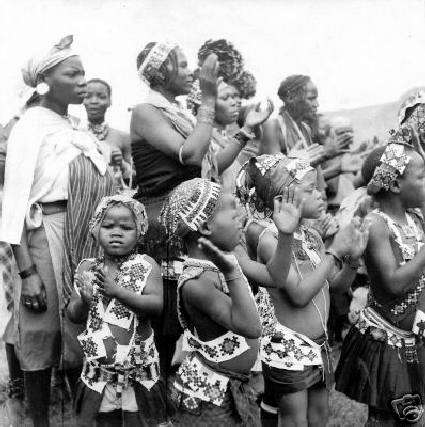
Perhaps the best known African tribal groups is the Zulus in South Africa. The Zulu now live in the KwaZuluNatal province of South Africa. Zulu legend trace their origins to the patriarch Zulu, the son of a Nguni chief in the Congo basin of central Africa. The Zulu people began to migrate south towards Natal where they eventually settled (16th centuty). The Zulu were not a people with a string central organization, but rather many relared clans. This was aboutvthe same time that the Dutch arrived in South Africa. The most admired figure in Zulu history is King (1816-28). Shaka was a gifted political and military leader.
He united the various clans into a single centralized tribe which as they were no longer fighting each other, emerged as the most powerful tribal group in sothern Africa. He developed effective battle tactics and innovative formations. He demanded undending loyalty and discipline from his soldiers, including celibacy. Violations of his discipline could mean death. Not only were the Zulu clans united, but other conquered tribes were incorporated into the Zulus. The Zulus has 1,500 soldiers when Shaka became king and at the time of his death there were 50,000 soldiers. The Zulu came to dominate much of the eastern coastal regions and interior of South Africa. The Zulu were first confronted by the Dutch Afrikaners. Later they had to face the British. The Zulu War was the most serious challenge the British faced from an African tribal group (1879). The war rnded the Zulu's existence as an independent kingdom. Chief Bambatha led the final Zulu uprising against the British (1906). The Zulu like other South African tribes were subjected to an increasingly harsh series of racist laws under South Africa's Apartheid system.
Thomas, Elizabeth Marshall. The Harmless People. This is the ground-nreajing study of the San people. Thomas has updated the book with The Old Way: A Story of the First People (Picador, 2007).

Navigate the Boys' Historical Clothing Web Site:
[About Us]
[Introduction]
[Activities]
[Biographies]
[Chronology]
[Cloth and textiles]
[Clothing styles]
[Countries]
[Topics]
[Bibliographies]
[Contributions]
[FAQs]
[Glossaries]
[Images]
[Links]
[Registration]
[Tools]
[Boys' Clothing Home]
Navigate the Boys' Historical Clothing national pages:
[Return to the Main African page]
[Algeria]
[Burkina Faso]
[Democratic Republic of the Congo]
[Egypt]
[Ethiopia]
[Gabon]
[Ivory Coast]
[Kenya]
[Liberia]
[Lessotho]
[Madagascar]
[Mali]
[Nigeria]
[Rwanda]
[Somalia]
[South Africa]
[South Sudan]
[Sudan]
[Uganda]