**
World War II Europen Theater -- liberation of the Ukraine
World War II: The Ukraine
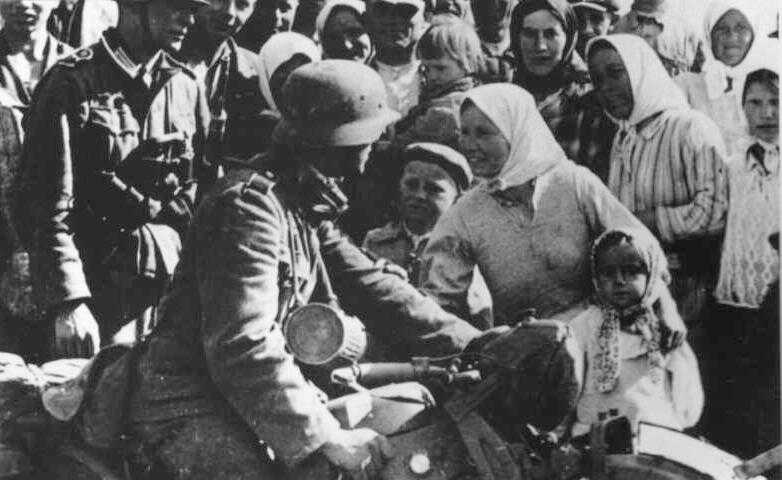
Figure 1.--Ukranians had suffered greviously under Soviet rule, escpecially the Great Famine engineered by Stalin. Thus many Ukranians, especially in the Western Ukraine greeted the Germans like liberators. Here Ukranian peasants cheerfully greet the advancing Wehrmacht. It soon became clear that the Germans were no liberators and NAZI contempt for the Slavs was soon demonstrated in terrible attrocities. In a short period the NAZIs turned potential allies into committed foes.
Most of the Ukraine at the time of World War II was part of the Soviet Union. There was an important nationalist movement in the Ukraine and thus there needs to be some separate consideration of the Ukraine outside of our discussion of the Soviet Union. The Ukraine became one of the major prizes in the conflict between Hitler and Stalin. The famine engineered by Stalin in the Ukraine was part of his attack on Ukraian nationlism. When Hitler spoke of Lebensraum in the East, one of the principal areas he coveted was the vast agricultural lands of the Ukraine. And it was in the Ukraine that the miitary contest between the Red Army and the Wehrmacht was finally resolved. Some of the most important battles of the War were fought in the Ukraine and the death and destruction occurred in almost unimaginable levels. Hitler's focus on the Ukraine resulted in two fateful decesions which in the end doomed the assault on the Soviet Union. First he failed to utilize the Ukranian nationalist movement and anti-Soviet feeling. Two he diverted major forces from the drive on Moscow into the Ukraine at a critical point of the campaign. The intensity of the fighting and the scoarched earth polices waged by the Soviets and NAZIs left the Ukraine devestated. The Ukraine was one of the countries most heavily damaged by the War.
World War I (1914-18)
Much of World war I on the Eastern Front was fought in the north in Poland and Western Russia between the Germans and Russians. Fighting also took place along a central front in the Western Ukraine on the Russian-Austro-Hungarian border. Here the Russians had more success. Fighting in the south was limited because Romania was not initially involved in the War. Relatively little fighting actually took place in the Ukraine except the western border lands. Many Ukranians drafted into the Russian Army died in the fighting. Other Ukranians were drafted to fight in the Austro-Hungarian Empire. The War and the Russian Revolution destroyed The Russian Empire which had dominated most of the Ukraine. The Treaty of Brest-Litovsk between The Bolshevik Goverment and the German Empire (March 1918) separated the Ukraine from Russia. This would have resulted in the creation of a German client state in the Ukraine. The Ukranians attempted to declare independence. The German defeat in the West (November 1918) invalidated the Treaty and significantly changed the balance of power.
The abdication of the Tsar and subequent Civil War led to distructive fighting between Reds and Whites (1918-22). Foreign governments intervened to assist the whites. The Red Army fought to retain the old Rusian imperial borders, but lost Finland, the Baltic Republics and large areas of White Russia to Poland. The Red Army fnally succeed. The old Imperial Army was shatered by the Germans. Many soldiers mutinied and killed their officers. People's Commisar for War Leon Trotsky organized a new Red Army, recruiting massive numbers of peasants and workers. The Red Army without trained officers performed poorly in the early phases of the fighting. Leon Trotsky played a msajor role in fashioning the Red SArmy into an effective fighting force. The Bolshevicks attached political officers to all Red Army units to keep warch over the officers (many who had been in the old Imperial Army) and explain Communism to the largely illiterate peasant recruits. The Bolshevicks were especially concerned with the younger generation, untained by the Tsarist past and capitalism. The War and the Civil War affected agricultual production. Food shortsages were widespread. Large numbers of children orphaned in the fighting were particuilsrly at risk. As in Europe, American food again played a role in saving millions of children.
Ukranian Indepependence
There no strong, unified nationalist movement. Various Ukranian groups attempted to declare independence (1917-18). The various efforts included the Tsentral'na Rada, the Hetmanate, the Directorate, the Ukrainian People's Republic and the West Ukrainian National Republic. These efforts divided Ukranian groups and defeat in the Polish-Ukrainian War weakened the Ukranian forces. Pilsudski and Petliura failed in their Kiev Operation. The Red Army victory left the central and eastern part of the Ukraine in Soviet hands which was organized as the Ukrainian Soviet Socialist Republic.
The Poles had moved quickly in the east, engaging the Bolshevicks in Lithuanian and Beylorusia. They captured a primary objective--Vilna (April 19, 1919). The League's answer was the Curzon Line (December 8, 1919). This would have left most etnic Poles with in the boundaries of the new Republic. It did not, however, satisfy the Poles. They wanted the pre-partition boundaries even though the population beyond the Curzon Line was mixed with many non-Poles, including many Ukraines, Beyelorusians, and Lithuanians. The Poles demanded that the Bolshevicks negotiate a new border well east of the Curzon Line (March 1920). Negotiatins got nowhere. Poland declared war (April 25). The Poles with French assistance moved east, even taking Kiev in the Ukraine (May 8). The Bolshevicks launched a counter offensive (June) and drove the Poles back almost to Warsaw. At that point the Franco-Polish Army struck backmand defeated the bolshevicks in several sharp engagements. The two sides reached a cease fire (October 12, 1920). A factor here was the Civil War in Russia and the Bolshevicks need to end the war with Poland so thaey could focus in the White armies. The Treaty of Riga confirmed Polish possession of large areas in the east beyond the Curzon Line (March 18, 1921). The western part of the Ukraine and Beylorussia were in Polish hands.
One of the greatest crimes of the Stalinist era was horific famine in the Ukraine. The famine area included both the Ukraine and the Soviet northern Caucasus, as well as Russian areas in the lower Volga River basin. Famines are historically primarily the results of natural events such as drought, heat, diseases, insect infestations, and other natural causes. The Ukrsanian famine was primarily caused by Stalin's program of collectiving Soviet agriulture, especially the forced collectivization of the Ukraine. The Ukraine had been the bread basket of Russia. It was the prize sought by the Germans in two world wars. The rich, well watered soil made the Ukraine the most productive agrivcultural area of the Soviet Union. Two issues merged which resulted in dissaster for the Ukranian people. Not only did the Ukranian peasantry resist collectivization, but there was a strong Ukranian national spirit, especially in the western Ukraine. Stalin was determined to both bring agicultural under central control, but to crush Ukrainian nationalism at the same time. Stalin not only used the famine to crush the spirit of the Ukranisn peole, but he also purged the Ukrainian intelligentsia. Stalin even purged the Ukrainian Communist party. At the cost of millions of lives, many of them children, the famine succeedded in breaking any organized redsistance on the part of the peasantry to collectivization. Stalin's purges also succeeded in smashing the Ukranian national movement. Stalin's actions in the Ukraine were not without costs beyond the deaths of Ukranians. Agricultural production plummeted. Soviet agricultural became one of the most inefficent agricultural operations in the world. Stalin bought Ukranian agricultural under his control through collectivization, he also signicantly reduced the output of Soviet agriculture.
The Carpatho-Ukraine was part of the Austro-Hungarian Empire. It was variously known as Ruthenia, Podkarpatska Rus, Carpatho-Rus, and Transcarpathia. A largely Hugrian aristocracy ruled the area on a almost fedual basis. Ukranian agriculturl workers eked out a living essentially as serfs. There was little access to education. After World War I the area became the eastern-most province of Czechoslovakia. It was, however, primarily populated by ethnic Ukrainians. The Czech Government created Podkarpatska Rus as a province (1928). After Munich the privince became autonomous (October 11, 1938). The NAZIs seized the remanent of Czechoslovakia left after Munich (March 15, 1939). President Augustin Voloshyn declared Carpatho-Ukraine independent on the same day. It became the "Republic for a Day".
Hitler to help cement the relationship with Hungary approved the Hungrian take over of the provice. The Hungarians the next day invaded and seized the Carpatho-Ukraine as well as the cities of Uzhhorod and Mukachevo. was quickly invaded by a powerful Hungarian Army which decimated the small under-equipped army defending Carpatho-Ukraine.
Hitler and Stalin Launch World War II (September 1939)
Hitler and Stalin stunned the world with the NAZI-Soviet Non-Aggression Pact (August 23). It was a blue-print for agression which launched World War II. Hitler struck first, invading Poland (September 1). The more cautious Stalin struck 2 weeks later (September 17). Fior both dictatiors, it was just the beggining of the aggressions they planned between them.
The NAZI invasion of Poland launched World War I (Septeber 1, 1939). The German utilized their Blitzkrieg tactics for the first time in Poland and the Polisg Army despite heroic resistnce was severely battered. Any hope of effective resistance was ended when the Soviets invaded from the East. The NAZIs instituted brutal occuption policies to supress any vestiage of Polish nationalism. Occupied Poland was divided into different areas. The Western zones were annexed to the Reich and a process of deporting Jews and Poles begun. One of the NAZI administrated areas was the Government General, named after the German World War I occupation zone. Pre-war Poland was not an ethnically uniform state, especially eastern Poland. There were large numbers of Ukranians and other ethnic groups in Eastern Poland. Most of these fell into the Soviet occupation zone, but there were about 0.5 million Ukranians in NAZI occupied Poland, most located in the Government General.
The NAZI invasion of Poland was made possible by the the NAZI-Soviet Non-Aggression Pact (August 1939). Stalin ordered the Red Army under the terms of secret protocols of the Non-Agression Pact invaded Poland from the East (Septeber 17). This ended any possibility of effective Polish resistance. The Soviets seized western Volhynia and most of Galicia. They were annexed into the Soviet Ukrainian SSR. The Soviets replacement of Polish administration meant that the Ukrainian language was used in both state administration and education. While this was warmly received by the Ukranian population in the areas of Eastern Poland annexed to the Ukranian SSR. The Soviets of course did more than change language policies. The Soviets suppressed all existing political and community institutions outside of Communist Party control. This involved the Sovietization of institutional life and the and the arrest of nom-Communist political and community figures. Executions and deportations followed. Large numbers of Poles as well as Jews were deported East.
Soviet Partition of Romania (June 1940)
Stalin after the fll of France moved agains the Baltic Republics and Romania. Stalin demanded the Romanins ceed the former Tsarist provinces of northern Bukovina amd Moldavia. The move shocked Hitler, in part because it brouh the Soviets closer to the Romanian oil fields at Ploesti which were vital to the NAZI war effort. The Red Army quickly occupied the Romanian provinces which were also annexed into the Soviet Ukrainian SSR. As in Poland, Romanian was replaced by the Ukrainian language in state administration and education. The the Sovietization of institutional life proceeded. There were arrests of non-Communist political and community figures and deportations East. leaders and community activists.
Organization of Ukrainian Nationalists (OUN)
The NAZIs as part of their effort to supress Polish nationalism permitted a degree of Ukranian linguistic and cultural activity. No political activity was tolerated, except for the except for the Organization of Ukrainian Nationalists (OUN).
The OUN ws not a tightly united group, but rather compones of elements with very different vissions of the Ukraine's future. The ONU had been suppressed by Polish and more importantly Soviet authorities. Andry Melnyk headed the organization from abroad. His predecessor Konovalets had been assassinated by a Soviet agent (1938). Another factin was led by Stepan Bandera with more experience in running an underground organization. The ONU held a congress in NAZI-occupied Krak�w (February 1940). The delegates failed to bridge their differences and a permanent split resulted--OUN-M and OUN-B.
German Ukraniam Military Units (May 1941)
The Germans set up Nachtigall and Roland military units with Ukrainians (May 1941).
The NAZI's launched Operation Barbarossa, a titanic effort to destroy the Soviet Union (June 22, 1941). After the partition of Poland with the NAZIs, Stalin had moved the Red Army out of fixed positions forward to occupy the Eastern Poland. The Wehrmacht fell upon these forward elements with great effectiveness and rapodly moved East. In the south German and Romanian forces moved into the Soviet Ukraine. The speed of the initial German advance was staggering. Stalin after an initial confusion organized the resistance to the Germans. His military decessions contributed to the German success. He also instituted a scoarched earth policy to deny the NAZIs useful industriasl and agricultural facilities. The security forces before abandoning a city would shoot political prisoners they were holding. Mass graves are still being found in the Ukraine. ["Executions"] The Soviets gave priority to ship iductrial machiery east, but where possible people and llivestock were also evacuated. Crops and others resources that could not be moved were destroyed. Other actions such as destroying bridges amd plants and flooding mines were also carried out. An estimated 4 million people were moved east beyond the Urals. The speed of the German advance meant that larger scale population evacuations were not possible. While Hitler's generals asrguing for a focus on the drive on Moscow, Hitler could not resst a diversion south where Army Group South was encountering unexpectedly stiff resistance. (Knowing that Hitler was especially interested in the Ukraine, Stalin had deployed substantial Red Army forces in the south.) The result was the battle of Kiev, one of the greates German successes of the War. The Germans took over 0.6 million Red Army prisioners. That victory came, however, at a high price. The diversion of south of Army Group Center meant that the drive toward Moscow had stalled. This bought Stalin precessious time. He ordered Marshal Zukov to Moscow to plan fo the capital's defese. Hitler's decession to divert Army Group Central south from the drive on Moscow is one of the critical decessions of the War nd was motivated by his avarice for the agricultural and mineral resources of the Ukraine.
By the onset of Winter with Whermacht moving toward Moscow, most of the Uktaine was in NAZI hands (November 1941). Only the Crimea im the extreme south continued to resist the Germans.
Independent Ukranian State (June 1941)
The Germans reach Lviv in the western Ukraine. Yaroslav Stetsko and OUN(B) immediately proclaim an independent Ukranian state (June 30). They did noy obtain authorization from NAZI authorities. The Germans moved against the Bandera-Stetsko Ukrainian government dispersed and arrested by the Germans (July 9). The German juggernaught capture one important Ukranian city after another: Berdichev (July 15), Bila Tserkva (July 18), Nova Ukraina (July 25), and Kirovohrad (July 30). Einsatzgruppen C and D begin killing Jews and would later turn on other Ukrainians. The Germans began arresting Ukrainians associated with the Stetsko government (July 12). They incarcerate Bandera, Stetsko and others at the Sachsenhausen Concentration Camp, one of the most feared in Germany.
The Germans began mass executions of non-Jewish Ukrainians. Ukrainian guerillas led by T. Borovets-Bulba begin the fight with the Red Army and later become nucleus of UPA. The Germans beggan executing OUN Ukrainian nationalists. Ukrainian guerillas began fighting the Wehrmacht (September). With the arrival of the Germans, Ivan Rohach begins publishing the Ukrainian nationalist newspaper, Ukrainske Slovo September 11). The Germans move against the newspaper, arresting the staff (December 12). The Germans execute the entire staff at Babyn Yar.
After the NAZI invasion (June 1941), the Soviets evacuated large number of individuals east out of harms way, estimates rin up to 3.5 million people. Those evacuated included government and Party officials, scientists, skilled workers, and other educated individuals. As the NAZI armies made more progress in the northern and central sectors of the front, there was more time in the south (meaning the Ukraine) for the evacuations to take place. The reason there was less progress in the south is that a subsantial portion of Soviet armor had been deployed in the south. It is unclear just how many Jews were evacuated, but estimates suggest about half to two-thirds of Ukranian Jews were able to reach safety to the east. [Reitlinger p. 251.] Behind the combat forces which swept east were the NAZI Einsatzgruppen C and D. YThese were especially trained units of 500 to 1,000 men who were mobile killing squads with orders to kill Jews. As soon as a city was secured, the Einsatzgruppen began rounding up and killing Jews. Major actions were conducted at Lutsk, Zhitomir and Berdichev. The Romanian Army which participated in the invasion also participated in the killing of Jews. The killoing continued throughout the summer of 1941. They suceeded in killing about 0.6 million Ukraniamn Jews. SS Standartfuehrer Paul Blobel was particularly diligent in carrying out his orders. He commanded Sonderkommando 4A, Einsatzgruppe C. And he participated in the the huge killing operation at Kiev. The killing was conducted at Babyn Yar (Babi Yar) (September 29-30, 1941). Blobel's unit reported killing killed 33,771 Jews in only 2 days. That was about half of the 70,000 Jews killed at Babi Yar. Blobel was tried after the War at Nuremberg and hanged in Landsberg Prison (June 8, 1951).
Encirclement of Kiev (September 1941)
Kiev was the largest city in the Ukraine. The population before the Gerrman invasion was 0.9 million. Stalin vefore the German invasion had positioned a substantial part of the Red Army armor in the south (Ukraine), in part because he thought the resource-rich Ukraine was amajor German target. As a result, Army Group Center had penetrated deeper in the Soviet Union than Army Group South. Hitler decided to hault the drive on Moscow and ordered importamt elements of Army Group Center tobdrive soith and in cooperation with Army Hroup South to trap the Red Army forces defending Kiev. The Germans enter Kiev (Swptamber 19). Soviet forces including five Armies surrender (September 26). The German operation nets 665,000 Red Army troops. This is the largest force in the history of warfare to ever surrender in a single battle. The Germans also take 886 tanks and 3,718 artillery pieces. The German occupation pf Kiev lasts 778 days. The city's population was reduced to less than 0.2 million. Military historians differ as to the importance of the German victory. Some claim that the redirection of Army Group Center south in effect saved Moscow. By the time the drive to Moscow was resumed, the weather began to change and the Soviets had strengthened the forced defending Moscow. It is, however, difficult to credit the Wehrmacht with a great victory. It is difficult not to see the great encirclement of Kiev in which 0.7 million Soviet soldiers surrendered as a great victory that seriously weakened the Red Army.
The Ukranians were Slavs and thus in NAZI eyes not only an inferior people, but a threat to Germany and the Aryan people. NAZI plans were to conduct a Holocaust of Slavs, but unlike the Jews, a portion of the Slavic population was to be allowed to live as slave labor. Hitler until the fall of France had been a calculating politican. He seized power in Germany even though the BAZIs were a minority power by keeping the opposition divided. The same was true in his seizure of much of Europe, he managed to keep the opposition divided. This enabled him to seize Czechoslovakia and then through the Non-Aggression Pact bought off Stalin while he defated first Poland and then France, leaving him the master of Western Europe. Even after these victories, NAZI Germany was still not an overwealmingly powerful state. A combination of the Soviet Union, Britain, and America had far greater industrial, scientific, and human resources. A victory in the East would change that calculation. Any logical assessment of a war with the Soviet Union would point to using the same divide and conquer policies Hiltler had used in the past. The obvious step was to ally themselves with the Ukranians where because of the Famine and other suppresive Sovirt policies, there was a great deal of anti-Soviet feeling. And the NAZIs had in fact showed some willingness in Poland to cooperate with the OUN agaist the Poles. Because of the anti-Soviet feeling, many Ukranians in the opening phase of Barbarossa greeted the Germans as liberators. This was especially true in Galacia where the Poles before the War had supressed the Ukranians. Ukranians there were not anxious to join the Soviet Union, the wisdome there had been confirmed by brutal Soviet occupation policies (1939-41). This the Germans were seen as enemies of both the Poles and Soviets when they entered Galacia providing the posibility of a liberated Ukraine state. The NAZIs could have achieved a public relations coup and obtained large numbers of military recruits by giving lip service to Ukranian nationalist aspirations. The Germans entered Lviv, a largely Ukranian city (June 30). With them was the OUN-B which they had allowed to operate in the Government General (occupied Poland). The OUN-B upon entering Lviv proclaimed a new Ukrainian state. Hitler was outraged by this action which he had not approved. The OUN-B leaders were arrested and sent to concentration camps. Subsequentlky the NAZIS also arrested Bandera and subsquently Melnyk as well. Both were vocal anti-Soviet spokesmen with a following in the Ukraine. Not only did Hiltler decide not go even give lip-service to Ukranian nationalist aspirations, he perpetuated the division of the Ukrnian people (August 1941). The NAZIs returned Galicia to occupied Poland. Bukovina was returned to Romania as a reward for that country's military participation in Barbarossa. The Romanians also received other Ukranian populated territory. The Romanians received the land between the Dniester and Southern Buh rivers which was renamed Transnistria, with a capital in the former Soviet city of Odessa. The rest of the NAZI occupied Ukraine became the Reichskommissariat Ukraine. Decessions like this were not made by committess and experts leaving written records. They were decessions made arbitrarely by Hitler himself. Thus we do not know just why he decided not to take advantage of anti-Soviet Ukranian nationalism. Hitler's < href="/bio/h/hitler/bh-ww2.html">conduct of the War, especially behavior and change of tactics is one of the largely unanswered questions of World War II. We know that Hitler did not like enjoy the political dealing (he was so good at) and aspired to be a great war commander (which he was not competent at). We can only assume that he decided that the Soviet Union was already defeated and the Ukranians were not needed. Arming the Ukranians wuld have created a frce that would have to later be disarmed. Thus Hitler decided to avoid this complication.
NAZI Occupation Policies
The NAZI anti-Semetic policies in the occupied East are the best known aspect of NAZI rule in the occupied East. This was the most draconian asoect of the NAZI racial policies the NAZIs implemented, but it was only one aspect of the overall program. After their victory at Kiev the NAZIs murderd about 70,000 Jews at Babi-Yar alone. In all the NAZIs murdered about 0.6 million Jews in the Ukraine (1941-44). Hitler appointed Erich Koch as Reichskommissariat who proved to be a barberous as NAZI administrators in Poland. Overall NAZI plans called for large-scale killing of Ukranians as well as deportations and servitude for those not killed. There were actions against the Ukranians although not on the industrial scale of the Jewish Holocaust. (We will never know for sure what would hae happened to the Ukranians had the NAZIs won the War but almost certainly there would have been horendous actions.) The Ukranians hoped that the unpopular collective farms would be broken up and the land returned to the peasants. Koch did not do this, seeing as Stalin did that the collectives were useful in exerting political control. Much of the industry of the Ukraine was evacuated or destroyed by retreating Red Army troops. Koch made no effort to reactivate Ukranian industrial plants which actually might have proved useful to support the NAZI war effort. The NAZIs saw the Ukraine as important for grain and mineral resources. Koch proceeded to loot the Ukraine. Food stuffs were diverted from Ukranian cities to the Reich, creating severe food shortahes in the Ukraine itself. The Ukraine was also used a source of slave labor for the NAZXI war effort. Some were recruite, others were forcibly seized. An estimated 2.5 million workers were transported to Germany. The NAZIs as in Poland supressed any kind of nationalist expression or organization. The one exception was the Ukrainian Orthodox church which had been supressed by Stalin. The situation was somewhat different in Galacia which was outside Koch's control.
Here there was degree of cultural and civic activity allowed as well as relief orgamization.
Ukranian Resistance
There wasc considerable anti-Soviet feeling in the western Ukraine. Many Ukranian nationalists thought that the NAZIs would liberate their country from Stalin and Soviet control. Ukranian nationalists especially the OUN had conceived of a policy of cooperating wih the NAZIs to achieve an independent Ukraine. There was as a result a pro-NAZI Fascist orientation of some OUN members. They at first accompanied the Wehrmacht units that drove into the Ukraine in the opening days of Barbarossa. The NAZI racist attitudes toward all Slavs soon made apparent as to what they intended to do in the Ukraine. NAZI policies were incredibly brutal in the occupied East. Rather than supporting the NAZIs, most Ukranians joined the resistance to them. The NAZI suppression of the nationalist movement forced the Ukranians to organize clandestine operations. The ONu thus began to develop an underground organization among the locl population. The importance of Fasist elements began to decline, but not disappear. The anti-Soviet feeling was strongest in the Western Ukraine. Thus underground Communist Party cells were able to effectively organize in the central and eastern Ukraine. (This political division still continues today.) The Soviets were able to organize an effective partisan movement with increasing military success the northern Ukranian forests. Estimates suggest that 7 million Ukranians civilians died during the War. Many Ukranians were killed in atrocities and forced labor under brutal conditions. The NAZIs killed executed whole villages in reprisal for resistance attacks. German reverses before Moscow (December 1941) severely affected the Wehrmacht. There were enormous losses of men and material. This left the Wehrmacht severely strained on the Eastern Front. The Ukranians at the beginning of 1942 began to form their own partisan units to resist both the Soviets and NAZIs. The first units were formed at Volhynia. Units were also formed in Galicia. The units became the Ukrainian Insurgent Army (UPA). Initially as the Ukraine was occupied by the NAZIs, operations were focused on the Germans, but they also fought the Soviet partisans as well as other UPA units, revealing the fuundamental differences within the Ukranian nationalist movement. When the Red Army drove the NAZIs out of the Ukraine, nationalists attempted to fight the Soviets in guerilla bands, but were eventually defeated. The Soviets did not completly destroy the nationalist forces until years after the War.
Joining the Red Army
Many Ukrainians appaled by Stalinist repression at first welcomed the Germans. Ukrainians joined the resistance to fight the NAZIs as well as the Soviets. Many Ukranians loyally joined the Soviets resistance to the NAZIs. About a quarter of the 11 million Soviet troops who were killed in the War were ethnic Ukranians. The disaproprtinate number probably reflects the fact that the Ukraine was occupied by the NAZIs and large numbers of Ukranians were killed or taken prisioner in the first year of the War. In addition, some of the Ukraine was a battleground in 1942-43 while the norther frongt was relatively quiet.
Some Ukranians joined the Whermacht. Hitler was oppoed to this. Some units accepted Ukranian volunteers quietly without forming spcialized units. These were mostly voluteers in the field and not recruited POWs. We do not at this time have information on just how many Ukranians joined the Whermacht and iother German formations. The recruited POWS were commonly used to form units. We do not know of German Ukranian units at this time comparable to the Russian Liberation Army. Trawniki was a German concentration camp where anti-Soviet men, many from the Ukraine, were trained as Hiwis (Helpers) for the Whermacht. We do know of Ukranian police units formed by the SS to aid in the Holocaust and partisan sepression operations. SS and police officials inducted, processed, and trained some 2,500 auxiliary police usually used as guards (Wachm�nner). They were also known as Trawniki men. The camp was thus an important cog in the German camp system and the Holocaust killing process. The Wikipedia page on this subject calls these people 'Collaborationists'. We think that with the possible exception of the Trawniki men, Wikipedia simplifies the situation by using the Collaborationist term. The Ukrainians were in the unfortunate position of other Eastern Europeans, caught between two brutal totalitarian powers. I think it is unfair to put them into the same categiry as the Western Europeans who collaborated with the Germans. The Ukrainians experienced more than a decade a Stalin's brutal rule and repression under the NKVD. Stalin's engineered Ukrainian famine was one of the great crimes of the 20th century. It is true that Hitler had even a worse fate for the Ukrainians planned as part of Generalplan Ost, but the Ukranians who joined the Whermacht did not know that. And do not forget, Stalin himself joined with the NAZIs in the Non-Aggression Pact (August 1939). This Wiki page significantly over simplifies the choices available to the Ukrainians and the decisions that they made. Many of the Ukranians who signed up to fight with the Germans did so in 1941 before the German attitude and policies toward the Slavs, including the Ukranians was clear. Some authors suggst that the killing of Jews also affected Ukranian thinking, positing that the Ukranians asked themselves, "If the Germans kill the Jews today, what will prevent them from killing us tomorrow?" It was a sound question and in fact, Generalplan Ost was a plan to do precisely that.
The NAZI 1942 Summer offensive was powerful, but much more limited than Barborossa. The losses before Moscow in Winter 1941-42 has severely reduced the Wehrmacht's capability. The NAZIs could no longer strike along the entire Eastern front. Stalin and Zukov assumed that the Germans would renew the drive on Moscow and concentrated their forces in the north. Hitler was, however, still fixed on the resources of the Ukraine and struck in the south. The territory surrendered to the Soviets during the Winter was regained and a poorly planned Red Army offensive resulted in dissaster, opening the way to the eastern Ukraine. The Crimea finally fell. The powerful 6th Army thus began a drive on Stalingrad. Again Hitler learning nothing from 1941 split his forces diverting major elements to a campign into the Caucasses. The result was the catestrophic NAZI defeat at Stalingrad.
The final German offensive in the East occurred at Kursk in the central Ukraine. The Germans after Stalingrad fell back, but began amassing their forces for a third summer offensive of the Russian campaign. The offensive this time was even more limited than in 1942. The target was a buldge in the Soviet line, the Kursk salient. The effort was code named Citidel. The fighting on the huge Eastern Front involved vast armies in some of the most savage fighting ever recorded and Kursk may well have been the most vicious fighting of the War. Hitler delayed the offensive until the Wehrmacht could be equipped with the new Panzer Mark IV tanks. The Mark IV could take on the Soviet T-34, but it was a mich more complicated tanl. Not only could it not be produced in the numbers of T-34s, but it required much more intensive maintenance than the T-34. The Offensive was overseen by von Manstein. Guderian objected to the plan for the battle approved by Hitler. It was to be a set piece battle. Guderian argued that the battle plan deprived the Panzers from the mobility which was their greatest advantage. The Soviet defense was planned by Zukov.
NAZI Withdrawl
Germany's Panzer forces were decimated at Kursk, including the improved Panzer types. The revived Red Army launched its own offensive. The NAZIs were forced to withdraw from the Ukraine. This meant another round of destruction. The retreating German armies proceeded to conduct their own scoarched earth campaign, destroying what the Soviets had failed to destoy in 1941.
Guerilla Fighting
As the Red Army moved into the western Ukraine, guerilla clashes intensified. Here the civilian population was often the target. Bloody clashes occurred in ethnically mixed areas, especially between Poles and Ukranians. Surviving Jews were also targeted. Attroicities were reported in Volhynia. This was an ethically Ukranian area of pre-War Poland. Dubno in Volhynia was where 12,000 Jews were murdered, although accounts vary as to who was responsible. The UPA was intent on driving Poles out of Volhynia. Some reports suggest the UPA murdered as many as 80,000 Poles, mostly in 1943. [Snyder]
The iberation of the Ukraine began with the Voronizh-Kharkiv offensive (January � March 1943). The Germans managed to reseiz Kharkov. And then fighting slowed as the two sides prepared for a huge battle over te Kursk salient.
Following the monumental Red army victory at Kursk (July) the Soviets organized followp offensves. General Vatutin and Geeral Konev led the Soviet offensives. , The Steppe front troops liberated Kharkov (August 23). The cental step in liberating the Ukraine was to cross the great Dnieper wjich flows through the country. This was necessaey to liberate Kiev.
The Germans tried to build strong defence line using the Dnieper. Here the Red Army had an ally. He refused to allow importnt formtions to retreat to strong defensive positions. Rather units were ordered to stand and fight and when they finally fell back were unable to estblish a strong line. The Red Army assulted the weakened German forces grouping along the
Dnieper (September-October 1943). A major offensive was fought ovr the Donbas (August � September 1943). This was followed by the Chernihiv-Poltava offensive (September). The Red Army entered Kiev (November 1943). The Korsun-Shevchenko offensive was fought (January- February 1944). The Soviets reached parts of Galacia (Spring 1944).
The success of Bereznegovato-Cnigiryev operation in the south opened the way to Odessa whivh has so heoically resisted te Germans and Romanians at the onset of Brbarossa (March 1944). The 3rd Ukranian front under the command of General Rodion Yakovlevich Malinovsky forced a crossing of the Southern Bug and began the drive tward Nikolayev and Odessa. The Red Army etered Odessa (April 1944). Finally timed with Bagration in the north, the Lviv-Sandomyr offendive drove the Germans out of some of the last areas they occupied in the Ukraine (July - August 1944). The last Ukrainan populated aea librated was the Carpathian region which had been part of Czechoslovakia before the War. This offensive was conducted (September - October 1944). Red Army troops entered Uzhhorod (October 28).
War Losses
Some of the most important battles of World War II were fought in the Ukraine, in part a reflection of Hitler's desire to seize the area. As a result, the Ukraine was one of the areas most seveely damged bu the War. The losses suffered there are incalcuable. As many as 5-7 million people are believed to have been killed. An estimated 10 million Ukranians were left homeless. The Soviets reported that 700 cities and towns and 28,000 villages were destroyed. A mere 20 percent of the industrial plants and 15 percent the agricultural equipment necessary to plant and harvest had been destoyed or damaged. The transportation network was devestated.
Post-War Settlement
The boundaries of Eastern Europe were redrawn in the post-World War II peace settlement. As the Red Army had played a decisive role in the defeat of NAZI Germany and controlled the area east of the Elbe River in Germany, Stalin was in a strong position to determine the new boundaries. The result, the Ukranian people were largely unified under Soviet control. The Ukranian SSR was expanded west. Poland ceded Volhynia and Galicia to the Soviets which was compensated with German territory in the west. There was a population exchange of ethnic Poles and Ukranians between the Soviet Union and Poland.
The Red Army also occupied Northern Bukovina (1944). Its incorporastion into the Soviet Union (Ukranian SSR) was recognized in the Paris Peace Treaty of 1947. The Soviets seized Transcarpathia from Hungary and theoretically transferred to Czecholovakia (1944). Under the terms of a Czech-Soviet government agreement ot was ceded to the Soviet Union (Ikranian SSR) (1945). The Soviets also demanded a separate United Nations seat or the Ukraine (1945).
Personal Experiences
One Ukrakian provudes this account of the NKVD after the Germans launched Barbarossa. "Wars bring grief, unbearable pain and even death. But for me, World War II brought a gift of life.
In January 1940, I was arrested by the Soviet NKVD (later known as the KGB) in my native Ukraine and incarcerated in the Brygitki prison with about 10,000 others like me. I will not go into details of the physical and mental agonies each of us endured during endless nocturnal "hearings." The ones who survived the torture were brought back, unconscious, on stretchers and literally thrown into the cell. Fresh prisoners arrived, bringing with them the news of the German occupation of France. They hinted that Germany might attack the Soviet Union. It was dawn on Sunday, June 22, 1941, when we heard the first bombs falling on Lviv. Somebody whispered, "War." The walls shook with each explosion, and we were giddy with the anticipation of freedom. Oh, how premature was the joy we felt. That same day, in the afternoon, the NKVD started herding the prisoners into groups and taking them down to the cellars below.
We listened with horror to dull popping sounds. It was hard to believe that a state would dare to liquidate thousands of defenseless political detainees, but it was true. The death machine was working day and night. On Friday evening, I observed bodies falling into a huge pit after being shot, one by one. By Saturday, there were only 12 of us in the cell. We heard the boom of cannon fire, and we started praying that the Germans would occupy the city soon.
That day, the NKVD fled. Men from the Ukrainian underground broke down the prison gates. Of the 10,000 prisoners, about 500 to 600 came out alive. I was one of the lucky ones. Unfortunately, the Gestapo was no better than the NKVD. The Jewish population was liquidated, and the Ukrainian political activists were publicly hanged or shot dead in the middle of town. I thank God I lived to see it end. I am 88 years old and happy to be in the United States." This a rare account of an NKVD killing action. Survivors are very rare. [Kazaniwsky]
Sources
Kazaniwsky, Bohdan. "Amid death, gratitude for life," The Washington Post (May 28, 2004), p. W11.
Snyder, Timothy. The Reconstruction Nations: Poland, Ukraine, Lithuania, Belarus 1569-1999.
"Executions," New York Times (December 4, 2001). A short New York Times item read,
"Officials have found evidence that Soviet forces summarily executed 513 people whose bodies were dumped in a mass grave in July 1941 near Lviv, now western Ukraine. Municipal archives yielded information on the mass grave in the registry of the Yanivske cemetery. Authorities have not yet made a decision on whether to carry out exhumations."