|
Japanese school uniforms vary depending on age, type of school, and gender. They basically wear uniform garments adopted from western countries, although in some cases styles that are well over 100 years old. Many public elementary schools do not wear uniforms, but just their ordinary clothes. Most other school children do wear uniforms. Some of the garments are quite similar to schoolwear in Western countries. Japan is a very traditional country and some schools have distinctive uniform items, esoecailly caps, or styles that were formerly worn by European school children. Details on some of the principal garments worn by Japanese school children are available here.
Headwear
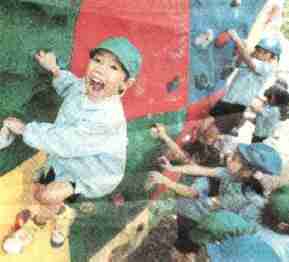
Most Japanese kindergartens and primary (elemntary) schools require caps or hats, even those schools that otherwise have no uniform requirement. Many are quite colorful to help motorists spot the younger children. The most common style is a rounded, short brimmed hat, sometimes with short streamers, although other styles from peaked caps to Zouave caps to full-brimmed hats are also seen. The most popular non-uniform cap for primary schools are baseball caps. Although the baseball cap is now seen worldwide, baseball is actually a popular sport in Japan. A military-style hat formed part of the Prussian cadet-style uniform once ubiquitously worn by secondary school boys, but even schools that retain this uniform rarely require this hat anymore. I'm less sure about the headwear of girls wearing sailior dress uniforms.
It can get quite cold in Japan, although this depends as to where one lives in the country. The coldest weather of course occurs in the northern island of Hokido. As a result some schools have uniform coats. Our information on school coats is limited at this time. Not all schools with uniforms have uniform coats. The state schools in particular may have a unifirm, but allow the children to wear non-uniform coats in cold weather. Some may have a geneeral color rule. The private schools are much more likely to have a winter coat as part of the uniform. Here an over-coat style is quite common. The most cmmon color is blue.
Here we have only limited information. Pinafors were not very common at Japanese schools, but we do notice them. We see colored pinafores being worn at some Japanese schools. So far we have only noticed them being worn by kindergarten children for lunch or activities like art.
|
Some pre-schools and kindergardens require the children to wear smocks. They are usually light-colored back buttoning smocks. I do not know of any primary schools which require smocks and primary-age children rarely wear smocks in Japan. We notice more schools adopting smocks in the 2010s. Not a large number, but a few elementary (Primary schools) and we see children wearing them during classes and not just for science lab work. We even see some children wearing them during recess. We see the children at Seika Elemnentary wearing smocks for science work. Rge chikdren at Toin Gakuen wear similar light-blue smocks more generally.
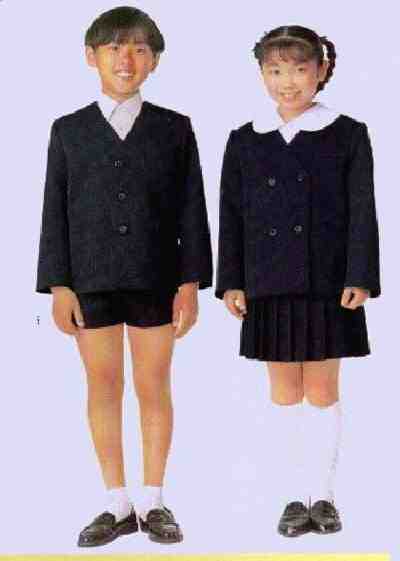
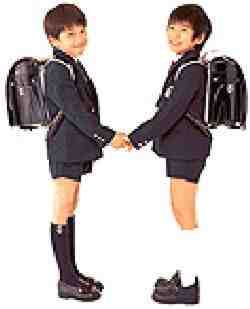
Boys at some Japanese schools wear suits as school uniforms. Solid colored blue and grey suits are common, but patterned suits are also worn at some schools. Solid colors are generally worn at private schools, but some public schools have patterened suits.
Blazers are worn at both elementary and secondary schools, althogh the style varies greatly from school to dchool. Some elementary schools require jackets although they are most common at private
schools. The most popular style among the uniformed primary schools are Eton-styled blazers without lapels. School badges on the blazers are not common as in England. Some elementary schools use them only for dress up occasions or for winter wear. Blazers are now becoming more common at secondary schools. Many secondary schools are now replacing the old army and sailor uniforms, which are perceived as old fashioned, with blazers, white shirts, and ties--giving a rather British look. Japan is, however, a very tradionally oriented society and the old military styles continue to be widely worn. We have also noticed jackets that are very simply styled and button at the collar, giving a rather military look. These jackets are mostly worn at private schools. Japanese school jackets are almost always blue. Although some schools have an optional light-gray summer jacket.
Japanese children mostly wore traditional clothing before World War I. Their teachers were ordered to wear Western clothing as a moderizing influence. This was aklso a gial for the children, but many Japanese parents coulod not aford to buy Western clothing at the time or have any special desire or taste for the new styles. Even before the War we begin to see some children in the cities wsearing Western cloyhing to school. Gradualy after the War we begin to see more more children wearing Western dress. By the 1930s almost all vhildren were wearing Western cloyhes and increasingly common for the primary boys as part of the militarization effort were wearing basic army uniforms. The secondary school boys wore cadet uniforms. This was a uniform determined decades earlier in the 19th century.
Gakuran is the term for the boys' cadet style school uniform. The 'gaku' comes from the word for the students who wore the clothing--'gakusei' The 'ran' in 'gakuran' is an abbreviation of the Edo period slang word for western clothing, 'randa'. It actually meant Dutch because while Westerners were prohibited from entered Japan, the Dutch were allowed a trading post. As a result, the Japanese workd for the Dutch became a generalized term for Westerners. 'Randa' came to mean western clothing. The cap worn with gakuran looks to be a Prussian style cadet cap. The jackrt with the high collar is basically a naval officer's uniform. We have not found a definitive statement of how this style became a the standard uniform at Japanese secindary schools. As besr=t we can piecectogether, after the Meiji Restoration, a high priority was given to creating a moodern edication system. Aling with this, porimoting Western dress was seen as a modernizing measure. The Japanese began with building a promary system. Much of the population could notb afford to buy sprcial clothes who for the first time were attemding schools. The teachers who were virtually all male were, however, ordered to wear Western suits and hats. While most of the iniitial effort went into building a primary system, yhe Jaoanese also began building a secondary system and founding universities. Here the students for the most part were from the upper and middle classes and the families could afford school uniforms, but a t fiurst was givernmenbt issue, The first appearance of this styke as a uniform was noted (1873). It was used in the Ministry of Works’ engineer school dormitories. It was then adopted at The school uniform for the students in the engineer dormitories were government issue. It was subsequentky adoopted at Tokyo Imperial University (1886). It was mainly based on the army uniform, but was was also influenced by the navy uniform in its use of hooks rather than buttons and the navy blue/balack color. Secondary schools as thgey ooened adopted this style. A few elementary schools adopted also adioted the style, moistly private schools. This style is primarily worn at secondary and middle schools. The secondary system was very small in the 19th century, but began to be expanded after Japan had created a primnary system that for virtually all the country's primary age chikdren. Despite the demilitarization of Japan, this uniform continued to be worn even after Japan's defeat in World War II (1941-45). The uniform is now being replaced in some secondary schools, but continues to be widely worn.
Japan when after the Menji Resoration in the late 19th century began building a modern school system along European lines. One aspect not coomon in European schools, however, were school uniforms. The Japanese decided, however, that school children should wear school uniforms, especially in secondary schools. This was at a time when many children still wore traditional clothes. The Government chose Prussian cadet uniforms for boys and English sailor suits for girls. This coresponded to the models used for the new modern Imperial Japanese Army and Navy. Although education for girls was not nearly as important when the country's modern education system was founded, there were some schools for girls and these schools selected the sailor dress as the appropriate uniform. Gender differebces in education declined in Japan after World War II. The sailor suit is still widely used as a girls' uniform at many Japanese secondary schools. There are a variety of stylistic variants to the sailor suits worn. Thecsailor suit is also used at a few primary schools. This seems more common at private than public schools. A few primary schools have adopted it as a uniform for both boys ad girls, but this is not very common. Boys and girls wore the same sailor blouse, but the girls wore skirts and the boys pants.
Blazers are worn at both elementary and secondary schools, althogh it varies greatly from school to dchool. Some elementary school although they are most common at private schools. Some elementary schools use them only for dress up occasions or for winter wear. Blazers are now becoming more common at secondary schools. Many secondary schools are now replacing the old army and sailor uniforms, which are perceived as old fashion, with blazers, white shirts, and ties--giving a rather British look. Japan is, however, a very tradionally oriented society and the old military styles continue to be widely worn.
|
Sweaters do not appear to be as common at Japanese schools as at European and American school.
We do not have much information on uniform shirts. Uniform schools generally require white shirts, with the exception of the schools still using military style jackets where the shirts do not show. The vast majority of the shirts we have noted are white. Most appear to be collared white dress shirts. We have noted both long and short sleeve shirts. Rhese shirts are almost always worn without ties. We note catalogs usually show the collars buttoned. We are not sure to what extent the schools actually required this. Primary children might wear informal-sport style polo shirts. We are unsure just how common such shirts were. Some may have been used for gym. Middle and secondary schools often have uniforms such as Cadet jackets annd middy blouses which do not require shirts. Some schools have changed to modern styles like blazers in which shirts are required. The shirts in these cases are white dress shirts with collars.
Japanese boys do not normally wear neckties at primary schools. We know of one primary school, however, where ties are worn. The boys are from a private school. It is an all boy's school connected to a university with Anglican/English affiliations; the primary uniform is clearly inspired by British boys school uniforms. The unifom also features peaked cap, gray shortpants suit,
white shirt, navy knee socks, red tie, black shoes, regulation navy overcoat. Some of the boys wear overcoats. Neckties are not required in the summer at this school. A number of secondary schools do, however, require neckties. This is a realtively recent
phenomenon. Most Japanese boys used to wear high-colared Pussian military unifrms at secondary schools. Japanese secondary schools are now gradually shiting to uniforms with British-style blazers and ties. Uniformed secondary schools that no longer have the old Prussian cadet uniform typically require some form of (long pants) suit or jacket and slacks
with tie. Some schools dispense with the tie requirement in the summer; others continue to require it (typically worn with short sleeved white shirt).
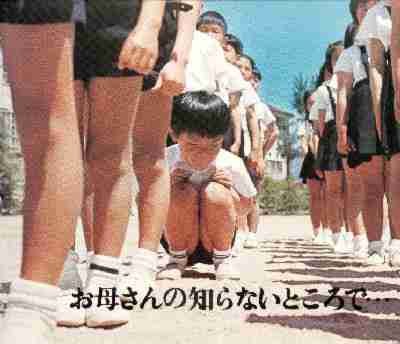
There has traditionally been a major divide between primary and secondary schools with boys wearing short pants in primary schools and long trousers in secondary schools. I am not sure just when Japanese primry boys began wearing short pants, but the earlist photographs I have seen date to the 1930s and almost all of the boys appear to be wearing shorts, albeit rather long, knee-length shorts. Beginning in the 1950s, many school adopted much shorter length shorts. The short pants worn by Japanese boys to schools have traditionally been rather short, trim fitting shorts. This began to change in the 1980s as many primary boys began wearing long trousers, especially during th winter months. More change took place in the 1990s as the longer, baggy shorts popular in America and Euope also began to appear in Japan. This was especially true at non-uniform schools. The uniformed schools tended to retain the shorter, trim fitting shorts. After boys graduated from elementary school they would rarely wear shorts--except for scouts, even for casual wear. This began changing in the erly 1980s as shorts became popular among older boys fo casual, hot-weather wear--but not schoolwear.
Middle school and secondary school boys all wear long trousers for both the military and blazer style uniform. Girls are not allowed to wear trousers to school. A few secondary schools which have adopted the blazer uniform have very recently allowed short pants in the summer--but this is the case in only a few schools.
The majority of uniformed Japanese schools do not seem to have a sock requirement perse, or at least one which is very strongly enforced. One has to remember that there are two types of uniformed elementary schools in Japan--public, and private. Public schools (and I would guess about 1/3 the public schools require uniforms) typically have a very simple navy lapeless jacket and navy shorts uniform. White socks seem often to be required, but the type of sock (ankle or knee) is often not specified. Some private schools require navy knee socks, but most don't much care about the length of the socks. This seems a curious departure from an often rather strict uniform code. Tights are also worn at a few schools in the colder northern part of the country.
|
School rules about footwear vary. At non-uniform schools the children can choose their footwear, but mostly wear sneakers. Most primary schools with uniforms do not require a specfic shoe, but oftem do have rules about the color of the shoes or the general type such as sneakers or leather shoes. Quite a few primary schools have the children, both boys and girls, wear identical white sneakers. I know of no schools which permit sandals. Private schools may have more specific requirements. Most secondary schools require black leather shoes, although the styles are often not specfied. Some schools permit black sneakers. Often secondary schools require the girls wear strap hoes. Another garment worn at all schools are slippers. I am not sure if slippers is the est term. Perhaps we should say soft shoes. I'm not sure about the Japanese term here. When the children arrive at school, they take off their shoes and put on slippers. This is a common practice in the home as well and of course helps to keep the school clean. As far as we know the slippers are not uniform styles. There may be schools that have the children buy uniform slippers, but we do not yet know of any. We see children wearing a wide range of colors and styles. They are worn at both uniform and non-uniform schools.
Almost all Japanese elementry school boys and girls carry bookbags ("randoseru") on their backs. In private school, where the administration is often more conservative, the color is almost always black. (In some schools, the bookbags are dark brown.) In public school, boys generally have black randoseru and girls have red randoseru. In recent years, a variey colors have appeared, but most boys/girls still have black/red randoseru. They seem to be quite large, suggesting that the boys, even in elementary school, have quite a large amount of homework.
Careful, clicking on these will exit you from the Boys' Historical Clothing web site, but several are highly recommended

Related Chronolgy Pages in the Boys' Historical Web Site
[Main Chronology Page]
[The 1900s]
[The 1910s]
[The 1920s]
[The 1930s]
[The 1940s]
[The 1950s]
[The 1960s]
[The 1970s]
[The 1980s]
[The 1990s]
[The 2000s]
Navigate the Relate Boys Historical Clothing Style Pages
[Main country page]
[Long pants suits]
[Short pants suits]
[Lederhosen]
[Kneesocks]
[Eton suits]
[Jacket and trousers]
[Blazer
[School sandals]
Navigate the Boys' Historical Clothing School Uniform Pages
[Return to the Main Japanese school uniform garments]
[Return to the Main Japanese School Page]
[Return to the Main School Page]
[Australia]
[England]
[France]
[Germany]
[Ireland]
[Italy]
[Japan]
[New Zealand]
[Scotland]
[United States]
Navigate the HBC School Section
[About Us]
[Activities]
[Chronology]
[Clothing styles]
[Countries]
[Debate]
[Economics]
[Garment]
[Gender]
[Hair]
[History]
[Home trends]
[Literary characters]
[School types]
[Significance]
[Transport and travel
[Uniform regulations]
[Year level]
[Other topics]
[Images]
[Links]
[Registration]
[Tools]
[Return to the Historic Boys' School Home]