|
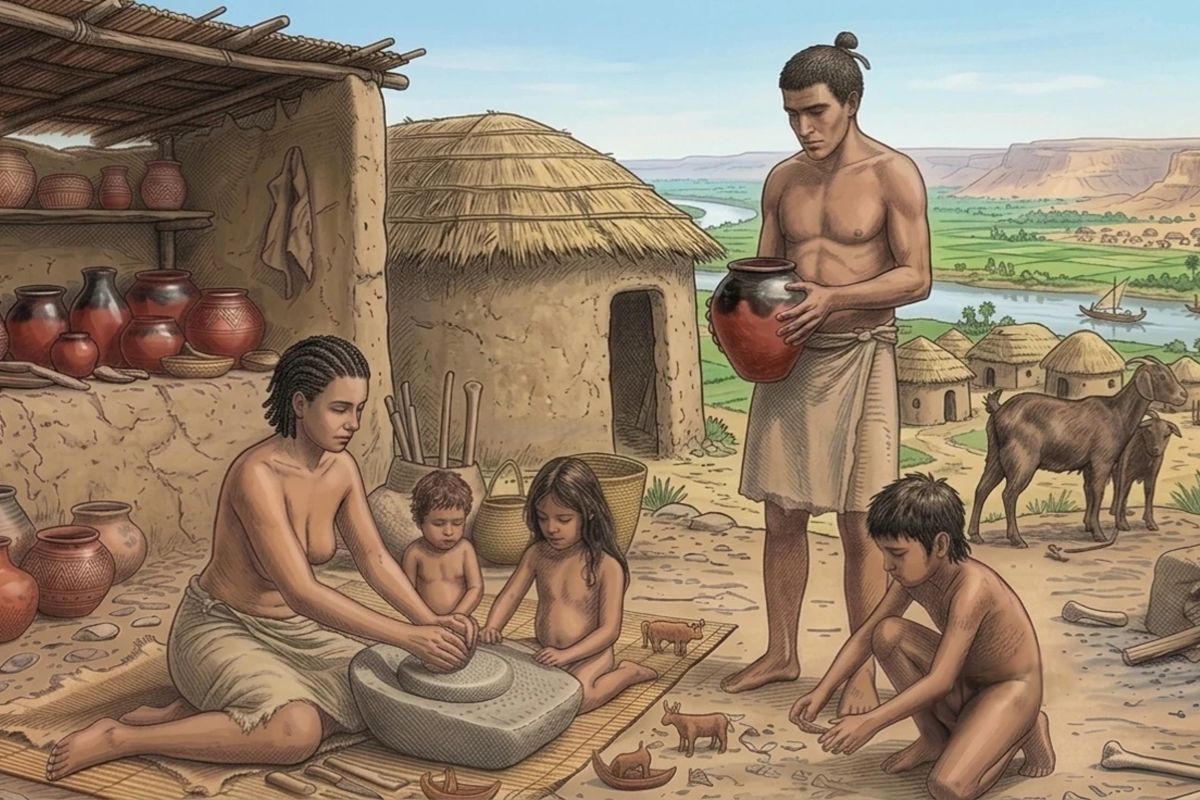
The population of pre dynastic Egypt were the remnants of of the Paleolithic inhabitants of northeastern Africa. The environment of the region was not always a Great Sand Sea. It climate varied over time. There were wet periods in which the area was a vast savanna area, a green Saharav with game animals, elephants, hippos, giraffe, and herd animals. (Many are depicted in rock art.) There were lakes and rivers with abundant sea life. As we understood it, North Africa was a kind of human terminus. We had thought that the the population did not move across the Mediterranean to Europe and that Europe was populated from the East. Humans following migrating herds seemed to have moved north through the Levant and the Caucuses and then split in the Eurasian Steppe with some moving West to populate Europe and some moving east to populate Asia. Increasing DNA evidence, however, shows European and Levantine admixture from what is now Europe which may have induced farming and pastoralism. Traces of North African lineages are even more limited in Europe. 【Simões et. al.】 This is, however rapidly expanding field and future DNA work may provide work based on wider sampling. Now as the North African savanna dried, the people of formerly green northeastern Africa were drawn toward the Nile Valley with its dependable source of water. The current desiccation of the Sahara was not complete until relatively recently (3rd millennium BC). Which is why you still see game animals and predators in early Egyptian art work. This appears to have driven the evolution from a nomadic hunter-gatherer life style of Paleolithic times to the settled agriculture life style of the Nile Valley. While the green savanna life style may have been primary hunter-gather, it is likely that a degree of agricultural knowledge observed from the natural world over time, perhaps nomads sewing seed or fruit pits knowing that when they returned to an area there might be a bountiful food source to gather. The raising of crops in the Nile Valley is notable on a horticultural scale (about 5000 BC). Agriculture developed somewhat earlier in Mesopotamia which may have accelerated Egyptian development. This was probably concentrated in the delta and northern Egypt at first. Overtime this spread southward into oases eventually reaching what is now Sudan. Unfortunately much of the surviving evidence comes from the southern drier regions, so the current DNA evidence is still tenuous. Some of the most important crops were native to Mesopotamia, further evidence of a connection with the first River Valley culture, but here were no large-scale migration occurred. The two developing civilizations seem for the most part largely self-contained. The earliest known Neolithic settlement in Egypt has been found at Marimda Banī Salāma at the southwestern point of the delta. Another early settlement to the southwest is in Al-Fayyūm. Grains were being grown at Marimda Banī Salāma (6th–5th millennium). Al-Fayyūm was near Lake Qārūn and the population was involved in fishing. Marimda is a substantial with evidence of occupation for centuries. There were primitive, lightly constructed huts and the dead seem to have been buried within the huts. Pottery had been developed. Other settlements have been found in the Western Desert, the Second Cataract area, and as far south as close to Khartoum. These include settlements close to the early Egyptian ones or overlapping Egyptian dynastic sites.
Simões, Luciana G., et. al.. "Northwest African Neolithic initiated by migrants from Iberia and Levant," Nature, (June 7, 2023), Vol. 618, Mo. 7965, pp. 550–56.

Navigate the Children in History Website:
[Return to the Main ancient Egyptian page]
[About Us]
[Introduction]
[Biographies]
[Chronology]
[Clothing]
[Disease and Health]
[Economics]
[Environmental issues]
[Feminism]
[Geography]
[History]
[Human Nature]
[Law]
[Nationalism]
[Presidents]
[Religion]
[Royalty]
[Science]
[Social Class]
[Bibliographies]
[Contributions]
[FAQs]
[Glossaries]
[Images]
[Index]
[Links]
[Registration]
[Search]
[Tools]
[Children in History Home]