|
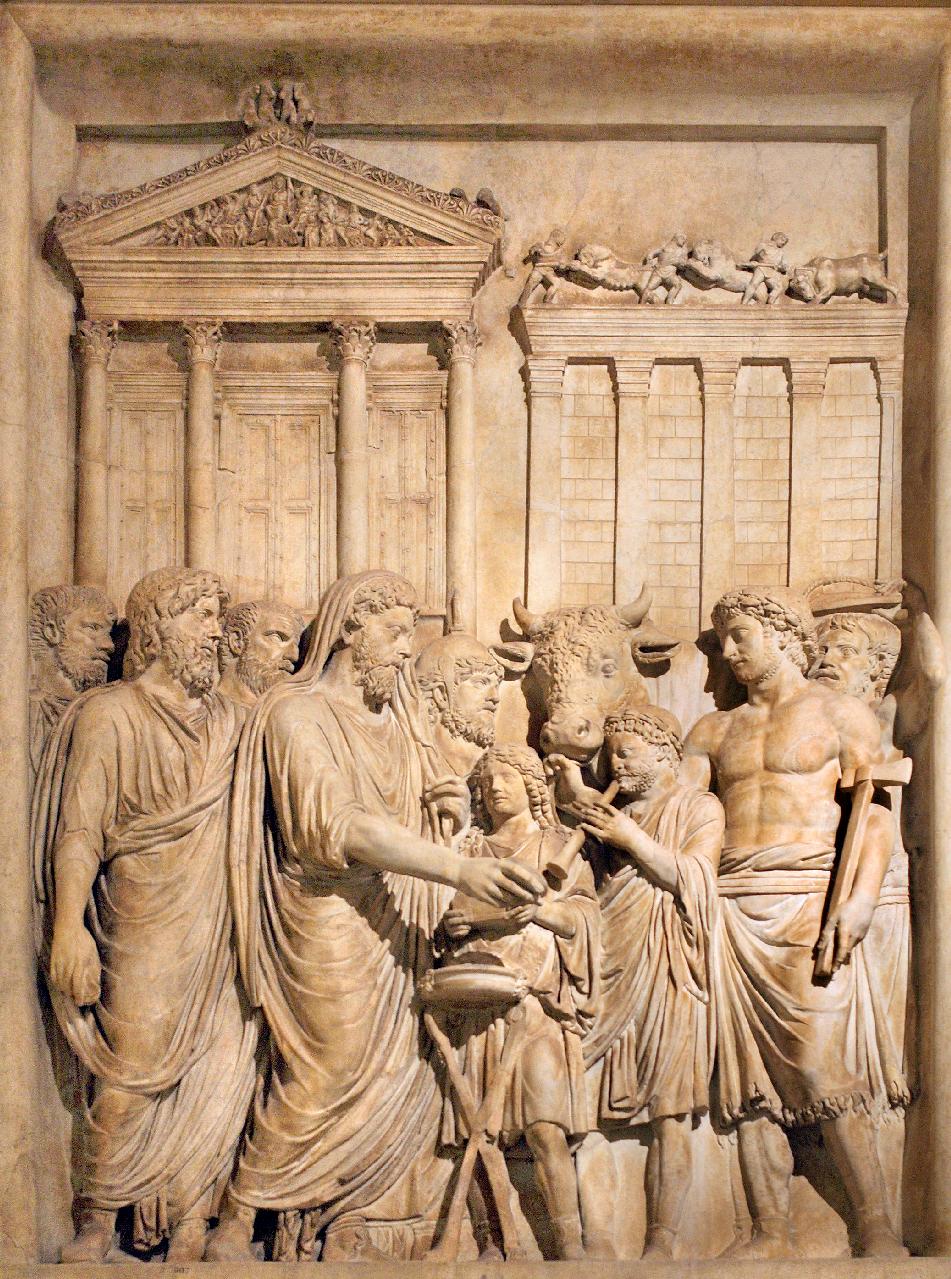
Rome's religion is today classified as paganism. It was a kind of mix of religion, morality, and patriotism. As Rome developed from a small farming village to a great power, the Romans cane to worshiped thousands of gods. Just about everything, including living and inanimate objects (trees, rocks, streams, bridges, virtually everything) was seen as having a guardian spirit or what might be called a god watching over it. Each of these many spirits or gods had at least one task job to do. Some had very important tasks vital to society. This included watching over the crops, or bringing out the sun daily. Something no one wanted to mess with and thus these gods were vital to society. But all Roman gods were of some importance to someone. The Romans dutifully prayed to their gods daily, sometimes more. As Rome expanded they came in contact with other people who worshiped and adored other gods. In many ways the Romans were tolerant of these additional gods. This was especially true if the conquered people had fought valiantly, the Romans seem to have concluded that their gods must have power to be reconned with. So the Romans adopted many of these gods and added them to their pantheon. They commonly gave those new gods Roman names and commonly changed some of their attributes and behavior to better accommodate Roman society. Thus is why the Greek gods have Roman names. There was one big exception--the Carthaginian god Baal Hammon. Both Carthage and Baal were utterly destroyed as a result of the Punic Wars. Now while foreign gods were often added to the Roman pantheon and tolerated, Roman law required that all people in the Empire must if not worship, at least honor the Roman gods which came to include the Emperor.
Important in Rome were mystery religions or mystery cults. These were important in the Greco-Roman world. Here participation was limited and reserved for selected individuals who were initiates (mystai). The distinguishing characteristic of these religious cults or schools was the secrecy associated associated with them. This included both the initiation and the ritual practices. They must never be revealed to non-adherents. The best known of these cults were the Eleusinian Mysteries, which had led back to Mycenaean times predating the Greek Dark Ages. These cults flourished in Late Antiquity, competing with Chtistinity. Emperor Julian is widely believed to have participated with various mystery cults (mid-4th century). The mithraists were particularly important. As a result of the secrecy involved, details are often limited. Withe the adoption of Christianity as the Empire's state religion, the mystery religions were heavily persecuted.
One group that had trouble with this were the Jews. In the early years of the Republic, Romans took all this very seriously. By the time of the Empire, many Romans dud their civic duty, but were much less serious about the gods. This explains in part the rise of mystery cults along with Christianity. A fundamental step in the waning years of the Empire was the conversion to Christianity. This would fundamentally affect the future of Western civilization. Some authors because of the timing attribute Christianity, at least in part, to the fall of the Empire. Most notably this was Gibbon's principal thesis. [Gibbon] Most modern authors provide a more complex assessment. [Woolf]
Gibbon, Edward. The Rise and Fall of the Roman Empire (1776).
Woolf, Greg. Rome: An Empire's Story (2012).

Navigate the Children in History Website:
[Return to the Main ancient Rome page]
[About Us]
[Introduction]
[Biographies]
[Chronology]
[Climatology]
[Clothing]
[Disease and Health]
[Economics]
[Freedom]
[Geography]
[History]
[Human Nature]
[Ideology]
[Law]
[Nationalism]
[Presidents]
[Religion]
[Royalty]
[Science]
[Social Class]
[Bibliographies]
[Contributions]
[FAQs]
[Glossaries]
[Images]
[Links]
[Registration]
[Tools]
[Children in History Home]