|
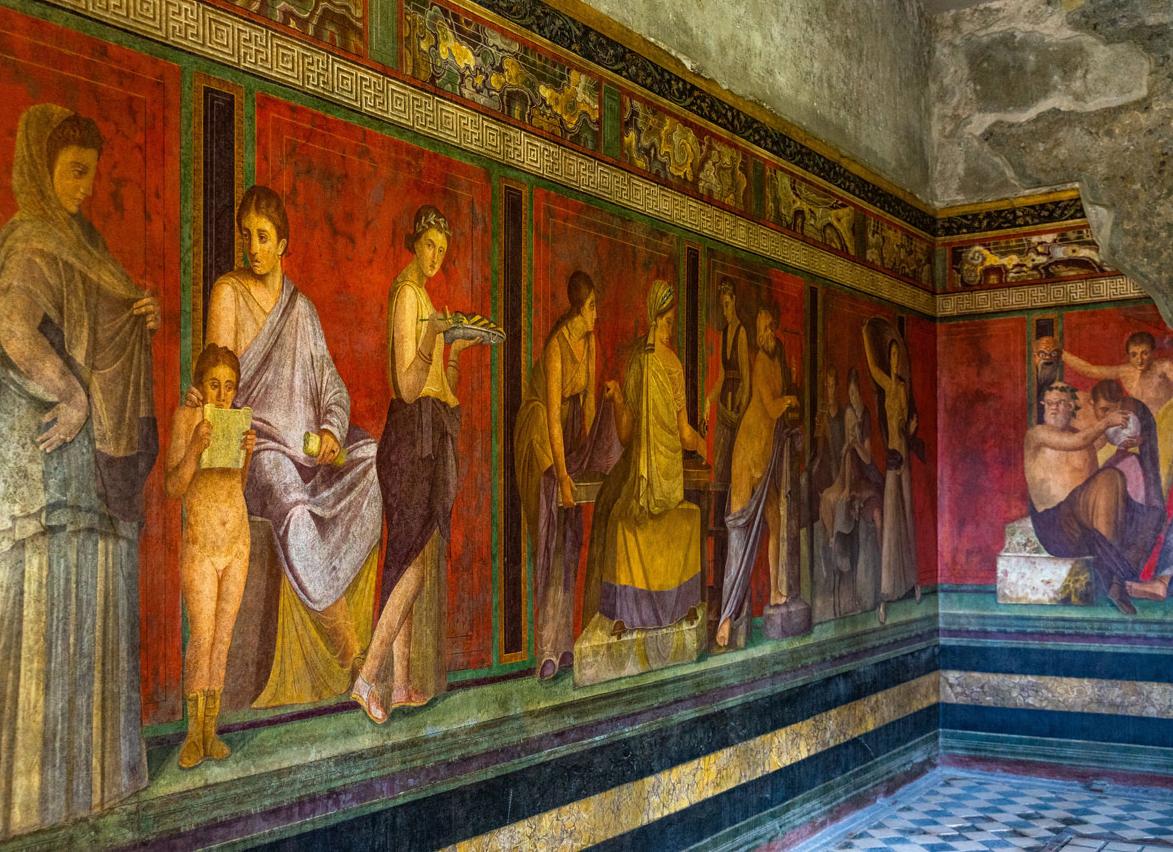
Important in the religious life of the Roman Empire were the mystery religions or mystery cults. These were important in the Greco-Roman world. Here participation was limited and reserved for selected individuals who were initiates (mystai). The distinguishing characteristic of these religious cults or schools was the secrecy associated associated with them. This included both the initiation and the ritual practices. They must never be revealed to non-adherents. The best known of these cults were the Eleusinian Mysteries, which had led back to Mycenaean times predating the Greek Dark Ages. These cults flourished in Late Antiquity, competing with Chtistinity. Emperor Julian is widely believed to have participated with various mystery cults (mid-4th century). The mithraists were particularly important. As a result of the secrecy involved, details are often limited. The frescos of the Villa of the Mysteries ar Pompei arebelieced to illustrate an initiation (figure 1). With the adoption of Christianity as the Empire's state religion, the mystery religions were heavily persecuted.

Navigate the Children in History Website:
[Return to the Main ancient Roman religion page]
[Return to the Main ancient Rome page]
[About Us]
[Introduction]
[Biographies]
[Chronology]
[Climatology]
[Clothing]
[Disease and Health]
[Economics]
[Freedom]
[Geography]
[History]
[Human Nature]
[Ideology]
[Law]
[Nationalism]
[Presidents]
[Religion]
[Royalty]
[Science]
[Social Class]
[Bibliographies]
[Contributions]
[FAQs]
[Glossaries]
[Images]
[Links]
[Registration]
[Tools]
[Children in History Home]