|
King Charles II issued a royal charter establishing the Hudson Bay Company (HBC) (1670). It was one of the first private company, in fact the oldest incorporated joint-stock merchandising company in the English-speaking world. The purpose was to seek a northwest passage to the Pacific, occupy the lands adjacent to Hudson Bay, and to carry on any commerce with those lands that might prove profitable--which proved to be the fur trade. It was an important step leading to the development of a British control of North America. The Hudson Bay Company still exits as a commercial company, but is now active in real estate, merchandising, and natural resources. Interestingly a company dating back to royal patronage and 1670 is today a trendy clothing retailer. It is headquarters in Toronto. The boundaries of the Hudson Bay Colony, which became known as Rupert’s Land, were never clearly defined in Charles' charter, but came to be seen to extend from Labrador to the Rocky Mountains and from the headwaters of the Red River to Chesterfield Inlet on Hudson Bay. The Hudson’s Bay Company primarily engaged in the fur trade during its first two centuries of existence. After founding, the HBC established a number of Trading posts along Hudson Bay. A southern inlet James Bay was especially important. After the British conquest of Canada (1759–60) during the French and Indian War, actually did not benefit the HBC. It increased competition which led the company to build fur-trading posts inland, starting with Cumberland House (1774). This led to more northerly operations and direct contact with the Native American fur hunters. Many of the Hudson’s Bay Company’s competitors strengthen by American Loyalists formed the North West Company (1783). This led to an extended, am increasingly bitter rivalry, including armed clashes. The British Government ultimately forced a union of the two companies (1821).
Hudson Bay is an defined as an inland-marginal sea. It is part of the Arctic Ocean. . It is a saltwater bay in northeastern Canada. It is located north of Ontario, west of Quebec, northeast of Manitoba, and southeast of Nunavut. A southern arm is James Bay. The boundaries of the Hudson Bay Colony, which became known as Rupert’s Land, were never clearly defined in Charles' charter, understandable as boundaries in he largely uncharted far north were pointless. Over time the Hudson Bay Colony came to be seen to extend from Labrador to the Rocky Mountains and from the headwaters of the Red River to Chesterfield Inlet on Hudson Bay.
The drainage basin of the Hudson Bay is a huge area of Canada, over half of the country, but mostly lightly populated area. It includes parts of five Canadian provinces, two Canadian territories, and small portions of four American states. The Bay covers some 1.2 million square km. It is the planet's second-largest bay after only the the Bay of Bengal. Hudson Bay is 1,370 km long and 1,050 km wide. While large, it is relatively shallow,with an average depth of only 100 m and a maximum of 270 meters. In sharp contrast to the Nay of Bengal, the northerly location and shallow depth of Hudson Bay means that the Bay freezes over completely during the winter. The Bay typically freezes over completely beginning in late- October or early November and remains ice-free during summer and autumn. Ice cover is nearly complete during the winter months, from January to April. The two coastal areas are very different. The western shores faces the northern reaches of Great Plains. It is the Hudson Bay Lowlands. Manitoba is covered by countless lakes. The region is drained by rivers creating characteristic vegetation called muskeg. The land was shaped by glaciers during the last global maximum. Polar Bear Provincial Park and the Waspusk National Park cover much of the area. The eastern shores are very different. They are rocky and hilly, and heavily forested. The principal commercial impact of Hudson Bay is that it cuts deeply into the North American land mass which offered the possibility of getting American fur to Europe avoiding the lock that France had on that trade. Eventually the American Revolution (1776-83) and Louisiana Purchase (1803) would allow Americans to open the trade (19th century), but Hudson Bay allowed the British to begin participating in the valuable Fur Trade (17th century).
France following the voyages of explorations attempted to found permanent colonies. Early attempts failed. The Fur Craze rekindled interest in the colonization effort. The experience of European fishermen on the Grand Banks alerted the French Crown to the availability of valuable furs in North America. The French Crown attested to interest French nobles in founding a colony by offering a fur monopoly. A young geographer named Samuel de Champlain became the founder if New France. His first expedition was to Port Royal on Nova Scotia, but he went on to found Quebec which became the French stronghold. From an early stage control of North America became an issue in the on-going competition between England and France. The colonization effort developed along very different lines in the English and French colonies. The English colonists pursued agriculture and developed along democratic lines. New France was centered on the fur trade and copied the feudal and absolutist model of France. The major outcome was that the French population in North America was very small while the English population reached substantial numbers in the colonies along the eastern seaboard. French interest in New France was limited and the suppression of the Huguenot limited that interest. The French also recreated the French political system in New France. Unlike the English colonies there was no separation from France at an early point. The English Civil War cut off the colonies and a tradition of colonial parliaments developed with little or no royal supervision. Nothing like a democratic system developed in New France. The King appointed a governor, the senior colonial figure and representative of the King. Like the French monarch, he had virtual absolute power. He was responsible only to the monarchy, not the people of New France that he governed. King Louis XIV created a new post with the appointment of an intendant (1665). His duties were finance and the judicial system. This change in the colonial administration did not work well. There was considerable overlap between the responsibilities of the governor and the intendant. This generated friction and complicated cooperation as only the king could resolve disputes. The English and French also pursued different policies toward the Native Americans. The French perhaps because of their small population and limited land usage developed amicable relations with the Native Americans. They also launched a major missionary activity. There was a major problem with the Iroquois.
The reason the America were discovered was discovered was efforts by Europeans to reach the Indies (India, the Spice Islands, and China) to circumvent Ottoman control of land routes--the Silk Road. These were places of immense wealth with products that the Europeans coveted and were willing to pay immense prices to obtain. This launched the European Voyages of Discovery. Reaching the Indies was Columbus' main goal (1492). The Portuguese after years of effort had opened up trade routes around the southern tip of Africa--Bartolomeu Diaz (1500). Balboa demonstrated that the Pacific was tantalizingly close (1513). Magellan demonstrated a southwest passage by sailing around the southern tip of South America through which is now known as the Straits of Magellan (1520). Jacques Cartier's exploration of the St. Lawrence River led to the founding of New France (1534). Curiously Columbus' voyages had touched on the easiest way to reach the Indies--the Isthmus of Panama. Given that the coastline of the Americas was well understood by this time, there was only one other option for Europeans to reach the Indies--a Northwest Passage. The dangers of sailing into Arctic waters, however, discouraged European explorers. Finding the Northwest passage became the Holy Grail for European explorers. Henry Hudson tried it (1611). He discovered what we now know as Hudson's Bay, but perished in the process. The Northwest Passage di exists. It is a 900-mile (1,450 km) sea route connecting the Atlantic and Pacific Oceans through the Canadian Arctic Archipelago. This route, however, because of the dangers of Arctic waters proved treacherous and was not commercially viable. It was not navigated until Roald Amundsen accomplished it (1903-06). Global warming causing melting pack ice is now beginning to open it to commercial shipping. But getting to Hudson By was viable and opened up a valuable trading rout for fur.
Henry Hudson (1565?-1611) was one of the most important English explorers--only he was not English. We know next to nothing about his early life, but he probably served as a ship's boy. Like many explorers of his age, he was primarily concerned with finding a Northwest Passage to provide an easy trade connection between northern Europe and Asia. His first expeditions were made in the service of Muscovy. He is best known for his expeditions to North America. He made four voyages of discovery primarily aimed at finding the Northwest Passage. He thus explored the northwestern Atlantic along the coast of North America and the Arctic Ocean On his third voyage (1609) he explored along the coast of North America 150 miles up what is now known as the Hudson River. On his fourth voyage aboard the Half Moon (1610) Hudson still searching for the Northwest passage found what is now known as Hudson Bay where his crew mutinied and Hudson and his son perished. Henry Hudson helped established New World claims for both the Dutch (New York area) and the English (northern Canada). Today the Hudson River, Hudson Strait, and Hudson Bay are all named for Hudson.
King Charles II of England was restored to power after spending years in exile, much of it in France (1660). In France the monarchy controlled the country's finances. In England Parliament controlled finances. And given what happened to his father, Charles was not about to challenge Parliament. This meant his finances were constrained. Charles looked enviously at the massive income accruing to the Spanish monarchy from its colonies in Mexico and South America. England had begum to found colonies in North America and the Caribbean, but they were modest operations compared to the expanding Spanish Empire.
The fur trade is a worldwide industry dealing in obtaining and marketing animal fur. It is primarily a northern hemisphere activity because this is where the fur-bearing animals are located and where the demand for warm clothing such as fur coats is strongest. The fur trade played a key role in the movement east of the Norsemen (Vikings) and the foundation of modern Russia. The Vikings also moved west, but as they did not colonize North America, the fur trade was not a factor. In modern times with the economic development of Western Europe where people could best afford expensive, fashionable clothing using animal fur. The industry was of huge economic importance (16th-19th centuries) and played a major role in the exploration and colonization of Siberia and North America. Russia at first dominated the fur trade. And as the market increased in Europe, this drove the Russian expansion east into Siberia and eventually even Pacific North America (Alaska). The same dynamic was at play in Europe. Portraits of European royalty often show fur items. Ermine in particular became a symbol of royalty. Russian domination of the fur trade and the high prices that they demanded was a factor in motivating the Europeans to seek out alternative supplies which of course meant sailing west to North America. A trickle of pelts from Portuguese, Basque, and Spanish fishermen operating on the Grand Banks alerted Europeans to North America as a source of furs. T
King Charles II granted an audience to two French men who had traveled from New France: Médard Chouart des Groseilliers and Pierre-Esprit Radisson (1668). They were brothers-in-law and voyageurs and came with a money-making proposition. he reported a 'great store of beaver' that they had discovered around Hudson’s Bay. Some 3 years later, they guided the first two English ships to Hudson's Bay. Radisson’s ship was damaged in a storm, but the Nonsuch with Des Groseilliers reached Hudson’s Bay. After crossing this inland sea, they headed south and reached the Nemiscau (Rupert) River (1668). During the winter, they laid the foundation of Fort Charles. To capitalize on the opportunity, King Charles II chartered the Hudson Bay Company (HBC) (1670). The King granted the HBC a monopoly to trade in the vast Hudson Bay drainage basin comprising most of what is now northern Canada. The territory became known as Rupert's Land. Prince Rupert of the Rhine (1619–82) was a nephew of King Charles I and the first Governor of the HBC. He had been a prominent Royalist commander during the English Civil War. After founding, the HBC established a number of Trading posts along Hudson Bay. A southern inlet James Bay was especially important. After founding, the HBC established a number of trading posts along Hudson Bay. A southern inlet James Bay was especially important. The French resisted English intrusion into their lucrative fur trade. And most of these posts were over run by vy the French (1686-1713).
The HBC's monopoly, however, was never safe because England possessed limited resources to enforce it. It was located in the middle of an inhospitable wilderness. It was separated from England's struggling Atlantic coast colonies by New France. And sea connections were tenuous. Sailing in Arctic waters was hazardous. But diplomatically, international recognition was achieved. The Treaty of Utrecht (1713–15) was a monumental turning point in European history. It ended the debilitating War of the Spanish Succession (1701-14), the last of Louis XIV's great wars. But more than that it established a European balance of power that would last for two centuries--a monumental achievement in war-prone Europe. The War had preventing a merger of the French and Spanish crowns. It recognized Philip V as the Spanish king but forced the separation of the Bourbon dynasties and solidified Great Britain's rise as a dominant naval and colonial power. And among its many minor provisions, it recognized British control over Hudson Bay. And as a result returned the Hudson Bay trading posts it had taken to the British.
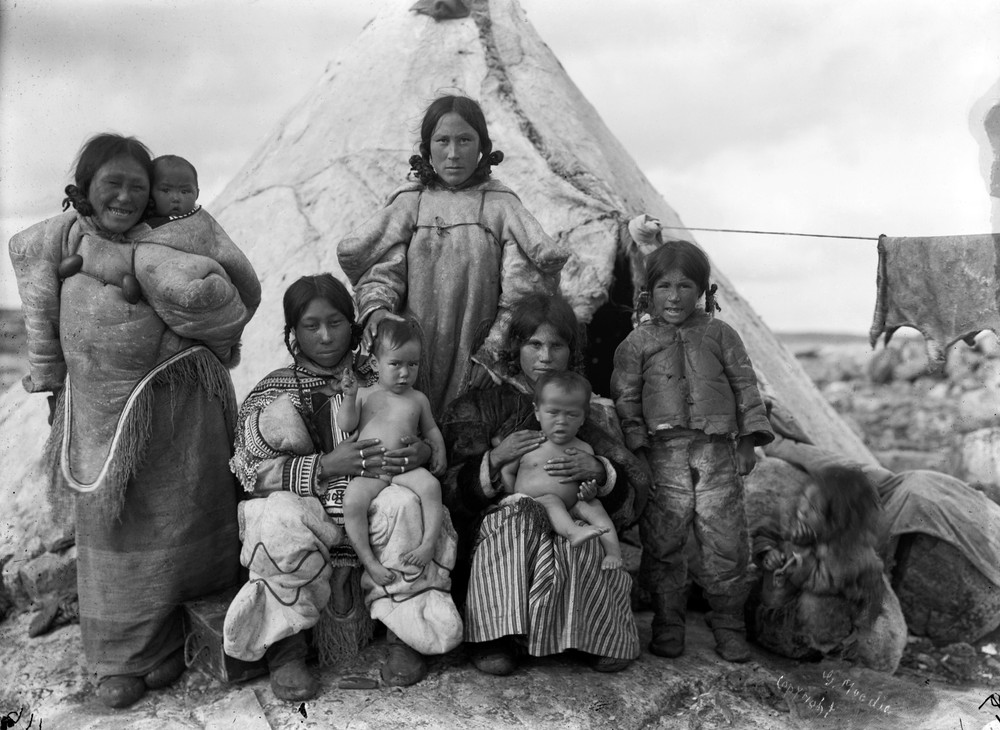
HBC envoys began visiting the Plains south and southwest of the Bay to convince the Native Americans to trade at York Factory on the southwestern shore of Hudson Bay in what is now northeastern Manitoba. It was at the mouth of the Hayes River. They had stiff competition from competitors in New France. Contactsat first were with the Northrn Olins rtibes. The HBC became a major supplier of European goods to the indigenous peoples of the northern Great Plains (1690s). These goods were having a major impact on the lifestyles of the tribes, especially fire arms. The HBC was the oldest company in the Canadian Prairie Provinces and one of the world's first joint-stock companies. It played a major role in Plains history for three centuries, especially as a fur-trading company. The Fur Trade was the major economic activity for both the HBC and New France. It would become very important in he United States as well. (John Jacob Astor would become first American millionaire.) The HBC competed on the Plains with Montreal-based rivals, both before an After Britain seized control of New France. The HBC and competitors They focused focused primarily on the rich furs of the Northern Plains. Eventually competition increased. And the HBC expanded operations beyound Hudson Bay rading post, moving into the interior. And they moved into the Sub-Arctic increasing contact with the Inuit.
After the British conquest of Canada (1759–60) during the French and Indian War, the HBC contrary to what might be expected, the HBC did not benefit. Competition actually increased. As competition increased after Britain seized control of New France (1766), the HBC turned to the northern margins of the Plains (after 1780). This led the HBC to open trading posts inland, establish better contact with the Native Americans producing he fur. This began with Cumberland House (1774). Relations with the Inuit became increasingly important. This began a period of intense competition, with important impacts on the Native peoples. European fur traders purchased furs (especially wolf and fox but also some beaver) from the Plains people. There was an other important lesser-known product--preserved bison meat (especially pemmican). The HBC and other companies operating in the sub-arctic. Cree, Assiniboine, and (mestizo) communities supplied most of this product. Blackfoot, Sarcee, Gros Ventre, Mandan, Hidatsa, and Ojibwa groups were also important traders. Revolition erupted in the American colonies. The Americans assumed that the Canadians wold join them. They did not. But by the time the Americans has gained their independence (1783), many of the HBC competitors had united and formed the competing North West Company. The two companies launched into a bitter costly rivalry. They also faced increasing competition from the Americans. The American Revolution actually fueled the competition. Many of the Loyalists went to Canada, the first major influx of English-speaking people into Canada. Some got involved in the fur trade. The HBC established the Red River Colony (1812). This was , the first permanent European American settlement in the northern Great Plains. There were actual armed clashes (early-19th century). One example was the Battle of Seven Oaks (1816). This was finally stopped when the British government forced a union of the two competing companies (1821). The unified company used the name of the Hudson Bay Company.

Visit Children in History Website:
[Return to the Main Canadian history page]
[Return to the Main North American history page]
[Return to the Main Canadian country page]
[Canadian art]
[Canadian catalogs]
[Canadian choirs]
[Canadian families]
[Canadian First Communions]
[Canadian long stockings]
[Canadian school uniform]
[Canadian television]
[Canadian youth groups]
Navigate the Boys' Historical Clothing Web Site:
[Introduction]
[Animals]
[Biographies]
[Chronology]
[Climatology]
[Clothing]
[Disease and Health]
[Economics]
[Ethnicity]
[Geography]
[History]
[Human Nature]
[Law]
[Nationalism]
[Presidents]
[Religion]
[Royalty]
[Science]
[Social Class]
[Bibliographies]
[Contributions]
[FAQs]
[Glossaries]
[Images]
[Links]
[Registration]
[Tools]
[Children in History Home]