|
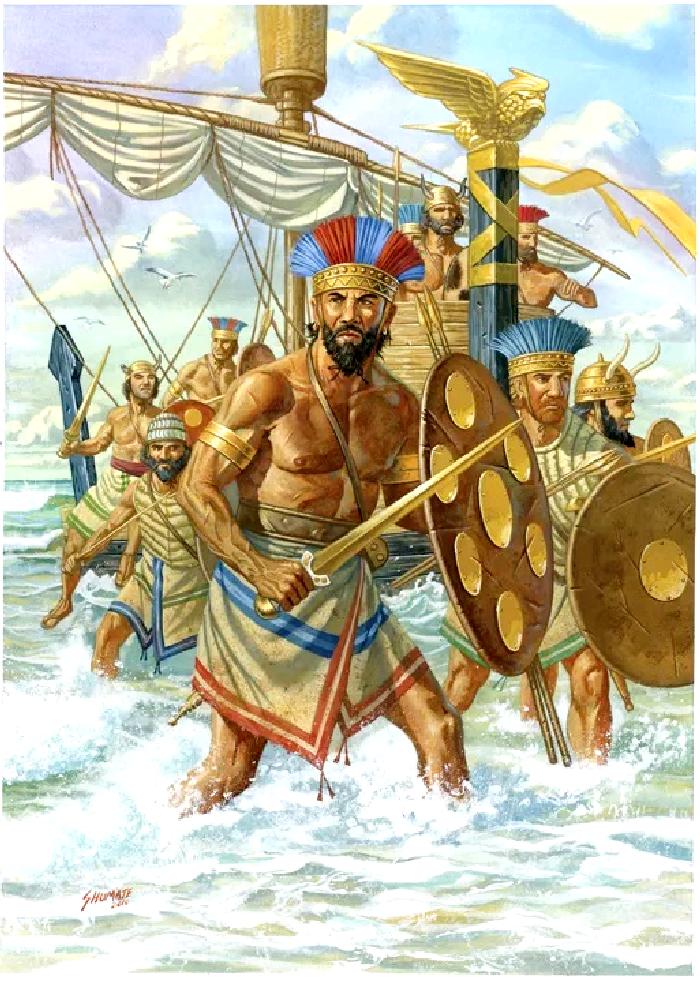
Sardinia has an extensive, fascinating history and given its modest modern existence, more important that might be expected. It has been settled since the Paleolithic Age. Archaeologists have no idea how the first humans reached Sardinia or from where. Unlike Sicily, Sardinia was located at some distance from the Italian mainland. It was inhabited throughout the Neolithic Age. The population has one of the oldest and most distinct DNA profiles in Europe. There is a very high percentage of the island's population with direct ancestry from the early Neolithic farmers who migrated from Anatolia. Sardinians are more genetically similar to ancient Neolithic farmers than any other modern European populations. And unlike mainland Italians and other Europeans, Sardinian have low levels of migratory Steppe-related ancestry. Sardinian were much less affected by the the genetic turnover experienced elsewhere on the Continent. Here they show a genetic similarity to Basque populations--in this case isolated by mountains rather than by sea. There are architectural treasures on the island. The rugged terrain includes thousands of nuraghi, poorly understood Bronze Age stone ruins looking like beehives. There are 7,000 Nuraghi and hundreds of archaeological monuments that are located all over the island. One of the largest and oldest of these Nuraghi is Su Nuraxi in Barumini (16th century BC). Also notable is the Domus de Janas, holy wells, temples and the mystic giant tombs, which are huge stones set into the ground called ‘betili’ or ‘menhir’ which stem from the megalithic architecture. The Bronze Age remains are interesting given that Sardinians were some of the Sea Peoples that destroyed the great Bronze Age civilizations--except Egypt (figure 1). The Sherden may have been the Sardinian Nuragic people. The Sardinian origin was only surmised at by historians based on pottery and other historical clues. But we now have definitive DNA evidence. Sardinia is not as strategically placed as Sicily which dominated the narrows between the eastern and Western Mediterranean. Thus Sardinia has been largely a backwater of history. Many historians suggest the Phoenicians first founded colonies on the island. The relationship may be more complex as the Phoenicians may have originated with the Sea Peoples. The Sea Peoples is a modern historical term. They were were actually named by the Bronze Age peoples upon whom they descended, especially the Egyptians. This included the Sherden who settled along the cost of the southern Levant. The Sherden were one of the Sea Peoples mentioned in the records of Ramesses II. He claimed to have defeated them in his second year when they landed in the Nile Delta (1278 BC). They also apparently landed further east where they did not face the Egyptian Army. Ramses eventually recruited some for his personal guard. 【Grimal, pp. 250–53.】 Sardinia was of some importance because of the mineral resources. The Carthaginians themselves with Phoenician origins seized Sardinia (about 510 BC). The principal Punic cities were Tharros, Nora and Sulci. Rome obtained control of Sardinia during the Punic Wars (238 BC). The Sardinian-Punic people resisted Roman rule, but over seven centuries of Roman rule the population was largely Romanized. This mean the culture was Romanized, but the ethnicity of the population was largely unchanged by Rome or the subsequent imperial powers which seized the island. With the fall of Rome the island was seized by the Vandals and then the Byzantines. The medieval history of Sardinia was complicated with local dynasties and then Aragon playing important roles. The major modern historical importance of Sardinia was the role it played in the unification of Italy. Sardinia was occupied by the Germans in World War II, but escaped the heavy fighting and destruction that occured on Sicily and mainland Italy (1943).
Pre-history means the history before the advent of writing. On Sardinia per-history began with the final years of the Paleolithic Age. Without writing this all means the only source of information is archaeological findings. There is some difference among researchers as to just when humans first reached the island. There is agreement that Sardinia has been settled since the Paleolithic Age. Archaeologists have no idea how the first humans reached Sardinia or from where. During the last ice age sea levels were lower by about 130 meters. Sardinia and Corsica formed a single large island, separated from Tuscany only by a narrow arm of sea which mean that it was relatively easy to get to the island. The Anatolia farmers that swept over Europe were able to get to the island, but not the Steppe people four millennia later. This means that Sardinians along with Basques are nost ethnically similar to Europeand before rhe arrival of the Steppe people (c3300-2600 BC). The Steppe people who drastically changed European ethnicity never reached Sadinia
There are architectural treasures on the island. The rugged terrain includes thousands of nuraghi, poorly understood Bronze Age stone ruins looking like beehives. No one knows what caused the Sardinians to begin making these structures.
The final years of SArdinian pre-gistory over-lpped ith clasical antiuity. With he advent of classical antiquity meaning the advent of writing, much more information becomes available on Sardinia. All three major civilizations active in the western Mediterranean were involved on Sardinia, especially the Phoenicians/Carthaginians and the Romans. These were literate civilizations. Th Sardinian peole did not have a written language. Somemay have learmed to read and wite one of the classical languages, but as far as we know there is no weitten reecord left by a Sardinian. The Greeks were unable to establish a permanent presence. Their primary interest in Sardinia was the island's mineral wealth. Silver and lead was especially important. Rome has no substantial contact with Sardinia because it had no naval tradition until the First Punic War.
Phoenician shippers and traders were especially interested in Sardinian mines. Fertile olive goves were also an attractopm. The strategic location of Sardinia was also an attrction. Phoenician and Punic contact created the first urban urban centers and maritime trade. The Phoenicians founded important cities, including Caralis, Cagliari, Sulci (modern Sant’Antioco), and Tharros, an early imprtant port. The remsains of Phoenician sanctuaries and places of worship have been found across the island which arecgeologists nelieve testify to the peaceful coexistence of the Phoenicians and indigenous Sardinians. .Metals were a major part of ancient trade because metals occur in distinct, widely separated locations. That meant states had to trade to get the metals they wanted. The first mines on Sardinia had been for volcanic obsidian. Sardinia was a major source for obsedian before metals became important in the Bronze Age. It was an important trade material. Gradually with the Bronze Age silver and lead became the most important metals. We also see mention of copper and iron. Trading posts were set up a Caralis (Cagliari), Sulcis (on Sant’Antioco Island), and Tharros. The Greeks also attempted to set up trading posts (Olbia in northeastern Sardinia), but met resistance from the already established Phoenicians. Gradually the Phoenician outpost of Carthage became a power in itself and gained control of the island. The Carthaginians, led by generals Amilcare and Asdrubale, exercised more direct control over the Sardinians. This eventually ended the long period of peaceful coexistence with the islanders. Eventually the Carthaginians began the military conquest of the island areas with valuable mines (c500 BC). They drove the indigenous Sardinian population into the mountainous interior.
Carthage had to cede control of Sardinia to Rome after the First Punic War (238 BC). There seems to have been a revolt by Carthaginian mercenaries which assisted in Roman control. The Romans taxed the population which paid in grain. The Sardinian-Punic people resisted Roman rule, but over seven centuries of Roman rule the population was largely Romanized. This mean the culture was Romanized. The modern ethnicity of the population is predominately indigenous, but there is substantial Phoenician, Punic, and Roman traces, probably mostly Roman meaning Italic. The Roman Senate made Sardinia a Roman province (226 BC). Roman rule firmly integrated Sardinia into the broader Mediterranean economic system. The Romans expanded mining activity working gold, silver, and lead ore bodies. Roman began using silver as a monetary metal (269 BC). Sardinia was seen at the time as one of the most important sources of metal, mostly mead and silver. One geographer wrote, "India ebore, argento Sardinia, Attica melle" ("India is famous for ivory, Sardinia for silver and Attica for honey"). 【Solinus】 The Sardinian language (Sardu) is directly descended from Latin Vulgar which was the spoken Latin of the late-Roman Republic and Empire. Linguists see the Sardinian language as the most conservative and archaic of the surviving Romance languages descending from Latin.
The medieval era following the fall of Rome, is a long and complicated era. With the fall of Rome the island was seized by the Vandals and then the Byzantines. The medieval history of Sardinia was complicated with local dynasties and then Aragon playing important roles. With the fall of Rome, Sardinia was largely separate from What we now call Italy. Mining declined. The indigenous population had little use for metal. There was a short period of control by the one of the German tribes--the Vandals. This was ended by the Byzantines. They revived mining, primarily silver mining. Byzantine power declined with the Islamic outburst from Arabia (7th century AD). While a land power, the Arabs soon developed naval capability. And the Arabs began plundering coastal villages in Christian principalities, both plundering and slave raiding. This would continue into the modern era. Whole coastal areas were depopulated. This included Sardinia. As Byzantine power receded. a kind of autonomy developed on the island. Four principalities appeared, Giudicati (judgedoms) of Cagliari, Arborea, Torres and Gallura. These were the names of the sovereign (judge). , after the title of their sovereign (it. giudice, meaning "judge"). These weak principalities began developing ties with Pisa and Genoa-- the two most important Italian city states along the western coast of Italy. There was an alliance against Muslim emir Musa who had landed fores on the on the island (9th century AD). Pisa tended to dominate, but there was a competition with Genoa. Pisa was especially interested in silver miningThere were also religious ties with the Papacy. Pope Boniface VIII created the Kingdom of Sardinia and Corsica (Regnum Sardiniae et Corsicae) (1297). 【Schena】 This was a diplomatic move to settle a decades-long Mediterraneanvvonflict beween Ajoou nd the House of the French uppoerted House of Anjou. The major isuewas the Sicilian Vespers. While Sardinia became a kingdom, the king liced in Savoy and not Sardinia. Power on the island remained largely in the hands of the landowners, and the vast majority of the population remained in a state of fedudal economic and cultural backwardness. . Sardinian mines supplied Pisa with almost 15 tons of silver annually. The Iberian kingdom of Aragon (modern Catalonia) gained control (1326 AD). It was a major factor in the decline of Pisa. The Aragonese attempted to revitalize mining activity, but with only limited success. Aragon was by this time one of the two leading Iberian kingdoms. The marriage of Isabella of Castille and Ferdinand of Aragon would lead to a united Spain (1469). The Algherese dialect of Aragon (Catalan) would add to Sardinia's linguistic diversity. The Spanish discovering the Americas (1492) and Portuguese opening trade with the East (1498) would lead to a major decline in Mediterranean economies and soon after the flood of American gold and silver would substantially reduce the value of Sardinian silver. Sardinia became a neglected part of the Spanish Empire for 400 years. There was an imprtant Jewish community om Sardinia dating to Roman times, but they were expelled as part bof the general Spanish expulsion of the Jews. Spain amassed a huge empire, but used most of the American gold and silver to finance religious wars. Spain and its colonial possessions languished, including Sardinia. Spanish rule ended as a result of Louis XIV of France last great war -- the War of the Spanish Succession (1701-14).
During the War of the Spanish Succession, Austria briefly gained control of Sardinia (1708). Spain seized the island in an attempt to regain lost Italian possessions--primarily Naples and Sicily (1717). In the end Savoy which lost Sicily was given Sardinia. Savoy's power, however, was increasing as the power of the city states declined after maritime trade began with the East. The Treaty of the Hague permanently transferred Sardinia to the rule of the House of Savoy, which acquired the elevated title of King of Sardinia. The Duchy of Savoy was a French‑speaking Alpine territory in the Western Alps. The Savoyard dynasty also ruled Italian-speaking lands: including the Principality of Piedmont, the County of Nice, and the Duchy of Genoa. These were separate principalities only all ruled by he House of Savoy. Over time the orientation shifted from French to Italian, especially after the acquisition of Sardinia which brought a royal title. The French Revolution erupted (1789). Soon conflict began with the monarchical regimes that dominated Europe. Savoy-Sardinia at first attempted to remain neutral. French revolutionaries decided to launch an expedition to take Sardinia which would improve their strategic position in the Mediterranean (1793). Napoleon was involved, but not in command. It was the first offensive of the new French Republic. Up until his point the French Republic was fighting defensive battles at the border with the armies of the First Coalition beginning when France declared war on Austria and Prussia (April 1792). As France prepared a naval expedition, the clergy on Sardinia organized the islanders for armed resistance. The French manged to establish a temporary foothold, but were ultimately defeated. As a result, Sardinia remained beyond French control even when Ma href="/essay/war/war-ne.html">Napoleonic armies swept over Europe. French ideals, however, were spreading. The population demanded an end to feudalism. Savoy itself, however, was overrun by Napoleon as part of his Italian campaign (1795). It was here he won his first important battles. The Savoy-Sardinian monarchy fled to Sardinia after the French failed to take the island. And they suppressed revolutionaries on the island. Ancien Régime policies persisted after the defeat of Napoleon (1815). Finally King Charles Albert (r. 1839-49) instituted a series of modernizing reforms. Sardinia was united with the other provinces of Savoy-Piedmont which upgraded its standing within the kingdom. Especially important was the Perfect Fusion Act (1847). This dissolved the separate legal entities and establish for the first time the unitary Kingdom of Sardinia. This meant the Duchy of Savoy and the Principality of Piedmont were fused into a single administrative unit. The capital became Turin. The shift from Savoy was complete when French peaking western Savoy was ceded to France. This was confirmed by the Constitution of 1848 and Sardinians were given seats in the Piedmontese Parliament. The year 1848 was the year of resolutions in Europe. The House of Savoy actually gained in status and it became clear that Piedmont would become the modern, progressive state under which Italy would unify. The major modern historical importance of Sardinia was the role it played in Italian unification.
Italian unification was made possible by the the Second Italian War of Independence/Franco-Austrian War (1859). Chancellor Bismarck was involved as he wanted to break the historic Franco-Austrian alliance. The primary result was that Lombardy was annexed by Piedmont. Now Naples and Sicily (the Kingdom of Two Sicilies) remained outside of Piedmont (House of Savoy) control. The final major step in unification was Garibaldi beginning with a very small force (the Expedition of the Thousand) swept through Sicily and then crossing the Strait of Messina into southern Italy. He was warmly received by he population, but the intervention of the Royal Sardinian Army (actually the Sardo-Piedmontese Army) was needed to defeat the Neopolitans. This brought Naples and Sicily into a unified Kingdom. Victor Emmanuel II was proclaimed king of a united Italy (1861). Had it not been for Sardinia, Victor Emanuel would have been a duke and not a king. An alliance with Prussia meant that the Veneto was obtained after the Austro-Prussian War (1866). Then finally Rome was annexed after the French garrison was withdrawn as a result of the Franco-Prussian War (1870). A major political figure was Count Cavour who quarreled with Garibaldi. The primary development was industrialization in the north and important infrastructure development. As the north developed, a major political issue became the Southern Question--disparities between the north and south. While not located in the south, Sardinia was essentially part of the Southern Question. This was the era of Scramble for Africa, Italy pursued colonial ventures in Africa, but became the only European nation to be defeated by an African army (1896). One might have thought that Italy would have addressed the Southern Question before pursuing African colonies, but this was not the case. Sardinia was part of the unified Italian nation, but as in the South, there was no important effort to address the inequities with the larger nation. Sardinia was not just any Italian province. The Islands geographic separation and its distinctive linguistic and cultural identity make it stand out. Something very different in the Italian body politics. This was especially the case in the 19th century before the advent of modern mass media. Given Sardinia's insular isolation it has been described as a 'forgotten' province. This gave rise over time to a growing desire for autonomy. Italy was part of the Triple Alliance (1882) becoming associated with the Central Powers. Italy did not, however, join the Central Powers when World War I broke out (1914). Given territorial claims in the Tyrol, Trentino, and Balkans (Istria), Italy joined the Allies -- Treaty of London (1915). The War had nothing to do with Sardinia, but the Italian Kingdom was destabilized by the War, the economic strain, battlefield losses, and failure to gain all of the territories anticipated. The Italian Kingdom did not end with the Fasixy seizure of power (1922) but effective control of the Itaian state did end. And most imprtantly for Sardinia, there was no major effort to assress the Southern Question.
After World War I (1914-18), the Sardinian Action Party (PSA) appeared and advocated for autonomy. Sardinian War veterans seem to have been attracted to the PSA. Benito Mussolini and his Fascist party seized power in Italy (1922). He imposed a totalitarian state suppressing democracy. Any idea of autonomous provinces was quashed. Other political parties including the PSA were closed. Mussolini for some reason seems to have taken a special interest in Sardinia, perhaps it was so underdeveloped. The Fascists gave considerable attention to the long ignored island making it a focal point of what could be achieved under Fascism. Parliament passed the much-publicized Legge del Miliardo (1 Billion Lira law) authorizing 1 billion lire (about $40 million in 1925 dollars)--a substantial amount at the time. It was intended to modernize the decrepit Sardinian infrastructure. For some reason only a part of this was actually dispersed, most for projects in Cagliari. The Fascist regime did promote development projects called 'land is redeemed, cities are founded'. This involved 1) rural land reclamation and malaria eradication and resettlement along with 2) the creation of new industrial towns. Large-scale drainage schemes were paired with water collection systems and dams (often building on earlier hydroelectric plans from the 1910s) to create usable agricultural land. The new owns included Mussolinia (now Arborea), Fertilia, and Carbonia (a coal mining town). They were designed as laboratories for Italian architecture and hubs for industrial development. The projects involvedf draining swampy areas and mining and were financed primarily by the Fascist state. One objective was to create jobs for unskilled workers. There was also forced relocation of entire families. There were also families from the over populated mainland as well as areas of Yugoslavia with Italian ethnic populations. (We are unsure about Yugoslav polices convening ethnic Italians.) One author suggesta a lasting political legacy. 【Carillo】 One such project was the resettlement in the 'redeemed' Nurra region (1933). We see Fascist ideology at play here, both Fascist corporatist ideals and repressive state control over the individual. Fascist policies do not seem to have changed the Sardinian orientation toward autonomy. Rural Sardinians do not seem much attracted to Fascism, although the urban middle class and transplanted mainlanders were more supportive. 【Gabriele】 There seems to have been less organized resistance than on Sicily. One report suggests the 'ruthless' repression of opponents, but we do not have much information on his. The overall Fascist legacy is was mixed. It suppressed local political identity which may not have been beneficial long term. It failed to solve the deep structural poverty of Sardinia and southern Italy in general. This is something that Socialist structured policies (Fascist or Marxist) are incapable of solving. The infrastructure projects successfully eradicated malaria, established important energy networks, and created notable examples of 1930s Rationalist architecture.
Hitler and Stalin launched World War II (September 1939). Italy as part of the Axis alliance was a NAZI ally. Mussolini as France was invaded by the Germans and clearly defeated decided to enter the War (June 1940). With Britain still defying the NAZIS, this suddenly made the peaceful Mediterranean an active theater of the War. The substantial Italian fleet performed poorly. Airfields and naval bases on Sardinia, however, became part of the struggle for the Mediterranean. They were used in an effort to off the Mediterranean to British shipping and were important in attacking British efforts to supply Malta from the West. American entry in the War changed the strategic balance (December 1941). This was first apparent in the Mediterranean. Afterthe Torch lamfings (November 1942), the Germans and Italians bases were used to support the Axis operations in Tunisia. American B-24 Liberators bombers sunk the Italian heavy cruiser Trieste at La Maddalena (April 1943). The cut off Axis forces surrendered in Tunisia (May 1943). After the Axis surrender in Tunisia (May 1943), The next Allied target was Sicily. Allied air attacks on Sicily and Sardinia increased. The Germans moved more air squadrons to Sardinia, but massive Allied air superiority made Sardinian airfields unsustainable. the Allies sought to confuse the German commanders as to their next move in the Mediterranean through Operation Mincemeat. The Allies chose Sicily, but attempted to convince the Germans that they were targeting Sardinia and Greece. Hitler himself ordered that 'measures regarding Sardinia and the Peloponnese take precedence over everything else' (May 12). Allied intelligence operations convinced the Germans that the Allies were going to invade Sardinia. Thus the Germans reinforced the Italian army on Sardinia (July 1943). The Germans used the replacements meant for the Africa Division which surrendered in Tunisia. The Division was reconstituted as the 90th Panzergrenadier, about 40,000 men. The invasion of course came, but the Allies invaded Sicily (July 1943). The 90th Panzergrenadier could have made a difference had it been deployed on Sicily. Sicily quickly fell although unlike Tunisia, most of the German troops escaped across the narrow Strait of Messina (August 1943). The Allies invaded Italy proper which the Germans had occupied (September 1943). The Germans after the Allied invasion of Italy decided to withdraw from Sardinia (September 19, 1943). OKW sent General Fridolin von Senger und Etterlin to rescue the 90th Panzergrenadier, which while stranded on Sardinia, but was a potent force. Unlike Sicily and Italy there was very little actual fighting on Sardinia. Thus the island escaped the massive damage that occurred in Italy, although there was some damage as a result of Allied bombing.
Von Senger decided to evacuate through nearby Corsica (September 1943). Any attempt to cross to the Italian mainland would have exposed him to Allied air and naval attack. Reaching Corsica involved only a short crossing, but there the Germans faced French and Italian forces.
The NAZIs seeing Mussolini's the Fascist regime collapsing invaded and seized control of Italy before the Allies invaded. Thus the Allied invasion of Italy was more of a liberation. There was a fight for Italy from the Toe north up to the Po Valley (1943-45). Tremendous destruction ensued. The Germans surrendered (May 1945). Italians were left with a badly damaged country to rebuild. The Allies allowed Italians to settle their future demonically. There was the a serious threat of a Communist future. The Communists had been important in the resistance to Fascism and the NAZIs. Democratic parties narrowly prevailed, in post-War elections. In a referendum, Italians decided on a republic (1946). With democracy restored, Sardinians revived the idea of autonomy. The Italian Government approved Sardinia's status as a self-governing region of Italy (1948). Sardinia has a special constitutional status that confers more important legislative and administrative powers than other most Italian regions, but not independence. Sardinia's indigenous language and the Algherese dialect of Catalan are recognized by both regional and national law as two of Italy's twelve official linguistic minorities. Sardinia has benefit ted greatly from the Italian Economic Miracle. The result was a phenomenal rise in Italian living standards. This is most notable in southern Italy, but also in Sardinia and Sicily, bringing living standards up to a more European level. We think much of this is due to growth of the Italian economy rather than major economic developments on Sardinia. The major growth engine in Sardinia has been tourism which primarily comes from Italy. While Sardinian living standards are no longer more similar to the Third World than Europe. There are still differences in education, health care, infrastructure, and other important areas, but the huge gap in living standards no longer existed by the 1990s. . An Italian reader tells us that "In terms of GDP, the capital, Cagliari, is in line with the national average. The island as a whole, however, is below the national average, but it ranks among the best in the south. In terms of life expectancy, the island is the best region in Italy." We wonder is the high life expectancy may be the result of diet.
GDP percapitaon Sardinia lafs national lvels, but Sardinia's cost of living is moderate compared to high mainland Italy and northern Europe. While overall living costs remain moderate, regional and seasonal differences are significant, and the island’s quality of life blends cultural heritage with contemporary amenities. 【"Sardinua cost ..."】 This varies sharply by location and lifestyle. The European Union (EU) was formally established ony the Maastricht Treaty. There was huge optimism that this would revolutionize the European economy and lead to huge increases in growth and improved living standards. There was some improvements at first. But over time European growth lagged behinf that of the United States. Looking at 1995 data, the American economy has soubled compared to very low growth lecels in Europe. This impcts Sardiniabecause most of the post-war imprivements on Sardinia havebeen financed by the expansion of the Italian economy. There are no important new industris on Sardnia. The major industry that has expanded has been the tourist industry which in large measure reflects the health of the Italian economy. There are major issues facing Sardinia. A substantial part of EU ecomomic success has been based on unustinable defecit spending. Demogrphic trends in Europe, epecially Italy suggest that levels of defecit spending will have to be cut. Thius could speciallu impact Sardinia.
Carillo, Mario F. Centre for Studies in Economics and Finance and the University of Naples Federico II.
Gabriele, Nicola. Trans Sally Davies A History of Sardinia (University of Cagliari: 2014).
Grimal, Nicolas. A History of Ancient Egypt (Oxford: Blackwell, 1992).
Morgunova, Nina and Olga Khokhlova(2013). "Chronology and Periodization of the Pit-Grave Culture in the Area Between the Volga and Ural Rivers Based on 14C Dating and Paleopedological Research". Radiocarbon. (2013) Vol. 55, Nos. 2–3.
"Sardinia cost of living: A practical price guide" lsarestcost.com (Feruary 2026).
Schena, Olivetta. "Ch. 3- The kingdom of Sardinia and Corsica, " In Andrea Gamberini and Isabella Lazzarini, eds. The Italian Renaissance State (Italian Renaissance State: 2012), pp. 50-68.
Solinus

Navigate the Boys' Historical Clothing Italian pages:
[Return to the Main Sardinian page]
[Return to the Main Italian island page]
[Return to the Main Italian regional page]
[Return to the Main Italian activity page]
[Return to the Main Itlalian page]
[Italian school uniforms]
[Italian youth groups]
[Italian choirs]
[Italian movies]
[Italian royalty]
Navigate the Children in History Web Site:
[About Us]
[Introduction]
[Biographies]
[Chronology]
[Clothing]
[Disease and Health]
[Economics]
[Environmental issues]
[Feminism]
[Geography]
[History]
[Human Nature]
[Law]
[Nationalism]
[Presidents]
[Religion]
[Royalty]
[Science]
[Social Class]
[Bibliographies]
[Contributions]
[FAQs]
[Glossaries]
[Images]
[Index]
[Links]
[Registration]
[Search]
[Tools]
[Children in History Home]