|
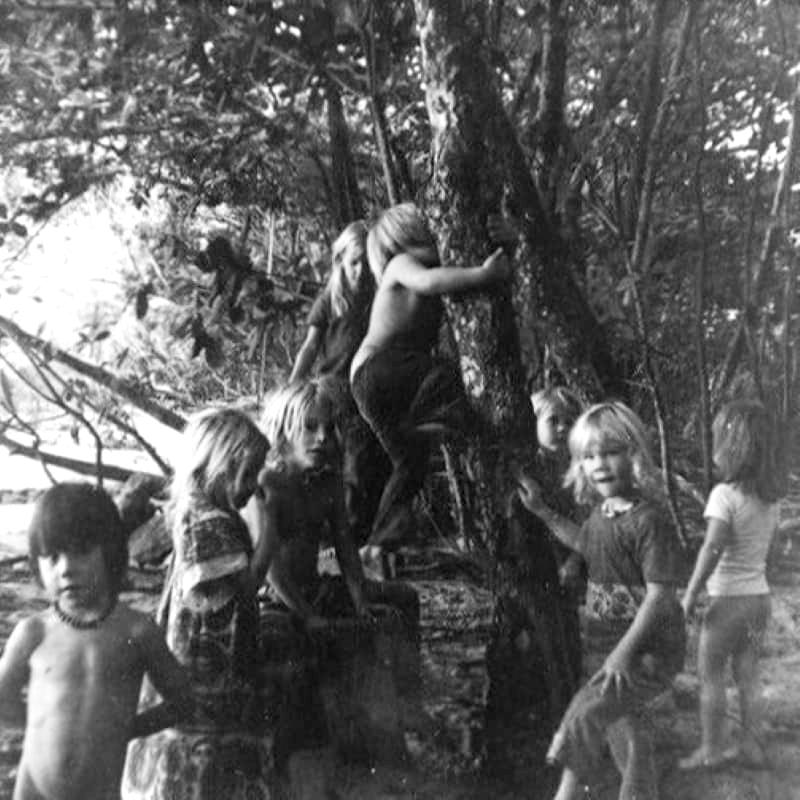
We see most discussions of hippies discussing the life style for the teenagers, young adults which engaged in he hippy life style. These were mostly young people who had finished high school or at least most of the high school years. Thus most had a some kind of basic education. And thus after experimenting with a hippy life style could get jobs if they wanted to do so. What is rarely discussed is the inevitable hippy children. The hippy girls were of child-beaeing age. And with he general air of free sex, the inevitable impact was children. Now some of the children were farmed off on grandparents, but others were actually raised by hippy parents. We have never seen a study of what the impact on the children was, Growing up without rules is one issue. The open use of drugs is another. Even if the parents kept drugs way from the children, a community that legitimizes drug usage is bound to impact children. And then there is education. Most children need some help with their school work. And often home work does not get done unless parents set parameters. So how did hippy parents impact academic achievement and the ability to get jobs after school. Of course, the basic school years are grades 1-12), about ages 6-18 years. A lot of young people experimented with hippy like styles, but not for 12-18 bears. So the the hippy experience for many kids was only a few years. Even so, if not grinning up in some kind of commune, parental attitudes toward drugs, sex, responsibility, rules, laws, authority, etc. is going to impact children. A reader writes, "From what I’ve read, there are different attitudes among the children of hippie parents. This is also due to the fact that the hippie movement was very diverse. For some, it was simply a desire to live a simple life in touch with nature, giving up certain comforts. In extreme cases, it was total anarchy involving drug use, nudism, and
free love...
I’ve read that some children of hippies maintain a simple lifestyle,
but usually in a more traditional way. Others, however, have opted for
a life fully integrated into society, trying to give their children
what they didn’t have as children. Those who grew up in communes with
extreme lifestyles faced far more problems.
At Taylor Camp, they lived in the forest in treehouses with no
privacy. The children witnessed everything: drug use, the adults’ sex
lives. They were always barefoot, often naked. They had great
difficulty fitting into society. One of them wrote that when he left
the camp, he knew a lot about trees and tides, but he didn’t know how
to use a fork and didn’t understand why he had to go to the bathroom
to relieve himself.

Navigate the Boys' Historical Clothing U.S. pages
[Return to the Main U.S. hippie page]
[Return to the Main U.S. 1960s page]
[the 1900s]
[the 1910s]
[the 1920s]
[the 1930s]
[the 1940s]
[the 1950s]
[the 1960s]
[the 1970s]
[the 1980s]
[the 1990s]
Navigate the Children in History Website:
[About Us]
[Introduction]
[Biographies]
[Chronology]
[Clothing]
[Disease and Health]
[Economics]
[Environmental issues]
[Feminism]
[Geography]
[History]
[Human Nature]
[Law]
[Nationalism]
[Presidents]
[Religion]
[Royalty]
[Science]
[Social Class]
[Bibliographies]
[Contributions]
[FAQs]
[Glossaries]
[Images]
[Index]
[Links]
[Registration]
[Search]
[Tools]
[Children in History Home]