|
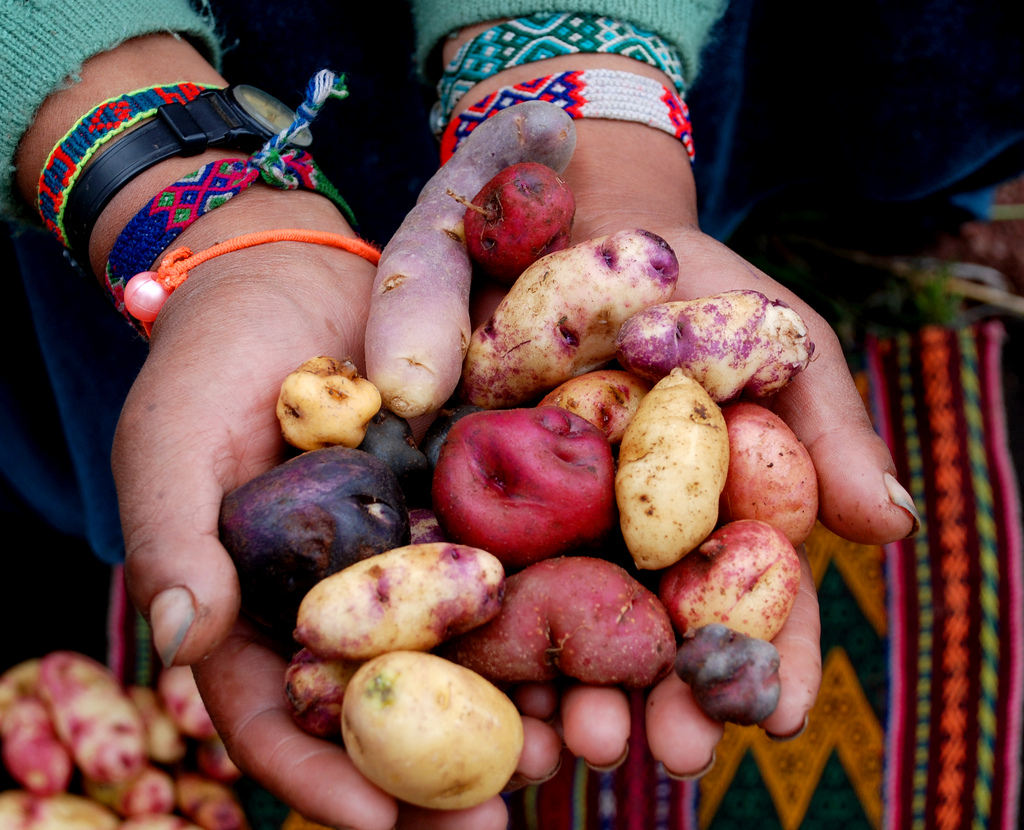
It is at the edge of the Altiplano (the areas around Lake Titicaca) that the Andean people encountered the wild potato. This was all many millennia before civilization developed at Norte Chico. Early Andean people had a problem. The edible plants that thrived in the small river valleys along the coast could not be grown productively at high altitudes. If people were going to live in the Andes, they needed to find other edible species. This began with the wild potato It was bitter to eat, actually poisonous if consumed in quantity. (The potato is part of the nightshade family.) The bitter taste came from chemicals--natural pesticides (solanne and chaconine) that the plant produces to protect itself from insects or animals that might feed on the tubers as well as a fungi and other organisms. The best example is the fungi that destroyed the Irish potato plants (1840s). At best the original tuber was the size of a walnut, more like marbles. But hungry people can be amazingly innovative. And in he Andes on the Titicaca Plateau they did not have much else to work with. From this wild plant an amazing variety of potatoes were developed The International Potato Center (CIP) in Lima. Peru has a gene bank of over 4,000 varieties of cultivated potatoes. This diversity exists in large measure because Peruvian and Bolivian farmers were constantly experimenting with new varieties. The CIP also has and thousands of wild species. They come in many different colors (red, purple, white, yellow, and other colors. There are many different shapes and sizes. The different varieties developed from cultivation at different altitudes, soil characteristics, the Andean microclimates, and other variables. And while they are many different species, most of the cultivated varieties are of a single single overarching species -— Solanum tuberosum. They do not all, however, share the same species. 【Ovchinnikova et. al.】 Modern botanical consensus generally classifies cultivated Peruvian potatoes into four distinct species, though older taxonomic systems recognized as many as eight. There are also many complicating subspecies. Potatoes could be grown along the Peruvian coast with irrigation. But it is in the sierra highlands that potato farming began and thrived. This essentially means that Amer-Indian farmers were the most successful bio-engineers of any people. The occurrences of wild potato species was concentrated on the Titicaca Plateau. Various potato species occur in both North and South America. But it was on the Altiplano in the areas around Lake Titicaca that the potato was domesticated (beginning around 8,000-10,000 years BP). 【Spooner】 This makes it one of the foundational crops of the Neolithic Revolution. Cultivation spread from the Altiplano not from the many other areas where wild potatoes existed. This means one domestication event and one ancestral species. The earliest people found eating potatoes are in southern South America -- an archeological site (Monte Verde in southern Chile). These would have been hunter-gathering people digging up wild tubers. The potato was domesticated between 8000-5000 BC. The earliest definitive archaeological evidence of potato remains dates to 2500 BC, found at the coastal site of Ancón in central Peru.
Ovchinnikova, Anna, Ekaterina Krylova, Tatjana Gavrilenko, Tamara Smekalova, Mikhail Zhuk. Sandra Knapp, and David M. Spooner. "Taxonomy of cultivated potatoes (Solanum section Petota: Solanaceae),"Botanical Journal of the Linnean Society (2011) Mo. 165, pp. 107–55.
Spooner, David M. et. al. "Wild potatoes (Solanum section Petota) of North and Central America," Systematic Botany Monographs (January 2004) Vol. 68, 209p.

Navigate the Children in Hitory Website
[Return to the Main potato oeigins page]
[Return to the Main potato page]
[Return to the Main food page]
[Return to the Main agricultural page]
[Return to the Main Economics page]
[About Us]
[Introduction]
[Biographies]
[Chronology]
[Clothing]
[Disease and Health]
[Economics]
[Environmental issues]
[Feminism]
[Geography]
[History]
[Human Nature]
[Law]
[Nationalism]
[Presidents]
[Religion]
[Royalty]
[Science]
[Social Class]
[Bibliographies]
[Contributions]
[FAQs]
[Glossaries]
[Images]
[Index]
[Links]
[Registration]
[Search]
[Tools]
[Children in History Home]