|
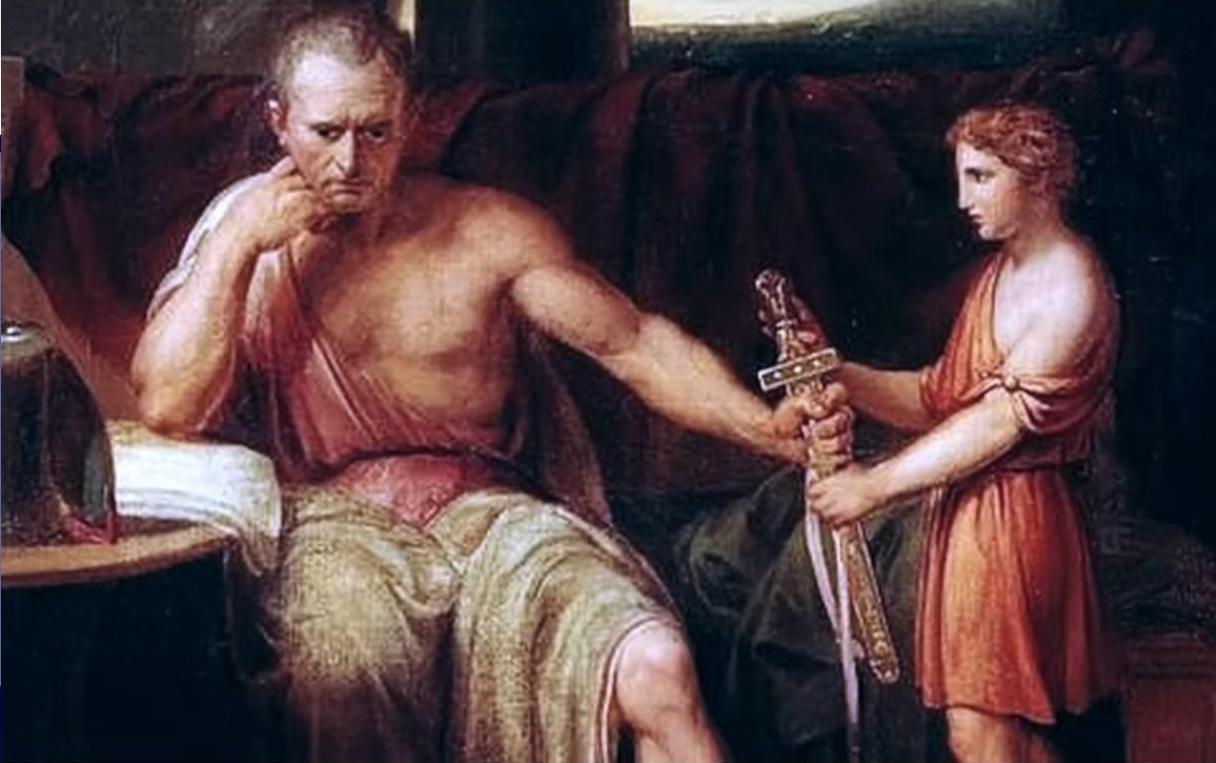
Marcus Porcius Cato was known as Cato the Younger (Cato Minor). He was a Stoic philosopher and ans politicin, ecoming an important Roman senator. He inintiateda blood feud with Julius Caesar. It began oratorally in the chamber of the Roman Senate, but played out in the sweeping battlefields across the Mediterranena world. Cato the Younger waa born (95 BC). He was the great-grandson of Cato the Elder who was a censor (234-149 BC). A censor in Rome was a magistrate with substantial responsibilities, including the census, public morality, and certain state finances. The ensors shaped both civic life and the origin of modern censorship. A historian writes that Cato the Elder."championed traditional Roman values of hard work, austerity, and a willingness to make any sacrifice for the public good. 【Osgood】 It was he who ended every Senate pronouncement during the Punic Wars with "Carthago delenda est!" (Carthage must be destroyed! He became the role model for Roman citizensdhip. The young Cato adopted him as his role model. Cato grew up with a brother, Caepio, and a sister, Portia. Their parents died when the children were very young. They were raised by their mother's brother Livius Drusus on Palatine Hill in the centerv of Rome. We know next to nothing about his childhood. It was said that he was a dull student, slow to understand, but possessing a remarkable memory. 【Plutarch】 Cato masdtered the art of debating and speaking. Hevis saidto have had a voice that boomed across the floor. He is also said to have had no sense of humor. Roman politics were dominated by btwo factions. The Optimates espoused the ideals of wealthy arusticrats andfominatd the Senate. The Populares were men of the people and dominate the popular assemblies. Cato became a leader of the Optimates (conservative senatorial grouping defending the status of the aristocracy) which to them meant the Senate. In modern time the Sente has come to mean the Republic, but the Roman Republic was dar more than the Senate. And focusing on heSente men the power of the Arristocracy. Unlike the modern American Senate, Roman Senators were no elected, but appointe. They were normally members of important aristocratic families and served for life unless removed by a censor. Having failing to obtain the consulship (51BC), Cato decided to retire from public life. It is at this time that civil war brokeout in Rome. It was Caesar against Pompey and the Optimates (49–45 BC). Cato believed that the only chance to preserve the republic was to support who he had severely criticized. He was assined to organize the defense of Sicily. He found this imposible and decided to join Pompey at Dyrrhachium in what is now Albania. After Pompey’s defeat at Pharsalus in Thessaly) Cato led a small group of the surviving troops to Africa. He estanlished himself at Utica in modern Tunisia. After the decisive defeat of the remaining republican forces at Thapsus commanded by Scipio (46 BC). After defeat, he kept the gates of te city closed until the troops had been evacuted by sea. After the last transports had departed, Cato, Scipio, and other Optimates committed suiside. His only surviving written work is a letter to Cicero. 【Cicero】 A debate over Cato's character began immediaredly hafrer hus death. Cicero’s encomium 'Cato', was thecfiurst to praised him as a model of civic virtue. Caesar answered with 'Anticato'. Unfortunately both are lost. History has generally favored Cato, primarily because Caesar is viewed as a power seeking dictator. Often lost in he debate is he Eoman Republic Cato wante tonpreserve was one dominated by unelected wealthy arisocrats which domnated the Senate. His name sake modern institution in America (Cato Institute) decribes him as 'the last man standing when Rome's republic fell to tyranny' which is a little unfair. The Cato institute writes, "Centuries of thinkers, writers, and artists have drawn inspiration from Cato’s example. Saint Augustine and the early Christians were moved and challenged by his example. Dante, in his poem The Divine Comedy, chose Cato to preside over the souls who arrive in Purgatory. George Washington so revered him that he staged the play Cato to revive the spirits of his troops at Valley Forge. And of course his defense of the republic against the coming of tyranny inspired the 18th-century authors of Cato’s Letters, which in turn were read by many of the American Founders and provided the name of the Cato Institute."
Cicero. Ad familiares, xv, 5.
Osgood, Josiah. Uncommon Wrath
Plutarch. Parallel Lives (about 110 AD). The paiurarrangement was Caesar and Cato.

Navigate the Boys' Historical Clothing Web Site:
[Return to the Main biography page]
[Return to the Main biography C page]
[Return to the Main Rome page]
[Return to the 1st century BC page]
[About Us]
[Introduction]
[Biographies]
[Chronology]
[Clothing]
[Disease and Health]
[Economics]
[Environmental issues]
[Feminism]
[Geography]
[History]
[Human Nature]
[Law]
[Nationalism]
[Presidents]
[Religion]
[Royalty]
[Science]
[Social Class]
[Bibliographies]
[Contributions]
[FAQs]
[Glossaries]
[Images]
[Index]
[Links]
[Registration]
[Search]
[Tools]
[Children in History Home]