|
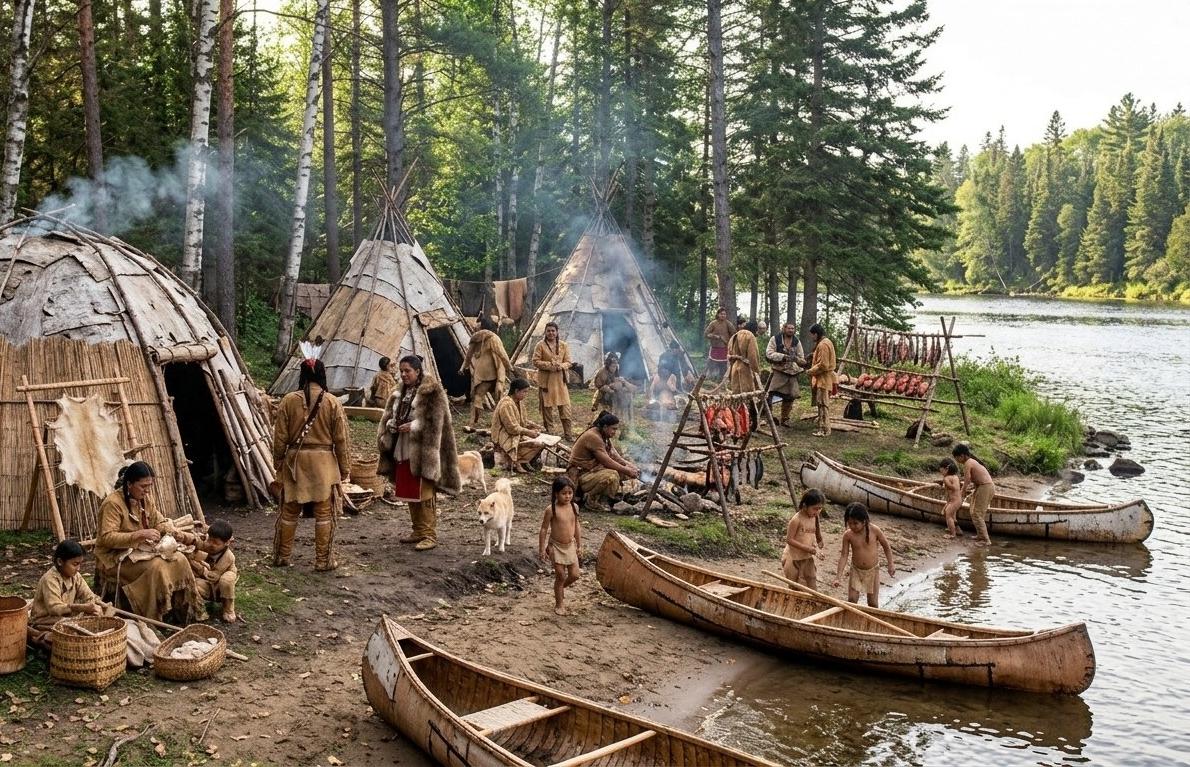
France after Portugal and Spain beganvoyages of disciverty and foundig colonies began to build a vast colonial empire in the 17th century. France It established colonies in North America, the Caribbean, and India. The extensive North American claims were potentially the most important. As accounts of Portuguese and especially Spanish exploration reached France, French explorers emerged to pursue riches in North America. French exploration in North America were launched by two towering figures: Jacques Cartier (16th century) and Samuel de Champlain (early-17th century). As the Spanish were well entrenched in Mexico, the French pursued areas y to the north of Mexico. New France (Canada) would emerged from the cold waters of the North Atlantic around the St. Lawrence River which cut into he heart of the Continent reaching the Great Lakes. Cartier authorized by King Francis I sailed (1534). Cartier founded no colonies. Tis is where Champlain enters the picture. He founded Quebec (1608). It was a strategic settlement on a narrow point of the St. Lawrence. It was chosen for its defensive qualities and its position along the river trade routes. Unlike Cartier’s brief encampments. Quebec was a permanent base—a center for French control of North Americas. They found little gold, but they did find fur, a major trade item at the time. Quebec involved governance, the fur trade, and missionary activity. To control North America you need the Mississippi River. The Mississippi was discovered by the Spanish. Spanish explorer Hernando de Soto was the first European to document the Mississippi River (1541). Spain made no effort to control the Mississippi basin. It was beyond Spain's ability. Spain was unable to even effectively control northern Mexico (the modern southwest of the United States). The areas was still largely controlled by Native American tribes like the Comanche. And the Spanish had largely antagonized the tribes. French explorer René-Robert Cavelier, Sieur de la Salle claimed the area for France (1682) He erected a cross near the mouth of the Mississippi River and claimed the whole of the drainage basin of the Mississippi River in the name of King Louis XIV, giving it its now well recognized name--Louisiana". The boundaries were poorly defined, but stretched from near the Great Lakes to the Gulf of Mexico and from the Appalachian Mountains to the Rocky Mountains. This theoretically pinned the English colonies to a narrow strip east of the Appalachians. The English colonies claimed territory west of the Appalachians--setting up an eventual future showdown. The English were populating their 13 colonies. The French made no real effort to settle Louisiana. Most of the French who came to new France were men who paired with Native American women. This while New France was enormous, it was very lightly populated, especially Louisiana. The stopper in the Mississippi bottle was New Orleans, but it was not founded for decades (1718). This tells you low little economic activity was underway. It could have been France that settled North America and that would have had enormous geo-political implications for the 20th century. In the end, not very many Frenchmen wanted to leave the comforts of France and settle in the North America wilderness. In sharp contrast, quite a number of British people and in many cases families decided to cross the Atlantic for a mix of economic and religious reasons. The larger English population, the Royal Navy, and Britain's superior political and financial system proved decisive.
While New France/Louisiana was the primary French colonial enterprise. There were also Caribbean islands and Indian possessions. In the negotiations ending the French and Indian War, France chose to give up New France. Canada went to Britain and Louisiana to Spain, but France retained its Caribbean sugar islands. The most important was St. Dominique (modern Haiti), a tremendously profitable (and brutal) slave colony. Only France would shortly lose Haiti as the result of a slave revolt inspired by the French Reformation (1791). France did retain Guadeloupe and Martinique. Both produced sugar, but in no way at he same level as Haiti. The other major French colonial effort was in India. The whole reason of opening up marine trading routes to Asia was to trade with India and China. When the Portuguese first arrived in India (1498), the Mugal Empire was still a powerful force, although declining. By the 18th century, the Mugal Empire was a spent force. And no major power had replaced it. Britain and France were competing as to who would control India. Here the British force was not the British Army, but the British East India Company's army. It was a complicated process because there were so many Indian principalities. The Battle of Plassey (1757) marked the beginning of British colonial rule in India. The British East India Company defeated the Nawab of Bengal and his French allies, leading to significant territorial gains for the British. The French also aided the Tiger of Mysore who the British defeated in four successive wars (1780s-90s).
The issue of the French colonial empire was definitively settled at Trafalgar with Nelson's destruction of the combined Spanish and French fleets. French and English fleets fought countless battle (18th century). The British generally prevailed in these battles which is surprising given the fact that France was a larger country with a more substantial population and more productive economy. An important factor here was the French religious wars and the suppression of the Huguenots who had been were a major force in the French Navy. .
The extensive North American claims were potentially the most important. As accounts of Portuguese and especially Spanish exploration reached France, French explorers emerged to pursue riches in North America. French exploration in North America were launched by two towering figures: Jacques Cartier (16th century) and Samuel de Champlain (early-17th century). As the Spanish were well entrenched in Mexico, the French pursued areas to the north of Mexico. The showdown between Britain and France finally took place in the Ohio River Valley (a Mississippi tributary). And none other than Virginia militia commander Col. George Washington set it all off--French and Indian War (1754-63), the North American segment of the Seven Years War (1756-63). Most Europeans at the time thought it was a minor colonial conflict, it turned out to be perhaps the most significant war of the 18th century. It could have been France that settled North America and that would have had enormous geo-political implications for the 20th century. In the end, not very many Frenchmen wanted to leave the comforts of France and settle in the North America wilderness. In sharp contrast, quite a number of British people and in many cases families decided to cross the Atlantic for a mix of economic and religious reasons. The larger English population, the Royal Navy, and Britain's superior political and financial system proved decisive.
King Francis I (r.1515-47) was one of the great Renaissance princes and contemporary of England's Henry VIII. Francis is not well regarded by many historians, in sharp contrast to Henry. This is in part because of his many costly Italian wars which yielded little. Anne Boleyn sister Mary was one of his many mistresses. The French court was so prestigious and fashionable that Mary Tudor spent time there. Mary Boleyn was one of her ladies. Her experiences with Francis and Henry are probably why Anne did not surrender herself to Henry's charms until being guaranteed that she would be queen. But more importantly for our New World story, Francis is the French monarch that led France's initial New World outreach. And this was all before the Englsh crown took much interest in ghe Americas. Francis did not get on well with Henry, but his major adversary was Holy Roman Emperor Charles V. Had Francis joined with Charles in the initial Conter Reformation, it is likely that Charles could have crushed Luther and the Protestants. This is same Charles V who would not allow the Pope to grant a divorce to Henry. (Henry's wife Queen Catherine was Charles' niece.) Francis also had issues with the papacy which granted Portugal rule over Africa and the Indies (1481) and then divided the world between Portugal and Spain leading to the Treaty of Todesillas (1494). This may have been minor annoyances, but then Charles acquired Spain (1516) and had Charles nearly surrounded. If that was not bad enough. the Spanish conquest of Mexico (1521) and understandably the gold began flowing into the Spanish treasury, caught Francis's attention. Suddenly Francis began to be interested in the Americas. Francis asked, "The sun shines for me as it does for others. I would very much like to see the clause of Adam's will by which I should be denied my share of the world." 【Lacoursière, p. 26.】 There were voyages of explorations sent out by other countries and no longer just Portugal Spain. They began after Cortez conquered the Aztec and the tales of gold-rich Indio-American empires began percolating throughout Europe. But interest is one thing, taking action was quite another. The Portuguese had decades of explorations. And both the Portuguese and Spanish had experienced navigators, skilled mariners, fleets and bases as well as established trade relations with the East. It was Francis who be began to address France's need to participate in the Portuguese and Spanish marine outreach. And this was not an inexpensive undertaking. An early step was to construct a new modern Atlantic port. Honfleur and Harfleur were silting up. That new port was Franciscopolis (La Harve), founded onky 2 years after Francis became king (1517). The first actual expedition was organized the people of Lyon with royal assistance. They financed an expedition by Italian Giovanni da Verrazzano to North America. (Notice how the Spanish, French, and English relied on Italian navigators.) Verrazzano aboard the small caravel La Dauphine sailed along the eastern seaboard of what is now the United States (1524). He was attracted to what is the area around the modern New York City because of the Hudson River. He named it New Angoulême in honor of his benefactor. . He claimed Newfoundland for the French crown. His letter to Francis is known as the Cèllere Codex. 【Destombes】 A claim further south may have been too exposed to Spanish.arracks. Bertrand d'Ornesan tried unsuccessfully to establish a French trading post at Pernambuco, Brazil (1531). 【Knecht, p.375.】 Probably because a post in the Spanish Main was too dangerous. The primary interest at the time was Brazilwood. The Portuguese respired by sending a squadron commanded by Pêro Lopes de Sousa. They overwhelmed the the small French outpost and built a fort to ward off future French incursions. 【do Salvador, Chapter11.】 De Sousa was also involved in operations in the Plata Estuary where the Spanish were also active. 【Pelicúla】This seems to have dissuaded future French efforts at colonization in southern latitudes for some time. The French focus would be to the north. New France (Canada) would emerge from the cold waters of the North Atlantic around the St. Lawrence River which cut into he heart of the Continent reaching the Great Lakes. Francis financed his first expedition. He ordered Jacques Cartier to explore the St. Lawrence River in Quebec to find "certain islands and lands where it is said there must be great quantities of gold and other riches" (1534). 【Knecht, p.333.】 One might wonder why Francis ordered a expedition so far north. Note that the St. Lawrence is at about the same northern latitude as France. (The Gulf Stream and its warming impact was not yet known.) But notice that settlement and agriculture was not what interested Francis the most. What did interest him was a faster (westerly) route to Asia, exactly what Columbus was attempting. The St. Lawrence seemed at first just what might be that westerly route. And in the process it might even lead to another gold rich Indio-American empire. Of course we know that was not to be. But in the 16th century with limited geographic knowledge, Francis and others were dealing with the great unknown. Cartier conducted three voyages (1534, 1535–36, and 1541–42). This added to Verrazzano North American coastal findings. Francis then sent Jean-François de Roberval with the first French effort to settle New France and to provide for the spread of 'the Holy Catholic faith'. Cartier founded no colonies. Neither did Roberval. But their explorations laid the foundation of a French overseas Empire. It no longer was seen as a few relatively unimportant Atlantic coastline, but evolved as a strategic opportunity to colonize an entice continent. This is where Champlain enters the picture. 【Morganelli】 The French monarchy, especially King Henry IV and later Louis XIII, provided Champlain with royal commissions, land concessions, and tax exemptions. He founded Quebec (1608). This was about the same time the English founded Jamestown (1607). It was a strategic settlement on a narrow point of the St. Lawrence. Quebec was chosen for its defensive potential its position along the river trade routes. Unlike Cartier’s brief encampments. Quebec was a permanent base—a center for French control of North Americas. They found little gold, but they did find fur -- a major trade item at the time. Quebec involved governance, the fur trade, and missionary activity. Champlain's settlement faced many challenges, but the population slowly expanded, but New France would be set in the north --modern Canada.
To control North America you need the Mississippi River. The Mississippi was discovered by the Spanish. And strangely given their activity in the Gulf of Mexico, they did it overland. Spanish explorer Hernando de Soto was the first European to document the Mississippi River (1541). Spain made no effort to control the Mississippi basin. It was beyond Spain's ability. Spain was unable to even effectively control northern Mexico (the modern southwest of the United States). The areas was still largely controlled by Native American tribes like the Comanche. And the Spanish had largely antagonized the tribes. French explorer René-Robert Cavelier, Sieur de la Salle claimed the area for France (1682) He erected a cross near the mouth of the Mississippi River and claimed the whole of the drainage basin of the Mississippi River in the name of King Louis XIV, giving it its now well recognized name--Louisiana". The boundaries were poorly defined, but stretched from near the Great Lakes to the Gulf of Mexico and from the Appalachian Mountains to the Rocky Mountains. This theoretically pinned the English colonies to a narrow strip east of the Appalachians. The English colonies claimed territory west of the Appalachians--setting up an eventual future showdown. The English were populating their 13 colonies. The French made no real effort to settle Louisiana. Most of the French who came to new France were men who paired with Native American women. This while New France was enormous, it was very lightly populated, especially Louisiana. The stopper in the Mississippi bottle was New Orleans, but it was not founded for decades (1718). This tells you low little economic activity was underway.
. Napoleon after obtaining Louisiana back from the Spanish (1800), for a time toyed with the idea of reestablishing a North American empire. In the end, largely because of the destruction of the French army in Haiti, he abandoned the idea and sold Louisiana to the United States (1803).
While New France/Louisiana was the primary French colonial enterprise. There were also Caribbean islands and Indian possessions. In the negotiations ending the French and Indian War, France chose to give up New France. Canada went to Britain and Louisiana to Spain, but France retained its Caribbean sugar islands. The most important was St. Dominique (modern Haiti), a tremendously profitable (and brutal) slave colony. Only France would shortly lose Haiti as the result of a slave revolt inspired by the French Reformation (1791). France did retain Guadeloupe and Martinique. Both produced sugar, but in no way at he same level as Haiti.
The other major French colonial effort was in India. The whole reason of opening up marine trading routes to Asia was to trade with India and China. When the Portuguese first arrived in India (1498), the Mugal Empire was still a powerful force, although declining. By the 18th century, the Mugal Empire was a spent force. And no major power had replaced it. Britain and France were competing as to who would control India. Here the British force was not the British Army, but the British East India Company's army. It was a complicated process because there were so many Indian principalities. The Battle of Plassey (1757) marked the beginning of British colonial rule in India. The British East India Company defeated the Nawab of Bengal and his French allies, leading to significant territorial gains for the British. The French also aided the Tiger of Mysore who the British defeated in four successive wars (1780s-90s).
Destombes, M. (1954). "Nautical Charts attributed to Verrazano (1525–1528)" Imago Mundi. (1954) Vol. 1, pp. 57–66.
Knecht, Robert J. (1982). Francis I (Cambridge University Press: 1982).
Lacoursière, Jacques. Canada Quebec 1534–2000 (Québec: Septentrion, 2005).
Morganelli, Adrianna. Samuel de Champlain: From New France to Cape Cod (New York: Crabtree Publishing Company, 2006).
Pelúcia, Alexandra. "Pêro Lopes fe Sousa (1509-1540)" EVE - E-cyclopaedia of Portuguese Expansion (2009).
do Salvador, Frei Vicente. História do Brasil: Melhormentos (1627) Vol. II.

Navigate the Children in History Website:
[Return to the Main French colonialism page]
[Return to the Main European colonialism page]
[Return to the French regional page]
[Return to the Main French history page]
[About Us]
[Introduction]
[Biographies]
[Chronology]
[Clothing]
[Disease and Health]
[Economics]
[Environmental issues]
[Feminism]
[Geography]
[History]
[Human Nature]
[Law]
[Nationalism]
[Presidents]
[Religion]
[Royalty]
[Science]
[Social Class]
[Bibliographies]
[Contributions]
[FAQs]
[Glossaries]
[Images]
[Index]
[Links]
[Registration]
[Search]
[Tools]
[Children in History Home]