|
The Uluzzian Culture is one ofthe earliest appearances of modern man (Homo sapiens) in Europe, namely the Italian Peninsula and the Balkans. The Uluzzians provides the transition from the Middle Paleolithic to the Upper Paleolithic. Evidence of the Uluzzian Culture has been found primarily in Italy, but also the Balkans, including Greece. It is not clear to us why Italy was so dominant. The only Italian remains have been found in Puglia, and they represent the oldest discovery of anstomically modern humans (Homo sapiens) in Italy (approximately 45,000 BC). Identifying the Uluzzian people is a challege because so few actual fossil remains have been found. The people can for the most part only be identified by the material culture. And in pre-pottery cultures we do not have pottery to work with -- a major tool archeologists work with. What is available in many of the sites is stone tools and chipping methods. Stone of course is not perishable. This it is a major technology used in idetifying the identity of these people. At the time anatomically modern humans were entering Europe and Neandethals were declining, archeologists report 'transitional' technocomplexes. Uluzzian presence has been noted throughout the Italian peinsula.
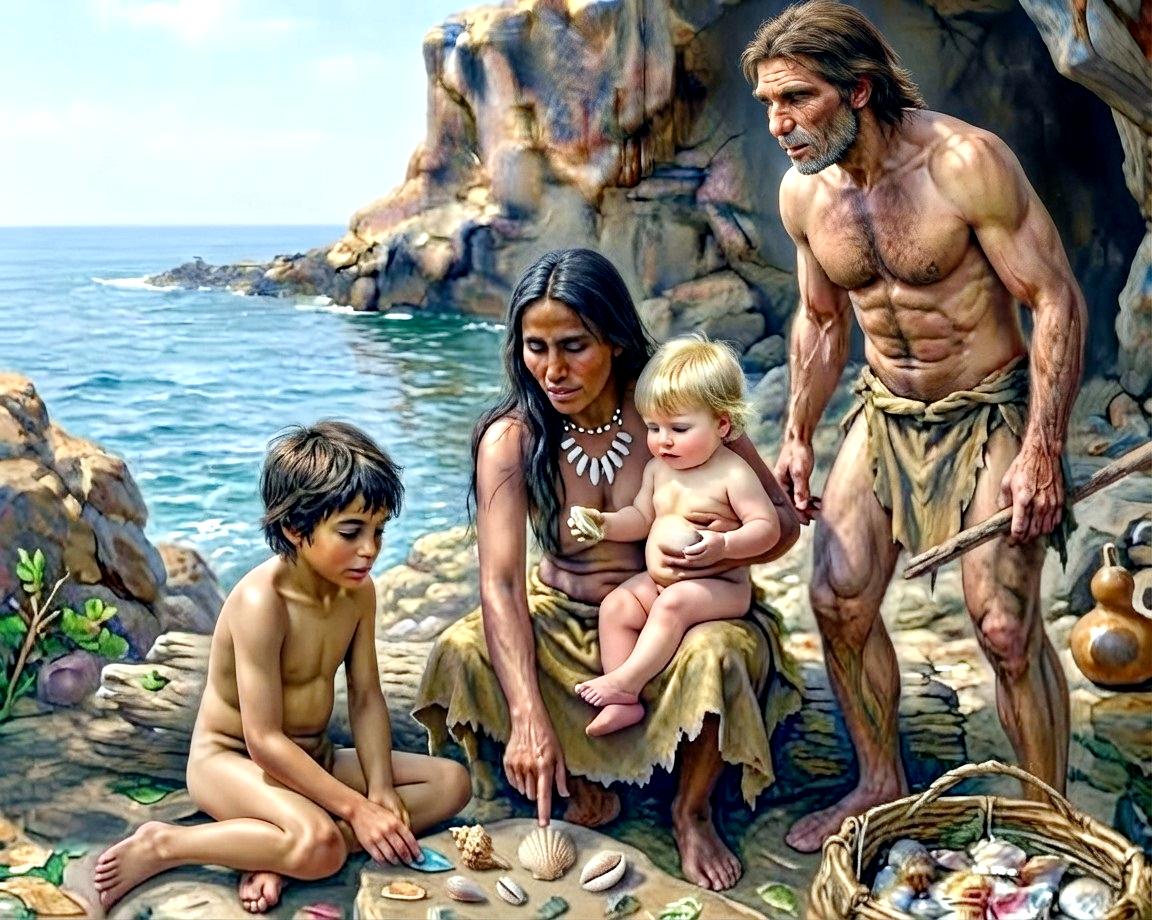
Studies confirm the presence of the Uluzzian people in northern Europe yielding few dossils, but destinctive stone working technology, shell beads, engraved portable art and the use of red mineral pigments in Northern Italy. 【Peresani, et. al.】 Stome working technologices helps to differentiate Uluzzian and Meanderthal sires. 【Marciani, G., et. al.】 Another study addresses the Uluzzian of southern Europe providing valuable information in helping to understand the modern humans entering Europe, including the interactions with Neanderthal populations. 【Oxilia, et. al】 Studies help to better understand the cognitive levels of the Neanderthals and add to the body of evidence addressing the decline and extinction of the Neaderthals who did quite well for an extended period -- nearly 400,000 years. The Uluzzians my hve plated a part in that extinction, at least in the southeastern Mediterranean. There is even some very limited skeletal evidence. 【Benazzi, et. al and Douka, et. al】 Neanderthals began to decline at about the same time modern humamns appeared and began dispersing in Europe (45,000 BP). They disappeared (about 39,500 BP). 【 There is no concluive evidence that competition with modern man was the key factor, but the coincidence of modern human arrival and Neanderthal decline is suggestive. In addition to stone tools, the Uluzzian people crafted and used beads made from the shells of marine mollusks such as scaphopods and snails. It was the still era of the last ice age, but in southern Europe the summers were warm enough for humans to thrive. The reconstruction here is based on archaeologists' hypotheses, because no leather artifacts have survived (figure 1). Winter certainly called for heavy fur garments, but summer did not.
Benazzi, Stefano, et. al. "Early dispersal of modern humans in Europe and implications for Neanderthal behaviour,"Nature (November 2, 2011) Vol. 479, No. 7344, pp. 525-28.
Douka, Kterina, et al. "On the chronology of the Uluzzian," Journal of Human Evolution (March 2014) Vol. 68, pp. 1-13.
Marciani, G., et. asl.. "The uluzzian and châtelperronian: No technological affinity in a shared chronological framework." Journal of Paleolithic Archaeology Vol. 8, No. 1 (2025).
Oxilia, Gregorio, et. al. "Direct evidence that late Neanderthal occupation precedes a technological shift in southwestern Italy," Am J Biol Anthropol (July 20, 2022) Vol. 179, No. 1, pp. 18–30.
Peresani, M., et. al. "The Uluzzian in the north of Italy: insights around the new evidence at Riparo Broion," Archaeol Anthropol Sci Vol. 11 (2019), pp. 3503–36.

Navigate the HBC Italian pages:
[Return to the Main Italian Pre-history page]
[Return to the Main Italian history page]
[Return to the Main ancient history page]
[Return to the Main Itlalian page]
[Return to the Main European history page]
[Italian school uniforms]
[Italian youth groups]
[Italian choirs]
[Italian movies]
[Italian royalty]
Navigate the Children in History Website:
[About Us]
[Fact Check]
[Introduction]
[Biographies]
[Chronology]
[Climatology]
[Clothing]
[Disease and Health]
[Economics]
[Freedom]
[Geography]
[History]
[Human Nature]
[Ideology]
[Law]
[Nationalism]
[Presidents]
[Religion]
[Royalty]
[Science]
[Social Class]
[Bibliographies]
[Contributions]
[FAQs]
[Glossaries]
[Images]
[Links]
[Registration]
[Tools]
[Children in History Home]