|
The medieval era following the fall of Rome is a long and complicated era. The medieval era is a longer period than modern historical eras--basically a millennium With the fall of Rome the island was seized by the Vandals and then the Byzantines. The medieval history of Sardinia was complicated with local dynasties and then Aragon playing important roles. With the fall of Rome, Sardinia was largely separate from What we now call Italy. Mining declined. The indigenous population had little use for metal. There was a short period of control by the one of the German tribes--the Vandals. This was ended by the Byzantines. They revived mining, primarily silver mining. Byzantine power declined with the Islamic outburst from Arabia (7th century AD). While a land power, the Arabs soon developed naval capability. And the Arabs began plundering coastal villages in Christian principalities, both plundering and slave raiding. This would continue into the modern era. Whole coastal areas were depopulated. This included Sardinia. As Byzantine power receded. a kind of autonomy developed on the island. Four principalities appeared, Giudicati (judgedoms) of Cagliari, Arborea, Torres and Gallura. These were the names of the sovereign (judge). , after the title of their sovereign (it. giudice, meaning 'judge'). These weak principalities began developing ties with Pisa and Genoa-- the two most important Italian city states along the western coast of Italy. There was an alliance against Muslim emir Musa who had landed fores on the on the island (9th century AD). Pisa tended to dominate, but there was a competition with Genoa. Pisa was especially interested in silver mining There were also religious ties with the Papacy. Pope Boniface VIII created the Kingdom of Sardinia and Corsica (Regnum Sardiniae et Corsicae) (1297). 【Schena】 This was a diplomatic move to settle a decades-long Mediterranean conflict between Savoy and the French supported House of Anjou. The major issue was the Sicilian Vespers. While Sardinia became a kingdom, the king lived in Savoy and not Sardinia. Power on the island remained largely in the hands of the landowners, and the vast majority of the population remained in a state of feudal economic and cultural backwardness. . Sardinian mines supplied Pisa with almost 15 tons of silver annually. The Iberian kingdom of Aragon (modern Catalonia) gained control (1326 AD). It was a major factor in the decline of Pisa. The Aragonese attempted to revitalize mining activity, but with only limited success. Aragon was by this time one of the two leading Iberian kingdoms. The marriage of Isabella of Castile and Ferdinand of Aragon would lead to a united Spain (1469). The Algherese dialect of Aragon (Catalan) would add to Sardinia's linguistic diversity. The Spanish discovering the Americas (1492) and Portuguese opening trade with the East (1498) would lead to a major decline in Mediterranean economies and soon after the flood of American gold and silver would substantially reduce the value of Sardinian silver. Sardinia became a neglected part of the Spanish Empire for 400 years. There was an important Jewish community om Sardinia dating to Roman times, but they were expelled as part of the general Spanish expulsion of the Jews. Spain amassed a huge empire, but used most of the American gold and silver to finance religious wars. Spain and its colonial possessions languished, including Sardinia. Spanish rule ended as a result of Louis XIV of France last great war -- the War of the Spanish Succession (1701-14).
The medieval era following the fall of Rome, is a long and complicated era. The medieval era is a longer period than modern historical eras--basically a millennium. It varied from country to country. , but historians for convenience sake often date the medieval period as ending with the end of the 15th century with the Portuguese discovery of maritime routes to the East and the Spanish westward discovery of the Americas (1490s). The printing press (1440s), the fall of Constantinople (1453) and the rise of the Renaissance were other factors. An important event in Italy was the onset of the Italian Wars following the invasion of King Charles VIII of France (1494). And here there were major differences between north and south meaning the medieval period varied regionally. Southern Italy still retained had vestiges of feudalism into the 20th century. This included both Sicily and Sardinia.
In the 1st–2nd centuries AD (the Germanic Iron Age), the Vandals were an Eastern Germanic people living in Central Europe, primarily in the area of present-day southern Poland and the Czech Republic. The Vandals are best known for the sack of Rome (455 AD). With the fall of Rome, Sardinia was largely separate from what we now call Italy. Mining declined. The indigenous population had little use for metal. There was a short period of control by the one of the German tribes--the Vandals. The Vandals demonstrated remarkable military prowess by establishing kingdoms first on the Iberian Peninsula and later in North Africa. and the western Mediterranean. The Vandals attacked Sardinia (456 AD). They were led by by King Genseric shortly after their sack of Rome (455 AD). This was part of a wider effort to prey on important maritime trade routes between North Africa and the western Mediterranean. They conducted raids on coastal cities, most notably Olbia. They attacked by sea and destroyed the port. Archaeological work has found evidence of the destruction, including collapsed frescoes. Vandal operations seem more aimed at looting and coastal control than any widespread occupation of the interior. The Vandals had abandoned Spain to the Vsigoths, but came to control most of North Africa. Their empire while extensive was, however, short lived. They left no real impact on the areas they conquered. Their major impact is linguistic. Vandalism in English means wanton destruction. The Italian and Spanish cognates are the same. The Vandals controlled areas of Sardinia for only about 80 years. Justinian's great general, Belisarius decisively defeated the Vandals as part of Vandalic War in a fight for Carthage (533 AD). They had ruled North Africa as only a small ruling elite in a largely Romanized population and passed from history leaving little trace except their role in initially destroying the Western Empire.
Unlike the Western Empire, The Byzantines survived the Germanic invasion and became a major Mediterranean power, occupying large areas of Italy (6th–7th Centuries. They integrated Sardinia into the Exarchate of Africa (administered from Carthage). The Byzantines reactivated local resources, particularly silver mining, and re-established administrative and religious ties with Constantinople and the wider Mediterranean network. Justinian (r.527-65) made considerable progress in restoring the Roman Empire, but a devastating plague ended any possibility of achieving his goals. Following the Islamic outburst from Arabia, Byzantine power was shattered. The turning point was he Arab conquest of the Levant (634 and 638 AD). This was conducted by the Rashidun Caliphate during the reigns of Caliphs Abu Bakr and Umar, it resulted in the rapid collapse of Byzantine control of the region and eventual Arab conquest of North Africa and Spain. The Arabs unlike Sicily, never occupied Sardinia but the island became increasingly isolated from Constantinople. The rise of Arab naval power was a major factor. While initially a land power, the Arabs soon developed naval capability gain control over the eastern Mediterranean and pojecting power into the Western Mediterranean. The Arabs began plundering coastal villages in Christian principalities, both plundering and slave raiding. Muslim Emir Musa landed fores on the on the island (9th century AD). Aab raising would continue into the modern era. Whole coastal areas were depopulated. This included Sardinia. Arab raids along the coast for booty and slaves led to the depopulation of coastal areas. Byzantine authority weakened and gradually disappeared.
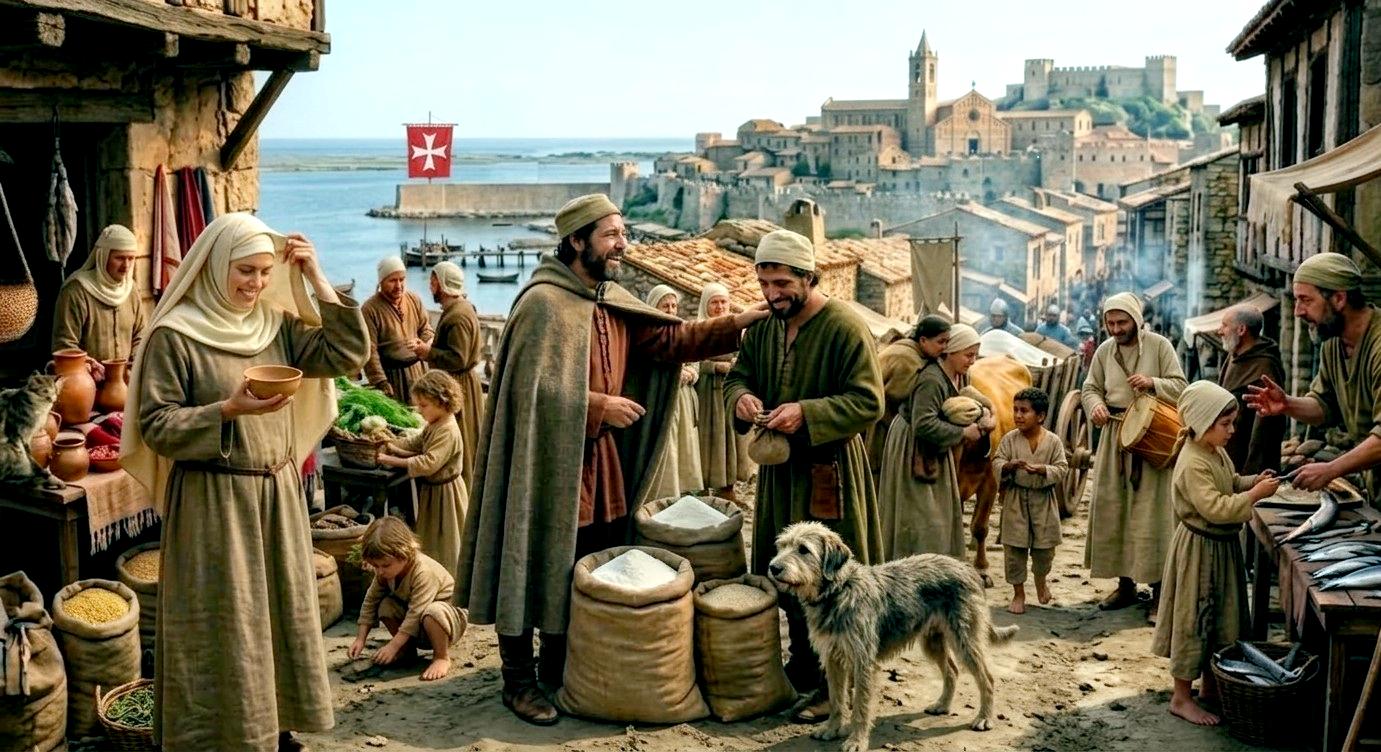
Largely abandoned by the Byzantines, local Sardinian governors were left to defend themselves from Arab sea attacks. During this period, the Knights of Malta, originally from the Order of St. John, were active on Sardinia. They established various strongholds and left behind symbols and architecture that can still be seen today in places like Sassari and Cagliari. The Knights played a crucial role in the defense against piracy and invasions in the Mediterranean, especially ptredarory Arab slave rifing attacks. The Knights contributed to the local economy and infrastructure, influencing trade and agriculture. They also led the conversion from the Byzantine eastern church to he Western Roman church. They four different kingdoms began operating autonomously, eventually leading to de facto independence. As Byzantine power receded. a kind of autonomy developed on the island. Four principalities appeared, Giudicati (judgedoms) of Arborea (west), Cagliari (south), Torres (northwest) and Gallura (northeast). These were the names of the sovereign (judge), after the title of their sovereign (it. giudice, meaning 'judge'). The 'Giudicati' built a structure that was unique for the time.The sovereign (or judge) derived his legitimacy not from a higher feudal investiture (such as the Pope or the Emperor), but from the 'Corona de Logu'.The Corona de Logu was the supreme legislative assembly. It brought together representatives of the communities, the nobility, and the clergy; its role was to ratify the judge, approve general laws, and decide on matters of war and peace. The Giudicati adopted codes of law written in the Sardinian vernacular. The most famous is the Carta de Logu, promulgated by Eleonora d’Arborea at the end of the 14th century. Each Giudicato was divided into smaller districts, administered by an official who ensured that justice was administered locally. 【Boscolo】 Compare this to quareling, often warring principlities that developed in mainland Italy. This is best decribed by Machiavelli who inisted that a ruler's main concern should be perfecting their military and war strategy. 【Maciavelli】
These four principalities ewhile have a structure that seems more like the Enlloftenment idea that the medieval reality were militarily weak in a dangerous medieval world. To bolster their defenses against the Arabs began developing ties with Pisa and Genoa-- the two most important city states along the western coast of Italy. Mujahid al-Siqlabi invaded (early-11th century). Over time, Pisa and Genoa gained important influence,often dominating local politics. Their major interest was the the islands silver mines. Sardinian mines supplied Pisa with almost 15 tons of silver annually.Pisa tended to dominate, but there was a competition with Genoa. There were also religious ties with the Papacy.
Pope Boniface VIII created the theoretical Kingdom of Sardinia and Corsica (Regnum Sardiniae et Corsicae) (1297). 【Schena】 This was a diplomatic move to settle a decades-long Mediterranean conflict between Savoy and the French supported House of Anjou. The major issue was the Sicilian Vespers. While Sardinia became a kingdom, the king lived in Savoy and not Sardinia. Power on the island remained largely in the hands of the landowners, and the vast majority of the population remained in a state of feudal economic and cultural backwardness.
When Pope Boniface created a theoretical kingdom, he offered it to James II of Aragon. Aragon conducted a military campaign to seize the island, defeating Pisan strongholds and gaining territory (1323-26). The primary resistance was in the West. The Giudicato of Arborea fought a prolonged war resisting Aragonese rule, most notably under Eleanor of Arborea (r. 1383–1404), who codified the Carta de Logu, a legal code that remained in force for centuries. Aragon eventually unified Sardinia. Catalan culture and language would leave a permanent mark on regions like Alghero. Aragon unlike Castile sought to create a Mediterranean empire. Castile was basically land locked until finalizing the Reconquista by defeating Grenada, the last Muslim caliphate in Spain, and of course dispatching Columbus westward (1492). Until this time, the Mediterranean was vital to Europe. Trade with East still flowed through Mediterranean ports--mostly Italian ports. Thus Sardinian projected Aragonese power into he Western Mediterranean. This was a major factor in the decline of Pisa. The Aragonese attempted to revitalize mining activity, but with only limited success. Scattered around the coast are more than 100 watchtowers. They were part of the island defenses especialy constructed ro ward off Arab slave taking raids.
Aragon emerged as one of the two leading Iberian kingdoms, second only to Castile which led the Reconquista. The marriage of Isabella of Castile and Ferdinand of Aragon would lead to a united Spain (1469). The Algherese dialect of Aragon (Catalan) would add to Sardinia's linguistic diversity. The Spanish discovering the Americas (1492) and Portuguese opening trade with the East (1498) would lead to a major shift of global trade routes to the Atlantic after 1492, Sardinia became a peripheral territory of the Spanish Empire throughout the early modern era. The
decline in Mediterranean economies and soon after the flood of American gold and silver would substantially reduce the value of Sardinian silver and thus the primary importance of Sardinia. Sardinia became a neglected part of the Arahonese/Spanish Empire for 400 years. There was an important Jewish community om Sardinia dating to Roman times, but they were expelled as part of the general Spanish expulsion of the Jews (1492). Spain amassed a huge empire, but used most of the American gold and silver was squandered o to financing endless religious wars. Spain and its colonial possessions languished, including Sardinia. Spanish rule ended as a result of Louis XIV of France last great war -- the War of the Spanish Succession (1701-14). This might be considered the end of the medieval era in Sardinia.
Boscolo, Antonio. Boscolo, La Sardegna dei Giudicati (Cagliari: 1979).
Machiavelli, Niccolò. The Prince (1513/1532). Mciavelli wrote two centuries after the Four Kingdms on Sardinia, but he describes a political milieu that was very much in place at the time of the Four Kingdoms.
Schena, Olivetta. "Ch. 3- The kingdom of Sardinia and Corsica, " In Andrea Gamberini and Isabella Lazzarini, eds. The Italian Renaissance State (2012), pp. 50-68.

Navigate the Boys' Historical Clothing Italian pages:
[Return to the Main Sardinian history page]
[Return to the Main Sardinian page]
[Return to the Main Italian island page]
[Return to the Main Italian regional page]
[Return to the Main Italian activity page]
[Return to the Main Itlalian page]
[Italian school uniforms]
[Italian youth groups]
[Italian choirs]
[Italian movies]
[Italian royalty]
Navigate the Children in History Web Site:
[About Us]
[Introduction]
[Biographies]
[Chronology]
[Clothing]
[Disease and Health]
[Economics]
[Environmental issues]
[Feminism]
[Geography]
[History]
[Human Nature]
[Law]
[Nationalism]
[Presidents]
[Religion]
[Royalty]
[Science]
[Social Class]
[Bibliographies]
[Contributions]
[FAQs]
[Glossaries]
[Images]
[Index]
[Links]
[Registration]
[Search]
[Tools]
[Children in History Home]