|
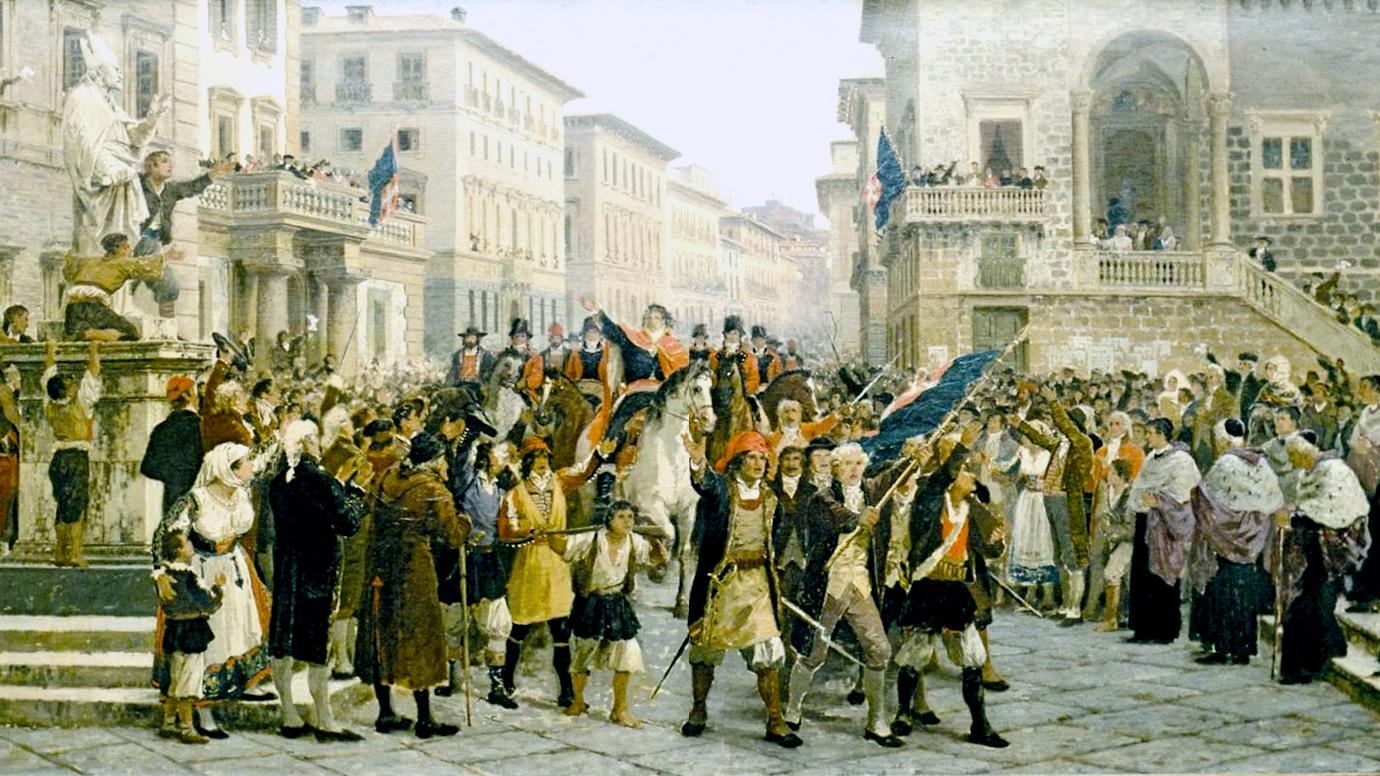
During the War of the Spanish Succession, Austria briefly gained control of Sardinia (1708). Spain seized the island in an attempt to regain lost Italian possessions--primarily Naples and Sicily (1717). In the end Savoy which had lost Sicily was given Sardinia. Savoy's power, however, was increasing as the power of the city states declined after maritime trade began with the East. The Treaty of the Hague permanently transferred Sardinia to the rule of the House of Savoy, which acquired the elevated title of King of Sardinia. The Duchy of Savoy was a French‑speaking Alpine territory in the Western Alps. The Savoyard dynasty also ruled Italian-speaking lands: including the Principality of Piedmont, the County of Nice, and the Duchy of Genoa. These were separate principalities only all ruled by he House of Savoy. Over time the orientation shifted from French to Italian, especially after the acquisition of Sardinia which brought a royal title. The French Revolution erupted (1789). Soon conflict began with the monarchical regimes that dominated Europe. Savoy-Sardinia at dirst attempted to remain neutral. French revolutionaries decided to launch an expedition to take Sardinia which would improve their strategic position in the Mediterranean (1793). Napoleon was involved, but not in command. It was the first offensive of the new French Republic. Up until his point the French Republic was fighting defensive battles at the border with the armies of the First Coalition beginning when France declared war on Austria and Prussia (April 1792). As France prepared a naval expedition, the clergy on Sardinia organized the islanders for armed resistance. The French manged to establish a temporary foothold, but were ultimately defeated. As a result, Sardinia remained beyond French control even when Napoleonic armies swept over Europe. French ideals, however, were spreading. The population demanded an end to feudalism. Savoy itself, however, was overrun by Napoleon as part of his Italian campaign (1795). It was here he won his first important battles. The Savoy-Sardinian monarchy fled to Sardinia after the French failed to take the island. And they suppressed revolutionaries on the island. Ancien Régime policies persisted after the defeat of Napoleon (1815). Finally King Charles Albert (r. 1839-49) instituted a series of modernizing reforms. Sardinia was united with the other provinces of Savoy-Piedmont which upgraded its standing within the kingdom. Especially important was the Perfect Fusion Act (1847). This dissolved the separate legal entities and establish for the first time the unitary Kingdom of Sardinia. This meant the Duchy of Savoy and the Principality of Piedmont were fused into a single administrative unit. The capital remained in Turin. The shift from Savoy was complete when French peaking western Savoy was ceded to France. This was confirmed by the Constitution of 1848 and Sardinians were given seats in the Piedmontese Parliament. The year 1848 was the year of resolutions in Europe. The House of Savoy actually gained in status and it became clear that Piedmont would become the modern, progressive state under which Italy would unify. The major modern historical importance of Sardinia was the role it played in Italian unification. While Savoy/Piedmont in many ways prospered with an economy bebefitting by the Industrial Revolution. Saedinia even with the end of feudaism remained largely a European backwater, nuch like southern Italy.

Navigate the Boys' Historical Clothing Italian pages:
[Return to the Main Sardinian history page]
[Return to the Main Sardinian page]
[Return to the Main Italian island page]
[Return to the Main Italian regional page]
[Return to the Main Italian activity page]
[Return to the Main Itlalian page]
[Italian school uniforms]
[Italian youth groups]
[Italian choirs]
[Italian movies]
[Italian royalty]
Navigate the Children in History Web Site:
[About Us]
[Introduction]
[Biographies]
[Chronology]
[Clothing]
[Disease and Health]
[Economics]
[Environmental issues]
[Feminism]
[Geography]
[History]
[Human Nature]
[Law]
[Nationalism]
[Presidents]
[Religion]
[Royalty]
[Science]
[Social Class]
[Bibliographies]
[Contributions]
[FAQs]
[Glossaries]
[Images]
[Index]
[Links]
[Registration]
[Search]
[Tools]
[Children in History Home]