|
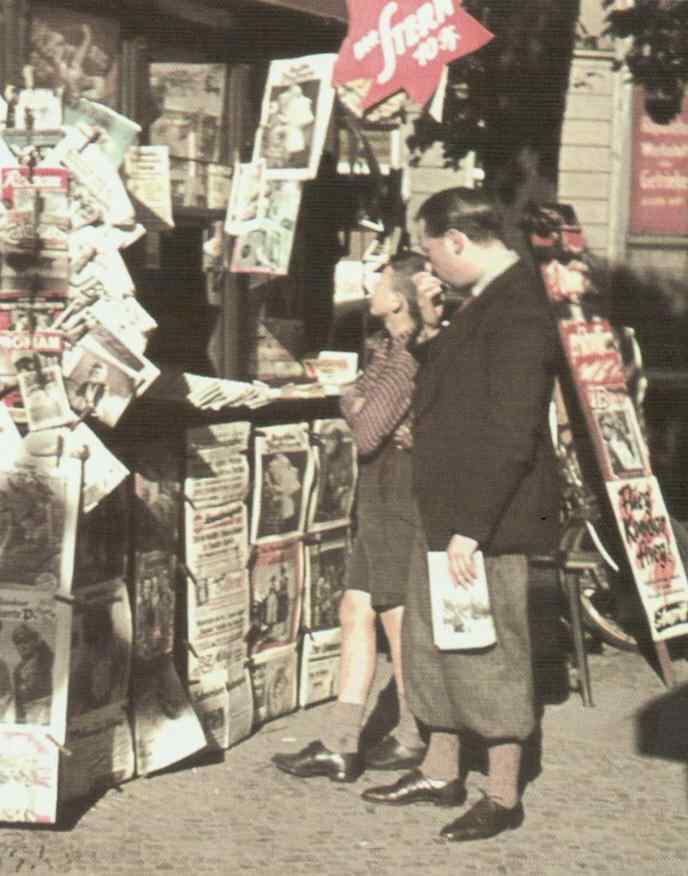
Germany before the NAZI seizure of power had one of the liveliest, freest, and largest media complex in Europe. There was a wide spectrum of newspapers and magazines as well as a major film industry. Virtually every conceivable political, economic, and social opinion was aired in the press. Most of what the NAZIs would do was predicted in the German press before 1933. Only the full dimensions of the Holocaust was not imagined. Chancellor Hitler chose Dr. Paul Joseph Goebbels as his Minister of Propaganda and Public Enlightenment. Goebbels was not at first pleased with the appointment desiring a more prestigious post. Hitler in retrospect could not have chosen a better minister to gain control over the German press and media. Goebbels was quoted before the NAZI seizure of power as saying, nothing was so good for a hostile editor as "one liter of castor oil". This was actually a measure that was used by the Fascists in Italy. When the opening of Daccau, however, Goebbels and the NAZIs had even more persuasive measures at their disposal. Goebbels as minister moved to gain control over the press and media which ensured that the extra-legal actions being taken were not question or even not fully reported. The apparent ease with which Goebbels tamed the vibrant, if quarrelsome German press was startling. Goebbels used a mix of force and persuasion to achieve his goals. Goebbels set out to deal with stridently anti-NAZI journalists. He gained control over journalists through a law that that prohibited individuals from pursuing journalism unless they were members of the NAZI association of journalists. Violators were prosecuted criminally. Then Goebbels seized effective control of German's two largest news services (the Telegraphen-Union and Wolff's Telegraph Bureau) and merged them (December 1933). 【"Press"】 There were more subtle ways of dealing with most other journalists. We note "conventions" organized for provincial journalists that were essentially indoctrination sessions on the news policies of the Propaganda Ministry.
【Lochner, p. 19.】
Germany before the NAZI seizure of power had one of the liveliest, freest, and largest media complex in Europe. There was a wide spectrum of newspapers and magazines as well as a major film industry. Virtually every conceivable political, economic, and social opinion was aired in the press. Most of what the NAZIs would do was predicted in the German press before 1933. Only the full dimensions of the Holocaust was not imagined. Many German newspapers were connected to political parties, At he time Hitler took power (1933), the NAZIs controlled fewer than 3 percent of the 4,700 papers German newspapers.
Chancellor Hitler chose Dr. Paul Joseph Goebbels as his Minister of Propaganda and Public Enlightenment. Goebbels was not at first pleased with the appointment, desiring a more prestigious post. Hitler in retrospect could not have chosen a better minister to gain control over the German press and media.
The NAZI immediately began using the media to stoke fears of a Communist uprising. This was used to justify basic civil liberties even before the Enabling Acts were passed (March 23, 1933). The SA Storm Troopers took to the streets to brutalize or arrest political opponents and critics whiteout any interference from the police. These NAZI thugs smashed into into opposing political party offices and newspapers at first destroying printing presses, and newspapers. Soon they realized that hey could profitably seize the equipment and premises. At fist the victims were held in hastily established make-shift in detention centers. Very quickly SS Chief Heinrich Himmler opened Dacau, the first concentration camp (March 20, 1933).
Goebbels was quoted before the NAZI seizure of power as saying, nothing was so good for a hostile editor as 'one liter of castor oil'. This was actually a measure that was used by the Fascists in Italy. When the opening of Daccau, however, Goebbels and the NAZIs had even more persuasive measures at their disposal. Goebbels as minister moved to gain control over the press and media which ensured that the extra-legal actions being taken were not questioned and not fully reported. The apparent ease with which Goebbels tamed the vibrant, if quarrelsome German press was startling. Goebbels used a mix of force and persuasion to achieve his goals. Goebbels set out to deal with stridently anti-NAZI journalists. Fearing imprisonment or death, reputable journalists who had criticized the NAZIs began to flee the country. Newspaper owners replaced them, often with ill-trained and inexperienced individuals, often with NAZI connections. There were also many skilled and veteran journalists who saw what was happening and decided to collaborate with the NAZIs to preserve their careers or in some cases to enhance it.
Once in control of the Government, the NAZIs instituted a range of laws to establish control over the media.
Within weeks, the NAZIs dismantlement German democracy. The major step was the "Law Against the Formation of Parties" (July 14, 1933). The Law declared the NAZI Party the only legal political party. This legally established a one-party dictatorship. The Law meant the demise of hundreds of newspapers published by the now banned parties. It also permitted the Government to seize the printing plants and equipment of the banned parties. This meant the many Communist and Social Democratic Parties. There was now little difference between the state and party. So the seized plants and equipment was turned over to the NAZI Party. Many newspapers continued operating, but now under NAZI control.
Goebbels gained control over journalists through a law that that prohibited individuals from pursuing journalism unless they were members of the NAZI association of journalists. Violators were prosecuted criminally. This was the Editor's Law -- Schriftleitergesetz (October 4, 1933. Journalists had to be citizens, Aryan, and register with the Propaganda Ministry to join the Reich Association of the German Press (. This made journalism a state-controlled profession in which only those willing to accept NAZI ideology could participate. This was standard in NAZI Germany. Many professions (architects, artists, authors, doctors, lawyers, teachers, etc.) had to join NAZI associations (bunds).
All of the changes to the German press made by he NAZIs were not always edible to the German public. The most educated understood, but many if not most did not understand, especially workers and farmers. Newspapers were taken over with little fanfare. Often the same mast heads were used, only ownership changed. And most readers paid no attention to ownership. In many cases, holding companies were used to disguise new ownership. NAZJ Party officials used their positions for personal benefit. There were Party-owned publishing houses. But Party officials purchased into ownership stakes at deeply discounted prices. Franz Eher established a newspaper empire that drove out competition and purchased newspapers at far below-market prices. Independent newspapers had no choice but to accommodate the regime. This was the easiest for the many non-political publications such as illustrated weeklies. They practiced self-censorship or focused on approved topics. Even radio changes were no clear becaue it was the NAZIs that briyght radio ownereship to the genral public. A majority of Germans only had radios after the NAZIs came to power and introduced low-cost sets.
A major part of the NAZI Party program was Aryanization. This was pursued not only because of the hatred toward Jews, but because it could be lucrative for the people involved. But Aryanization was seen as especially important as regards the media because it influence public opinion. The NAZIs seized control of Jewish-owned publishing companies, notably Ullstein and Mosse. This was not only a Party action, but individual NAZIs used their position to seize Jewish owned assets for personal benefit. This was usually done by forcing Jews to sell assets far below the actual value. Ullstein published the popular Berlin daily the Vossische Zeitung. It was the largest publishing house in Europe with 10,000 people. NAZI officials forced the Ullstein family to resign from the board of directors (1933). Thy were then forced to sell out for a fraction of the valuer of the assets (1934). The Mosse family owned and published a number of major liberal papers much hated by the Nazis, including the Berlin Tageblatt, The Mosse wisely fled the county the day after Hitler was appointed Chancellor (January 30, 1933).
Then Goebbels seized effective control of Germany's two largest news services (the Telegraphen-Union and Wolff's Telegraph Bureau) and merged them (December 1933). 【"Press"】 The new services were especially important because many newspapers used the news service copy with little or no editing. It was thus much easier to censor the unified news service rather than each individual paper.
Goebbels through the Reich Press Chamber oversaw the direction of Germany media. He controlled the Reich Association of the German Press which was an association (bund) which controlled who could become journalists. But it did far more, journalists were required to follow the mandates and instructions demanded by the Ministry. In paragraph 14 of the law, mandated that editors prohibit anything 'calculated to weaken the strength of the Reich abroad or at home.' Goebbels was determined to control the content of news and editorial pages. His mandates were distributed in daily Berlin conferences and transmitted by NAZI Party propaganda offices to regional or local papers. Goebbels guidelines set out what stories could or could not be reported and how thy were to be reported. Journalists or editors who did not follow these instructions could be fired or, if believed to be willfully opposing the regime arrested. Editors and journalists,however, were not fools. As a result, a very effective system of self censorship prevailed. Above all, the idea was o deny the German people access to any alternative sources of news. Even listening to foreign broadcasts became illegal. Goebbels began with 4,700 newspapers to manage (1933), but this declined to 1,100. Some papers were still in private hands, but they adhered to strict NAZI controls, but circulation was limited to about 4.4 million readers. The primary circulation was in he hands of the 325 NAZI newspapers with a circulation of 21 million.
There were more subtle ways of dealing with most other journalists. We note 'conventions' organized for provincial journalists that were essentially indoctrination sessions on the news policies of the Propaganda Ministry.
【Lochner, p. 19.】
Politics at the time was prissily the province of the print media. Interestingly, three of the great World War II leaders became masters of the radio -- Churchill, Hitler, and Roosevelt. (Churchill did not have access to broadcasting until he became prime-minister and World War II had began. Stalin did not have an appealing radio voice. Emperor Hirohito did not make a broadcast until he informed the Javanese people that they had lost he war and sere surrendering.) Commercial radio broadcasting only began in the 1920s and there was very little political content on the radio, including German radio, until the 1930s. Even with total control of the radio, Hitler had a problem. Radios were very expensive, so most Germans could not afford them. The solution was to build a really inexpensive set that workers could afford, basically the Volkswagen pollution, but much more successfully. The last German radio station broadcasting was located in Flensberg, near the Danish border where the rump NAZI Government set up. The last broadcast aired (May 9, 1945) They reported the unconditional capitulation of NAZI forces to the Allies and then went silent.
Hollywood dominated film making in the 1930s. But German had a large, advanced and very productive film inmdustry wehen the NAZIs seized power (1933). Some stars like Marlene Dietrich left Germany. Very few stars aand directors left unless they were Jewish. h Hitler and Goebbls were movie buffs. They would watch films together late into the night. Snd not just German films. They also watched Hollywoof films. Germans could watch foreign films, but World War II changed this. America was at first neutral, but with the War, Hollywood finally began to depict the NAZIs like the barabaians they were. But Hitler and Gobbels continued to watch Hollywood films during the War. Goebbels controlled the film industry. This was because it could influence public opinion, but also he loved the glamor of movie stars and film making.
At the beginning of the War, there was little need to censor reporting. The news was almost unbelievably good. There was glorious victory after he other. The only break in these victories, was Britain's survival (September (1940). Then Hitler turned a war against Britain to a war against the Soviet Union and America as well (1941). As a result the War began to turn against Germany (late-1942). Defeating Fance was one thing. Defeating Britain, the oviet Union, and the nitd tters is a very different matter. Not only did the map of German victories begin to reced e, bu the bombing began in earnest. There was very little good news to report, Gobbets did a masterful job of managing the narrative for the bad news, but there was no way of turning the news into a positive. Shortages of all kind developed,including newspaper. Limits were put on the sizes of newspaper from 8 to 4 to 2 pages.
Lochner, Ludwig. ed. The Goebbels Diaries, 1942-1943 (Doubleday: New York, 1948), 566p.
"Press: Nazi Merger" Time (December 11, 1933).

Navigate the Children in History Web Site:
[Return to Main NAZI interegnum page]
[Return to Main NAZI government page]
[Return to Main NAZI page]
[Return to Main World War II page]
[About Us]
[Introduction]
[Biographies]
[Chronology]
[Clothing]
[Disease and Health]
[Economics]
[Environmental issues]
[Feminism]
[Geography]
[History]
[Human Nature]
[Law]
[Nationalism]
[Presidents]
[Religion]
[Royalty]
[Science]
[Social Class]
[Bibliographies]
[Contributions]
[FAQs]
[Glossaries]
[Images]
[Index]
[Links]
[Registration]
[Search]
[Tools]
[Children in History Home]