|
Pre-history means the history before the advent of writing. On Sardinia per-history began with the final years of the Paleolithic Age. Without writing this all means the only source of information is archaeological findings. There is some difference among researchers as to just when humans first reached the island. There is agreement that Sardinia has been settled since the Paleolithic Age. Archaeologists have no idea how the first humans reached Sardinia or from where. During the last ice age sea levels were lower by about 130 meters. Sardinia and Corsica formed a single large island, separated from Tuscany only by a narrow arm of sea which mean that it was relatively easy to get to the island. The Anatolia farmers that swept over Europe were able to get to the island, but not the Steppe people four millennia later. This means that Sardinians along with Basques are nost ethnically similar to Europeand before rhe arrival of the Steppe people (c3300-2600 BC). The Steppe people who drastically changed European ethnicity never reached Sadinia There are architectural treasures on the island. The rugged terrain includes thousands of nuraghi, poorly understood Bronze Age stone ruins looking like beehives. No one knows what caused the Sardinians to begin making these structures.
There is considerable debate about the first humans to reach Sardinia. Some researchers claim humans reached Sardinia 250,000 years ago, based on a phalanx (finger bone) found in the Nùrighe caves of Cheremule. There is no evidence Neanderthals reached the island. And the phalanx bone dates to an era well before modern humans (Home sapiens). It is well doumnted that modern humans reached Europe (about 50,000 BP). Early evidence is mostly based on difficult to date stone tools. The oldest widely accepted physical human remains of modern humans found on Sardinia date back to the Upper Paleolithic (about 20,000 years ago). Human fossils found in sites like Corbeddu Cave near Oliena establish that anatomically modern humans reached the island by either rafts or primitive boats/canoes of some kind or because of sea-level land bridges during the Last Glacial Maximum. (This is the era of the better known Bearing Sea land bridge between Siberia and Alaska--Beriginia.) Knowledge exists of different early Sardinian cultures, but is very limited.
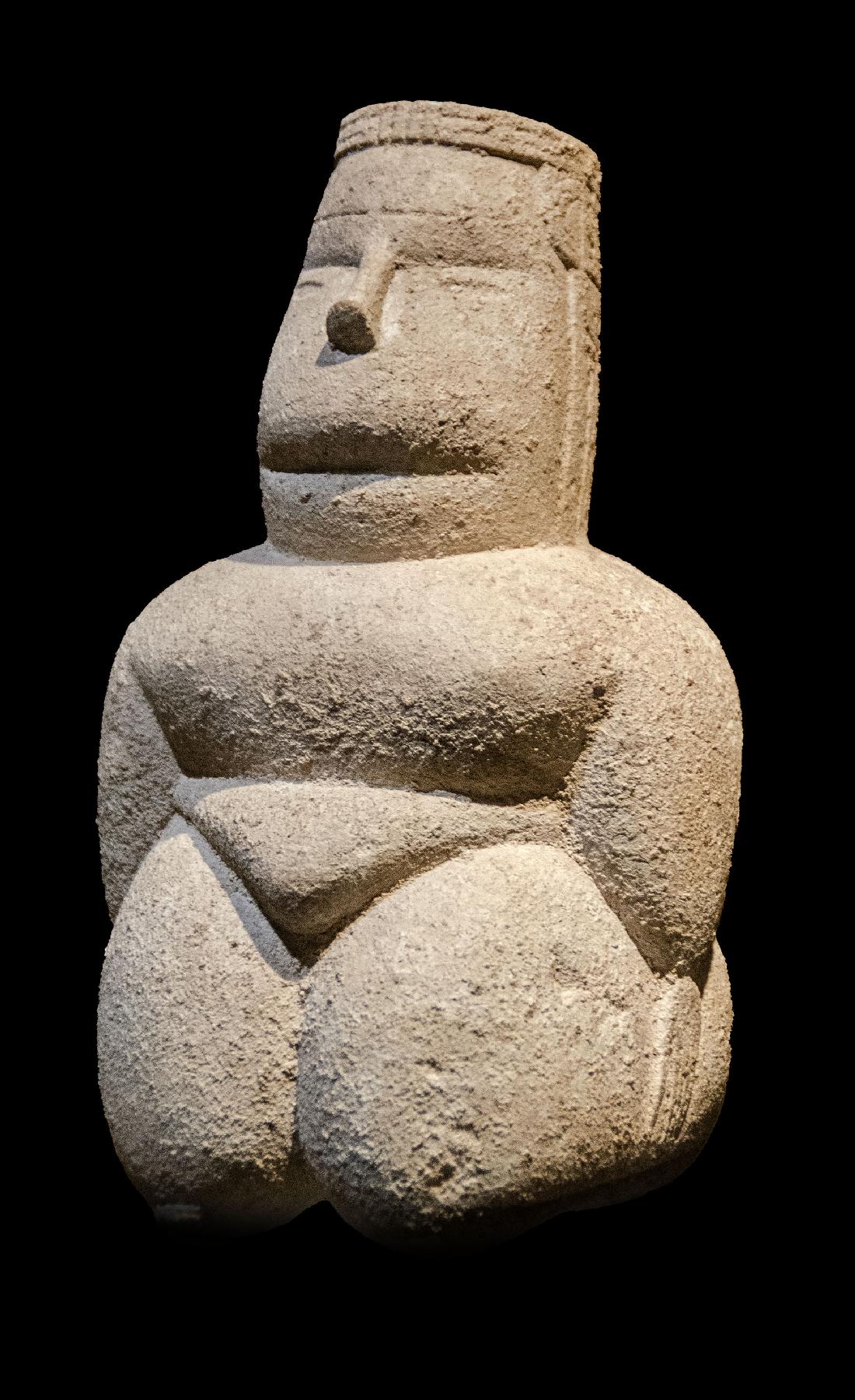
Anatolian farmers swept over Europe. These are the people that bcarried agricultural tecgbnology from Mesopotamia to Europe. They reached Sardinia (8th century BC). They fundamentally altered the genetic profile of Europe. And because Sardinia was unaffected by the subsequent invasion of Steppe people, the Sardinian population has one of the oldest and most distinct DNA profiles in Europe. There is a very high percentage of the island's population with direct ancestry from the early Neolithic farmers who migrated from Anatolia. Sardinians are more genetically similar to ancient Neolithic farmers than any other modern European populations, except the Basque people. This is unusual in Europe which has been racked by major wave of migratory peoples over time and massive changes in ethnicity. Archolohists have found evidence of several different culures after the appearnce of agriculture. This figureinr is the work of the Bonu Ighinu culture dating around 4000–3400 BC (figure 1). It was found near Cabras, but evidence of this culture has been found throughout the island, except for the higher rocky elevatins where agriculture could not be practiced.
The Yamnaya people (c3300–2600 BC) were a relatively small, nomadic Bronze Age pastoral society also known as the pit grave culture which appeared in the Pontic-Caspian steppe (modern Ukraine). 【Morgunova and Khokhlova 】 They were nomadic herders who lived on the grasslands of the Eurasian Steppe, raising cattle, sheep, and most notably horses. As a result, they left little physical trace, No cities, no monumental architecture. They were not the first to domesticate the horse. But it was done on the steppe. It may have been done by the Botai people to the east. Nor were they the group which invented the wheel. This apparently occurred by peoples to the west. But the Yamnaya seem to be the first to successfully put the two technologies together. The Yanmaya were renowned for horse riding and wheeled vehicles. And as they moved through Europe they like the Anatolian farmers remade the genetic map of the continent--to varying degrees. But one place they did not touch for some reason was Sardinia. Unlike mainland Italians and other Europeans, Sardinian have low levels of migratory Steppe-related ancestry. Sardinian were much less affected by the the genetic turnover experienced elsewhere on the Continent. Here they show a genetic similarity to Basque populations--in this case isolated by mountains rather than by sea.
The Bronze Age remains are interesting given that Sardinians were some of the Sea Peoples that destroyed the great Bronze Age civilizations--except Egypt. The Sherden may have been the Sardinian Nuragic people. Mo one know what set the SeaPople in motion, but it is generlly believed that natural diasters were inbolved, any comnintion of drought, famine, floods, earthqukes, volcanic eruptions, etc.) The Sardinian origin was only surmised at by historians based on pottery and other historical clues. But we now have definitive DNA evidence. Sardinia is not as strategically placed as Sicily which dominated the narrows between the eastern and Western Mediterranean. Thus Sardinia has been largely a backwater of history. Many historians suggest the Phoenician first founded colonies on the island. The relationship may be more complex as the Phoenician may have originated with the Sea Peoples. The Sea Peoples is a modern historical term. They were were actually named by the Bronze Age peoples upon whom they descended, especially the Egyptians. This included the Sherden who settled along the cost of the southern Levant. The Sherden were one of the Sea Peoples mentioned in the records of Ramesses II. He claimed to have defeated them in his second year when they landed in the Nile Delta (1278 BC). They also apparently landed further east where they did not face the Egyptian Army. Ramses eventually recruited some for his personal guard. 【Grimal, pp. 250–53.】 Sardinia was of some importance because of the mineral resources. The Carthaginians themselves with Phoenician origins seized Sardinia (about 510 BC). The principal Punic cities were Tharros, Nora and Sulci.
The Nuraghi people are the best know of the pre-history cultures of Sardinia. Some of the Sea People came from Sardinia, but that was a millennium before the Nuraghi. Strangely enough, over time, the inhabitants of Sardinia became shepherds, farmers, and also fishermen along the coast, but they rarely ventured out into the open sea. The Nuraghi have left architectural treasures on the island. The rugged terrain includes thousands of nuraghi, poorly understood Bronze Age stone ruins looking like beehives. No one knows what caused the Sardinians to begin making these structures. Archaeological evidence gives the impression of a strongly organized tribal organization. There is metal work from local mines which my have been the primary source of wealth. There are 7,000 Nuraghi and hundreds of archaeological monuments that are located all over the island. One of the largest and oldest of these Nuraghi is Su Nuraxi in Barumini (16th century BC). Which makes it one of the earliest such structures Also notable is the Domus de Janas, holy wells, temples and the mystic giant tombs, which are huge stones set into the ground called ‘betili’ or ‘menhir’ which stem from the megalithic architecture. While this was a new architectural era. The people did not change. We know that because the ethnicity remained that of the same Anatolian farmers that arrived millennia earlier. Some left as the Sea People, but many remained. Phoenician trading outposts appeared along the coast (9th-8th century). This probably made valuable contribution to the economy. The culture takes its name from the nuraghe, the megalithic buildings that are very common on the island. Whether the Nuragic peoples possessed a form of writing is a subject of much debate among scholars. It is certainly not possible to decipher some of the symbols that have been found, nor can we determine whether they constitute a form of writing. What we do know is derived from archaeological finds, particularly the bronze figurines. From these, we can determine what weapons they used, as various figurines depict warriors. The horned helmet, which is a legend about the Vikings, was a reality for the Sardinians of the Nuragic era, though the horns were made of metal. From the figurines, we also know that their clothing consisted of short tunics for men and long ones for women. The figurines also indicate that they went barefoot. The figurines, however, offer no clues regarding children’s clothing. As was the case elsewhere, it is believed that older children may have worn clothing similar to that of adults, smaller and simpler in style. It is possible that younger children went without clothes at all.
Grimal, Nicolas. A History of Ancient Egypt (Oxford: Blackwell, 1992).
Morgunova, Nina and Olga Khokhlova. "Chronology and Periodization of the Pit-Grave Culture in the Area Between the Volga and Ural Rivers Based on 14C Dating and Paleopedological Research". Radiocarbon: An International Journal of Cosmogenic Isotope Research. (2013) Vol. 55, Nos. 2–3.

Navigate the Boys' Historical Clothing Italian pages:
[Return to the Main Sardinian history page]
[Return to the Main Sardinian page]
[Return to the Main Italian island page]
[Return to the Main Italian regional page]
[Return to the Main Italian activity page]
[Return to the Main Itlalian page]
[Italian school uniforms]
[Italian youth groups]
[Italian choirs]
[Italian movies]
[Italian royalty]
Navigate the Children in History Website:
[Return to the Main Sardinian history page]
[About Us]
[Introduction]
[Biographies]
[Chronology]
[Clothing]
[Disease and Health]
[Economics]
[Environmental issues]
[Feminism]
[Geography]
[History]
[Human Nature]
[Law]
[Nationalism]
[Presidents]
[Religion]
[Royalty]
[Science]
[Social Class]
[Bibliographies]
[Contributions]
[FAQs]
[Glossaries]
[Images]
[Index]
[Links]
[Registration]
[Search]
[Tools]
[Children in History Home]